Showing posts with label rosemary. Show all posts

Saturday, August 21, 2021

Greetings from Locked Down Sydney!


It's been a long time (April 21) since I posted anything here in my gardening blog, which is semi-retired, just like me.

But as I finished this morning's final phase of the "weed then mulch" marathon, it occurred to me that it might help pass the time, maybe also provide some inspiration for gardeners who are cooped up at home due to covid lockdown restrictions, if I posted something here.

So what I plan to do every few days is to post something from my garden that I hope might of be interest, and maybe even motivate you to get out in the sunshine, which is good for both your mental and physical health (if you wear a hat!).

For starters, I'm starting off with a pair of panoramas of my freshly weeded and mulched garden, as it always looks very nice after new mulch has been spread around. 
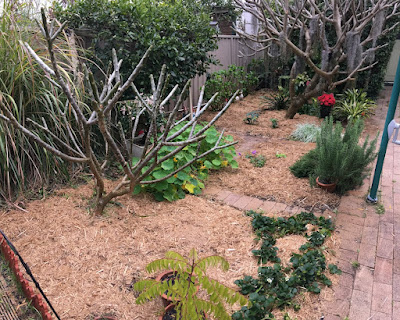
Mid August and both the frangipanis are asleep, so it looks a bit bare. In the foreground the bonsai curry leaf tree has enjoyed the winter, and in the right foreground the strawberry patch is flowering and looking promising. That's Pam's nasturtium patch middle-left, and middle right is the hardest working part of the garden, the pots of rosemary and thyme.

On the right ride of the garden is another of Pam's nasturtium patches, while behind them the Geranium 'Big Red' patch continues on its merry spreading way. The only care it needs is cutting back. Right foreground, the remains of our two very productive broccoli plants. The stumpy/stalky one on the right looks like that because this week we cut off all the leaves and cooked them up, Southern USA "collard greens" style — and they were delicious.

So that's your introductory guided tour. In coming days I have lots of spring flowers to show you, plus some garden jobs to do now, lots of problems in the succulent patch, South Africans at their glorious best, Pam's mum's garden refugees, crops on the go, garden critters, and I am sure several more things that I'll come across as spring warms up.

Hang in there locked-down gardeners! If you have a garden, even if it's just some pots on a balcony, they're the perfect project to take on now. Spring is well and truly in the air, the temperatures are rising so any effort you put into getting plants to grow will be rapidly — and beautifully — rewarded.

Saturday, October 17, 2015

So much happening


I am in awe of those garden bloggers who keep on slogging away, doing a posting every day. Me, I'm down to one posting a week at best, but at least I never seem to run out of things to write about and photograph. (I'd quickly run out of things to post about if I had to do one a day!)

However, right now, I could do a blog posting every hour, because there is simply so much happening in the garden right now. And don't be surprised if, over the next few weeks, I do individual blog postings on each of the plants I'm about to show you.

Just to make things easier for me to wrap my little head around the topic, I've divided this "so much happening" post into little categories.

First up, the NEW ARRIVALS


Not one but two new curry trees. I bought one
pot and realised it had two plants in it.
Fortunately their roots weren't entangled so
potting them up was easy. Expect a curry
tree blog posting soon, folks.
Our good friend Jolanda has a superb little
patch of mint bush by her front steps, and we
loved its purple spring flower show, so we have
planted three of these behind our geraniums. 
Pammy brought home a Pieris japonica in
flower a few weeks ago. We left it in its pot while
it was bloom, and now it's in a bigger pot and,
judging by the new growth, is happy enough.
Hardly the most exciting purchase, two punnets of blue flowered
salvias, but about two months from now they will start to flower
and they won't stop till autumn is almost over.

next, the FOOD GARDEN GETS GROWING


Lebanese zucchini, the light green, chubby smaller ones. So far
so good, with the first flower buds (boys only) showing.
A miracle! Our unproductive passionfruit vine, now into
its third summer, has for some reason decided to produce
quite a few flowers lately. Could this be our first decent crop?
Here's last season's crop in action. Yes, folks,
one flower and one - just one - fruit. This has
been my biggest dud of a food growing story
in 25 years, but I am determined to see this
thing finally produce a decent crop.
Just had to include this fragrant, lovely thing.
The more I water my potted rosemary bush,
the happier it seems to be. While in the ground
it's a classic "waterwise" plant that can survive
on rainfall alone, in a pot it's a thirsty sook.
Another miracle! Our Serrano chilli bush has
somehow survived winter. I gave it the mother
of all cutbacks five weeks ago and for a while
it didn't look like it was going to bounce back,
but now it's producing foliage and flowers,
and so I think it's a red hot goer for this summer.
And the first strawberries of the season are starting to appear
and colour up. As is a tradition in our garden, our strawberry
plants come up as "volunteers" out of our homemade compost.

Finally, FOLIAGE AND FLOWERS


The Louisiana iris is slowing down, but there
are still new blooms to enjoy every morning.
One of the greatest concentrations of onion weed and oxalis
in the Southern Hemisphere – our succulent patch – has been
cleared (temporarily I am sure) of the weeds and a new (and
prettily ineffectual) layer of pebble mulch has been spread.
At least it will look very nice for at least the next month!
Just like our sooky, thirsty, rosemary plants, our supposedly
waterwise trailing pelargoniums absolutely love a drink.
It's an Australian thing, I guess, once someone arrives in
Australia they just seem to start drinking more ...
Be careful if you are buying pots of Lamb's Ears (Stachys).
This is what one 3-inch pot planted in Spring 2014 has
turned into, without any encouragement from me. This lovely
grey beauty looks like it's about to flower, and from previous
experience seeing it in flower in other gardens, bees love this
plant's flowers in a big way, so I am hoping it will attract a
zillion bees that will then fertilise all my passionfruit flowers.
And last but definitely not least, what I like to
think of as "Pammy's office garden" has survived
the winter and is now ready to enjoy the summer.
Why "Pammy's office garden"? Well, all the
plants here have done too well inside the house in
Pammy's studio/office, getting too big for their
pots, and so when that happens they are retired
out here, where they are then cared for by me.

As I mentioned long, long ago at the beginning of this posting, don't be surprised if you find yourself reading another posting on these individual plants over the coming weeks.

I never go out into the garden thinking "gee, what am I going to blog about next?". I never know in advance. Something just catches my eye, or happens, or doesn't happen and most of my blog postings just write themselves, and are mostly already written in my head before I ever head back inside. But this morning it was a simple case of "so much is happening" that I realised I had a good dozen or more blog posting ideas all at the same time.

Spring is like that ... so much happening in the garden. It's wonderful.

Monday, August 24, 2015

Rain, the sound of plants growing


Gentle rain, the kindest rain of all. Soaking into the soil without damaging the tender seedlings, or even making the flowers sad. (Edit: well, that was how it was until last night's downpour!) We're into our second day of gentle rain now, after a record midwinter dry spell, and the garden definitely needs every drop it can get.

More usually, after a long dry spell we get pounding rain that brings damage and much needed relief in equal doses. (Edit: talk about speaking too soon ... the more usual pounding, damaging rain arrived last night.) I originally wished a special thankyou to Huey for this lovely, gentle, nurturing rain, but in this re-edited posting, it's "thanks Huey for the rain, but you can back off now".  

Anyway, it's good to have the rains arrive, so here's a quick lap of our garden, camera in hand.


Still bare, our frangipani is wearing strings of these watery jewels now.

Poppies never cope well with rain, but today they're just
drooping their heads a little. They'll look up when the sun
breaks out.

Rosemary in bloom with vivid green new growth, too.

A week away from full flowering, the scadoxus are already
glowing like beacons, and opening rapidly now there's rain.

Aeonium 'Schwartzkopf' looks like it's trying to resist getting wet. 

While in a dark, shady corner this Vriesia
bromeliad is putting on a colour party.

The foodies are loving it. Lettuce planted less than a week ago.

Potato babies growing noticeably every day.

Thai limes were fertilised on the weekend, and with this steady
watering they'll be flowering and fruiting through summer.
As I've mentioned before, I am so glad the roof over the rear part of our house is galvanised iron. There's nothing more pleasing to this gardener than enjoying breakfast, fresh mug of coffee to start the day, listening to the sound of rain on a tin roof.


Saturday, November 8, 2014

Splashing out on herbs


It's amazing what a difference a pot can make to a plant's personality. In the case of my traditional 'Mediterranean' herbs such as rosemary, thyme, oregano and bay leaf, they have turned out to be very different plants to care for, compared to how they grow in ordinary garden soil. Yes, of course they need more maintenance in a pot, but I am surprised how thirsty they are. They all love a drink (well, at least in springtime they do).

Let's put this discovery another way. Since I have started watering these potted herbs a lot more often than I ever did in previous years, they are much happier. And yes, I am slow on the uptake sometimes. (Just ask Pam!) 


Much happier now that it is being watered
every morning, the rosemary is lush, deep
green and very fragrant to be around.
As I water the rosemary now, I can smell its 
sharp scent wafting around in the air.

Same goes for my potted bay tree. More water
this season has produced more growth, and
much nicer looking foliage. 
The thyme is flowering its head off at the moment. It needs the
most clipping to stay bushy, plus, you guessed it, water.
I've already done a blog posting recently on this potted oregano
patch, but it needs lots of watering as well.
Though hardly classic Mediterranean herbs,
the two pots of mint (common mint in the
foreground and basil mint behind) lap up the
water like a pair of thirsty hounds. 
When I grew rosemary, oregano and thyme in the ground I never watered them. Sydney's relatively abundant rainfall took care of all their needs for many years. And so I always thought of them as almost drought-proof and definitely not thirsty. I knew that transferring them to a pot would mean I'd have to water them more often, but I have, until now, underestimated how much water they need.

And so, Aussie gardeners, if your potted Mediterranean herbs aren't looking too terrific this spring, think about giving them more water more often. It might be what they desperately need. 

I'm not sure what they want once summer comes around, but my new hunch is that it will be more water than I gave them last summer...


Saturday, October 4, 2014

Just the right amount of oregano


If you like growing herbs, as I most definitely do, I'm sure you will have encountered the minor problem of having too much of a good thing on your hands. That's especially true if all your herbs are growing in the ground, rather than in pots.

When I had my oregano, thyme, sage and rosemary plants growing in the ground, I had far too much oregano, thyme, sage and rosemary, up to 100 times more of each herb than I could ever sensibly use in the kitchen. The benefits, however, were that these herbs were lovely garden citizens. They flowered their heads off, they sent up delicious scents as you brushed past them, and they really didn't need much help from me at all. And they flavoured hundreds and hundreds of delicious meals as well.

But they did take up a lot of space, and in my tiny garden I decided a few years ago that I'd grow all these herbs in pots, and it has proved to be a good move. The same herbs are all still happily here and enjoying the spring sunshine. The oregano in particular looks a treat at the moment. It's just the right amount, one pot-full.

What a pleasing mound of green it is in this wide, shallow pot.
The only thing it's not doing this spring is flowering, and that's
because my oregano plant pays a visit to the barber's shop
four or five times a year, and that clumsy barber called Jamie
cuts off all the flower buds in late winter.
This is what its flowers look like, little pink clusters which pop
up on stalks in late winter and early spring. I took this photo
a few years ago when our oregano was growing in the ground,
spreading like mad and flowering its head off. Back then I
had far too much oregano but it was a delight to have around.
This is another "from the archives" shot of the oregano trying
 to take over the succulent patch, back in its in-ground days.
If you read my most recent posting on sage, I recommended it as a garden plant, and I can easily do the same for oregano. It makes a good, easy-care ground cover provided it's in the sunshine most of the day, and the soil doesn't suffer from sogginess. It'll eventually misbehave, like the stuff pictured above, and will take over neighbouring beds if allowed. However cutting it back isn't an especially tough chore, nor is it needed more than once or twice a year at worst.

In fact, one of my early successes as a "learner gardener" many years ago was the way I slowly "marched" a patch of in-ground oregano from one spot in the garden to another spot a metre or two further away. All I did was cut off the left-hand side of the oregano patch regularly, but I let the right-hand side keep on spreading. After about 12 months the whole patch had "moved" to its new spot. I felt like I was getting there as a gardener with that little selective pruning ploy!

So if you're looking for a ground cover, oregano might do the trick. It's easy to find seedlings in garden centres, but you can also buy seed. In fact my potted oregano patch is seed-grown. I think that's part of the reason it's so lush. There's probably half a dozen plants in that one little pot, and that's a lot of youthful, pent-up energy in there.


Friday, September 27, 2013

Spicing up the herb garden


I've been waiting for a chance to do an update on my herb garden, as it has changed a lot in the last year. The big change is that almost everything is growing in pots now, instead of in the ground. Now is the perfect time for the update for two very good reasons. The first is that it's spring, so everything is growing well and looks nice for photos. 

The second reason is that a new book on herbs and spices, by Don Burke, is going on sale next week, and as I worked behind the scenes helping Don to put the book together, I want to tell you all about it. Pictured below is the book cover, but I'll tell you all about it at the end of this blog post. Before my not-very-amateur burst of rampant commercialism, it's onto my potted herb garden show-and tell.


French tarragon is happy as larry in its new, wider pot,
replanted there during midwinter when it was just a bunch
of snoozing bare roots and runners. It has such a nice
mildly aniseedy flavour that is heaven with chicken, or eggs.

Oregano, grown from seed just on a whim, looking lovely
right now. It was looking straggly about six weeks ago, so
I cut it back all over and now it's at its finest. That's the big
secret with herbs in general, but potted herbs in particular:
cut them back often, a light cut once a month works wonders.
Chives in front, lemon thyme left and sage in flower, right.
The sage is from my original in-the-ground mother plant. I dug
up a section with a rootball and potted that up. It took a while to
bounce back, but it's happy now in its terracotta pot.
Another 'sprog of mum' plant, my common thyme is a roots-
and-all chunk of the former large mother plant, replanted and
doing well in a wide, shallow pot. This is one plant that I
cut back very regularly, to keep it low, dense and bushy.
The rosemary is a cutting grown from the monster size parent,
and I am cruelly trimming it to encourage dense, low growth,
as it can grow to silly sizes if you let it go unchecked. Rosemary
has such a strong flavour you never need much in any dish.
Moist mint is happy mint. I have two pots here, one with common
mint, the other with spearmint, and both need major cutbacks
about three or four times a year. I cut the whole plants down
to pot-rim level, back to just stumps, then give it a good feed.
I love the look of the two pots when they're in their pomp.
I still have a few herbs in the ground, including this chervil,
which I didn't plant here. It turns out that chervil is so happy
here it's behaving like a weed and self-seeding all over the
place. It has a lovely, light aniseedy flavour.
Also in the ground and "on the way out" is this patch of
coriander, which is starting to go to seed as the weather
warms up. The patch has been here for a few months now,
as coriander loves our mild winters the best. That's the
time to grow it here in Sydney. If you grow it in summer,
you'll have to sow, grow and harvest three or four crops
each summer season, as it goes from leafy to seedy in
no time at all during steadily hot summer weather.
That's enough for my own personal update on the herb patch. It's time to show you Don's new book, priced at $29.95 in hardcover, which goes on sale on October 1. It's published by New Holland Publishers, is 304 pages long and has entries on virtually every useful herb and spice you can think of, plus lots that you might not have heard of. Here's the cover.


With only a few exceptions, each herb is covered in what's called a 'double-page-spread' of two open, facing pages. Pam did some of the illustrations used in the book, and my wide-ranging contribution to Don's text goes under the heading of "editorial consultant". Don loves to get down to the practical nitty-gritty of gardening, so he offers tips on how to grow each herb, best varieties, how to harvest and dry or prepare it, then how best to use it in the kitchen. He also quite frankly tells you whether it's worthwhile trying to grow each herb or spice in the garden (as some are hopelessly impractical to grow in backyards while others are dead-easy). 

And Don loves a good debunking of myths, too. This is a no-mumbo-jumbo book! Instead of mindlessly repeating all the ancient myths about herbs and spices being good for curing ague, plague or whatever, he's gone straight to modern scientific research to find out whether each herb really is beneficial or not. (The good news is that many are very useful.) However, this is also where Don's book is full of new, fresh info that might contradict some of the very unscientific mumbo-jumbo that has been long attributed to the healing powers of various herbs and spices. Some traditional 'medicinal' herbs are actually unsafe for human consumption, and several are simply useless. While researching this subject area I was struck by how many herb experts writing their books had unquestioningly just repeated the traditional folk myths about the medicinal benefits of herbs and spices. So I say good on you Don for turning to science for your evidence in this area. I learned a lot at this stage of the project.

And did I tell you it's full of delicious recipes and gorgeous colour photos? And if you like to brew interesting cups of tea we've got the tea brewing recipes for you too.

OK, so I am a bit biased, but it's a new kind of herb and spice book, a deliciously practical one. A few enjoyable months of my working life went into helping Don research and prepare the text for this book, and I am very pleased with how it has turned out. Go check it out if you can. 

I've noticed that while it doesn't 'officially' go on sale until October 1, it's already up and available for pre-order on websites such as Amazon, the ABC Shop site here in Australia, and numerous other book sellers' websites. Just search for 'Herbs & Spices' by Don Burke and you'll find it.


Saturday, August 31, 2013

Spring started weeks ago!


One of the fortunate things about my new life as an erratically employed freelancer is that I get more time off to do gardening, whether I want the time off or not! The pay is lousy but the lifestyle is terrific. As a result, my garden looks rather tidy at the moment. As the heading for this post says, spring started weeks ago, so this posting is nothing more than a wander around my happy and unusually tidy spring garden. 

For me, this light, fresh green is the true colour
of spring. In this case it's the top leaves of my
potted Turkish Brown fig.
Flowers do announce the new season nicely, and our potted native
orchids are producing sprays of these tiny, fragrant little blooms.
Small but perfectly formed orchids less than an inch across
from side to side, the other nice thing about them, speaking
as a gardener, is that they are very easy to grow.
Our two lavender bushes have been blooming
their heads off for a month, the bees love them
and they aren't looking like slowing down any
time soon. I've added its fellow Mediterranean
classic, the rosemary, to keep them company.
Wet weather can truncate the show of the superb
scadoxus, but with hardly a drop for the last few
weeks they're putting on their best show ever.
Our self-sown strawberry patch (which came
up out of some compost spread in this spot) is
still rudely healthy. Its spot is a bit too shady
in winter so it's content to snooze then, but now
the amount of sunshine it's getting is growing
daily it is flowering (with liquid feeds from me
to help the cause) and the first fruits are forming.
The end of winter is one of the two times of the
year when my in-ground citrus are fed, and a
week ago our garden was resplendent with the
heady aroma of chicken poo. Now the Eureka
lemon is flowering its head off quite fragrantly. 
Our potted Thai lime is clapping on a lot of
deep maroon new growth, but as it's in a pot I
feed it lightly once a month, unlike the other
citrus trees growing here.
I sometimes channel a bit of Basil Fawlty when
I am yet again caring for my potted mint, as
what mint needs "is a damned good thrashing".
What I mean by that is mint needs constant
taming and cutting back, sometimes all the way
down to pot-rim level. I did that for the
umpteenth time about three weeks ago, and
since then with regular watering and liquid
feeds, it has bounced back nicely yet again.
It's a high-maintenance herb, mint, but it
does look and smell lovely in these peak times.

I'm not going to say too much about the passionfruit vine
trained on my neighbour's garage wall, other than to report
that it's ludicrously lush and green, and has no flowers and
is doing sod-all in the way of producing fruit yet.
The small gaggle of garlic plants raised from
sprouted supermarket cloves is growing on well.
I told you the garden looks neat and well mulched at the moment.
I pulled out the winter crop, dug it all over as usual, then planted
seedlings of lettuce, basil and chillies, along with pretty little French
 marigolds for some colour. The round bare patch on the right
rear is where I am raising Collard greens direct-sown from seeds.
The Collard greens came with the Soulicious eBook cookbook 
Pam and I bought from our friend Awia Markey.
New plants have been added recently, too.
This row of four Gardenia magnifica should
grow to about 2m tall and cover up that
white Colorbond fence. I am hoping for dense
glossy green growth, white fragrant flowers
in summer and no problems, please!
And finally, if it all grows too big and everything
gets out of hand – start again! That's what we
are doing with a potted bay tree. Our last one
was here for ages but grew too big, then became
pot-bound then got sick and ugly. All my fault.
So here is "Son of Bay", my attempt to make
amends for all my bay-tree growing mistakes
perpetrated over the last 20 years. Whether I find
redemption or not remains to be seen, but I do
like adding just a touch of epic theme to
gardening here. It puts things in perspective.