Showing posts with label lavender. Show all posts

Saturday, August 24, 2024

Asleep at the wheel


Spring has a way of waking you up like no other season. It brings you outside, don't forget the camera, "oh look over there that one is flowering too". You know the kind of thing. For a gardener it's called excitement.

And so this morning I spent the first hour of daylight wandering around the place capturing the morning glow. So come take a walk with me around our little Marrickville garden — all 7m x 10m of it — and say hello to the first of our spring flowers.


Our Scadoxus patch is steadily increasing in size. I could only fit in nine of the 11 flowers we have, and down at ground level there's another dozen babies doing well. Too small to flower yet, they'll eventually flower at some stage. Not sure when. That's half the fun of growing these things. I barely know what I am doing, but it's working.


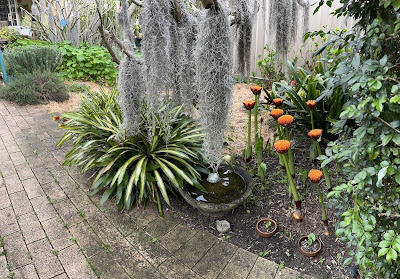
This wobbly pano shot shows where the Scadoxus live, under the big old frangipani (that's the ideal place for Pam to hang her forests of Spanish moss that she loves). This is a super shady place in summer but it's well lit in winter once the frangi drops its leaves. To the left of the birdbath those strappy looking things are bromeliads, and they love it here too. I never touch them and they're happily thriving. 

While we're under the frangipani tree, here's another flowering bulb from South Africa (as is the Scadoxus). This is Veltheimia, given to us by our good friends John and Liz, so it always reminds us of them.

The final South African residents happily multiplying under the care of the big old frangipani tree are the yellow clivias. Their flowers should pop out any day now, so the combination of yellow clivia trumpets and dazzling scadoxus fireworks is well worth seeing, and waiting for each year.


Speaking of yellow-flowered people, down the other end of our garden, near the house, the Mardi Gras style blooms of the native Sydney Rock Orchid, Dendrobium kingianum, are in full glory right now. The miracle of this performance is that last year these plants were being attacked by orchid beetles, little chompers that love to dine on unopened flower buds, and so the shows weren't as good as previous years, or this year. These beetles are impossible to control with organic sprays, and I'm not prepared to buy or use the bee-killing commercial sprays (containing Carbaryl) that can control these beetles. So I don't know why the beetles haven't attacked this year but I'm glad they haven't.


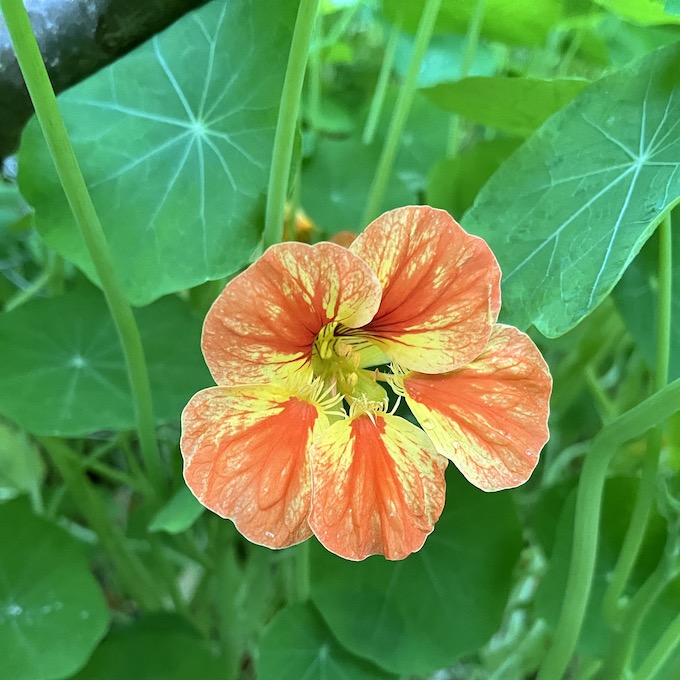
I couldn't decide which Nasturtium flower to show you so here's two: there are dozens of them and no two seem to be the same, although they come in all possible combinations of yellow, red and orange, maybe a bit of black trim. Pam and her watercolour art students absolutely adore nasturtiums as a painting subject, and as a gardener I do appreciate the way that nasturtiums suppress other weeds, but they do like to spread out and bully every other plant they come near. I cut them back every few days and they just merrily bounce back without a care in the world. They never complain, they just grow back each time.

We grow our Italian lavender in a pot and it likes it there. There's also a white-flowered type that Pam asked me to get, and it is slower off the mark and probably won't be in flower for another month or so.

One of the hardest flowers to photograph is this thing, a hellebore. That's because the flowers point down to the ground, and I'm too old to take photos lying on my back, so I hold up the flower's foliage with my hand, quickly take a snap and then edit out my finger from the photo. 


I'll finish off with two "panorama" shots of our small inner-city garden, just to give you a bit more context for what I have shown you already. To see the "pano" view, just double click on the photo itself and it will show the much wider shot (hopefully).


This first pano shows the left side of the garden looking out from the back of the house and its covered pergola. 


And this second pano is of the right side of the garden with lots of succulents in pots, more bloody nasturtiums trying to take over. The largish round white pot on the centre right is a native flannel flower bush that flowered beautifully last year and we are hoping will do so again this year too.

Finally, I actually have a couple more blog postings waiting to go. Our front garden is looking lovely but it has not worked out as I had intended, not at all. I'll fill you in on that bit of gardening fun next time.

Tuesday, July 22, 2014

Winter's pleasant depths


Do you find that on today's internet you often read stuff that's of interest, but only a few days later you can't remember exactly where you read it? It's a case of "that was a thousand clicks ago, how can I remember that?".

Well, I'm pleading a case of thousand-click memory loss, but I was reading some Australian gardening content last week – not a well-informed blogger, it was some fool doing it for money – who was banging on about the grey, gloomy depths of winter, as if they were living in Europe or North America. I wandered outside into my admittedly chilly-ish garden and all I could see in the depths of winter here was lush greenery and a beautiful array of colours.

And so for this little posting I would like to celebrate the depths of winter here in Sydney, Australia. When the cold winds blow from the south you certainly need jumpers and jackets, and slow-cooked casseroles still taste fab once the sun has gone down, but out in the garden there's plenty of colour to enjoy.


Squadrons of bees are feasting on the lavender, their little black
legs glowing golden with collected pollen.


The bromeliads enjoyed the World Cup action in Rio, and wish
they were back home in South America, but Sydney is OK.

Even the bromeliads waiting their turn to
flower can at least wear nice variegated fashions.

My 'hedge' of chervil is at its peak. The flopped
over bits in the foreground are merely drunk on
the drink of fresh water I gave them a few
moments before I started snapping pix. They'll
sober up soon enough.

Kalanchoe 'Copper Spoons' is loving the cooler weather.
I'm trying to strike lots of babies of this lovely thing. No luck
yet, but it is a slow process, I believe.

And the Crassula 'Campfire' is well and truly ablaze.

The new mint growing in the 'spot from hell'
under the adjacent grevillea is loving its first
few months here, but it needs lots of water to
keep this backlit beauty happy.

A Christmas gift poinsettia pot which Pammy
is taking a special interest in is doing what it
does naturally in the cooler months: blush red.
And finally, this single tibouchina bloom doesn't
know it's winter. It's meant to flower in autumn,
so either it's early or it's late, but it's on its own, the 

only flower on the bush at the moment.
And so that's the depths of winter here right now. Yes, growth is slow, but everything is still steadily growing, and for some plants it's their most beautiful time of year.


Saturday, August 31, 2013

Spring started weeks ago!


One of the fortunate things about my new life as an erratically employed freelancer is that I get more time off to do gardening, whether I want the time off or not! The pay is lousy but the lifestyle is terrific. As a result, my garden looks rather tidy at the moment. As the heading for this post says, spring started weeks ago, so this posting is nothing more than a wander around my happy and unusually tidy spring garden. 

For me, this light, fresh green is the true colour
of spring. In this case it's the top leaves of my
potted Turkish Brown fig.
Flowers do announce the new season nicely, and our potted native
orchids are producing sprays of these tiny, fragrant little blooms.
Small but perfectly formed orchids less than an inch across
from side to side, the other nice thing about them, speaking
as a gardener, is that they are very easy to grow.
Our two lavender bushes have been blooming
their heads off for a month, the bees love them
and they aren't looking like slowing down any
time soon. I've added its fellow Mediterranean
classic, the rosemary, to keep them company.
Wet weather can truncate the show of the superb
scadoxus, but with hardly a drop for the last few
weeks they're putting on their best show ever.
Our self-sown strawberry patch (which came
up out of some compost spread in this spot) is
still rudely healthy. Its spot is a bit too shady
in winter so it's content to snooze then, but now
the amount of sunshine it's getting is growing
daily it is flowering (with liquid feeds from me
to help the cause) and the first fruits are forming.
The end of winter is one of the two times of the
year when my in-ground citrus are fed, and a
week ago our garden was resplendent with the
heady aroma of chicken poo. Now the Eureka
lemon is flowering its head off quite fragrantly. 
Our potted Thai lime is clapping on a lot of
deep maroon new growth, but as it's in a pot I
feed it lightly once a month, unlike the other
citrus trees growing here.
I sometimes channel a bit of Basil Fawlty when
I am yet again caring for my potted mint, as
what mint needs "is a damned good thrashing".
What I mean by that is mint needs constant
taming and cutting back, sometimes all the way
down to pot-rim level. I did that for the
umpteenth time about three weeks ago, and
since then with regular watering and liquid
feeds, it has bounced back nicely yet again.
It's a high-maintenance herb, mint, but it
does look and smell lovely in these peak times.

I'm not going to say too much about the passionfruit vine
trained on my neighbour's garage wall, other than to report
that it's ludicrously lush and green, and has no flowers and
is doing sod-all in the way of producing fruit yet.
The small gaggle of garlic plants raised from
sprouted supermarket cloves is growing on well.
I told you the garden looks neat and well mulched at the moment.
I pulled out the winter crop, dug it all over as usual, then planted
seedlings of lettuce, basil and chillies, along with pretty little French
 marigolds for some colour. The round bare patch on the right
rear is where I am raising Collard greens direct-sown from seeds.
The Collard greens came with the Soulicious eBook cookbook 
Pam and I bought from our friend Awia Markey.
New plants have been added recently, too.
This row of four Gardenia magnifica should
grow to about 2m tall and cover up that
white Colorbond fence. I am hoping for dense
glossy green growth, white fragrant flowers
in summer and no problems, please!
And finally, if it all grows too big and everything
gets out of hand – start again! That's what we
are doing with a potted bay tree. Our last one
was here for ages but grew too big, then became
pot-bound then got sick and ugly. All my fault.
So here is "Son of Bay", my attempt to make
amends for all my bay-tree growing mistakes
perpetrated over the last 20 years. Whether I find
redemption or not remains to be seen, but I do
like adding just a touch of epic theme to
gardening here. It puts things in perspective.


Saturday, July 27, 2013

My friends the bees are in serious trouble, folks


It's such a gorgeous winter's day here in Sydney, sunny yet cool, the lavender is blooming and the bees are buzzing around every fragrant mauve bloom, collecting pollen. This is how it should be, and this is how it is going to be for as long as I can help matters. Yet there are forces at work well beyond both the bees' control and mine which are putting our little pollen-gathering friends in peril, not just one by one, but as a whole species here on the planet. New research just released paints one of those hopeless pictures, like when you hear a friend has been diagnosed with cancer. You know people can survive it and you hope your friend can especially, but you just feel helpless and sad, at least at first.

A useless bystander, all I can really do for the bees is hope and maybe at least practise what I preach about how gardeners, farmers and our society at large should work with nature, not poison and destroy it.

Here's the story which depressed me so much when I read it last night. 
http://qz.com/107970/scientists-discover-whats-killing-the-bees-and-its-worse-than-you-thought/

While I summarise what the article by Todd Woody at 'Quartz' says, I'll put my summary beneath some photos I've just taken of my little friends enjoying themselves here at my place. God I hope they never disappear.

It seems the phenomenon of Colony Collapse Disorder, where
whole colonies of bees die off suddenly, isn't due to one single
chemical cause, it's a combination of chemicals at work. The
article above calls it a 'witch's brew of pesticides and fungicides.'
And it's not always just the direct action of chemicals which
kills the bees; sometimes the chemicals reduce the bees' ability
to resist parasites, which then kill the bees. 
The surprise finding is that fungicides are playing a major role
in the decline of bee colonies. Up until now they weren't on all
that many scientists' lists of major suspects. Now they are.  
Bee pollen collected by researchers contained an
average of 9 different pesticides and fungicides.
Some samples contained as many as 21
different agricultural chemicals.
This is just my personal opinion, but the level of reform needed
in the use of chemical sprays in agriculture to reverse the
decline of bees is on a par with the task of convincing vested
interests to do something about climate change. And we all

know how slowly, and how badly, those efforts are proceeding.
So, please read the full article, as it's important to understand problems fully, no matter how powerless or depressed they make you feel.

At home, all we can do is encourage bees in our own environment. It's a genuinely good but puny start. No chemical sprays – definitely no fungicides! – plant lots of flowers and spread the word. 

By the way, if you're wondering what's the name of the lavender our bees are loving, it's a modern hybrid, two baby plants of which were given to Pam and I at a gardening event last year. It's called Lavandula x hybrid 'Little Posie Mauve'. Can't stand the corny name, but it's a nice little thing about 50cm high and wide that is currently flowering its head off in the cool winter sunshine, and it's as covered in bees as it is in flowers, which is how things should be.


Thursday, August 16, 2012

Mirror magic


I love the clear morning sunshine at our place, it's so fresh and clean in the way it beams through foliage like X-rays and sets flower colours alight in the early hours. Right now our garden is not all that afire with spring flowers, but with a well-placed mirror against the shed at the rear of the garden, at least we had twice as many flowers to enjoy this morning (that's lavender in the left pot, tibouchina on the right).


This is close to the view from our back door, brought up a bit closer here by the zoom lens on the camera. In fact I was standing in the kitchen looking out when the 'mirrored' view struck me as one worthy of both a pic and blog posting.
As the mirror is under the eaves of the shed, its gaps have been filled with silicone sealer, and its frame has been covered with about 4 layers of outdoor furniture varnish-sealant, it's standing up to the rigours of outdoor living quite well. Another good idea of Pammy's. "Let's put a mirror right there, in that spot, because you'll be able to see flowers reflected in it when you stand by the back door in the morning," she said a few years go. And she's right, you know!


Saturday, August 4, 2012

Waking from slumber


Yawn, stretch, roll over, back to sleep... who, what... what time is it? 
Oh, that's right, I'm a blogger, and I'm meant to do some blogging, at least occasionally. Been a while, hasn't it? Nuffink in July, and only one bread-baking post in June, and rainbow watching in May. Not much gardening at all. That's what life has been like for us, too. Not much gardening at all, despite life being busy.
Well, like my garden, which is slowly waking up now after a very quiet winter, I too am waking up from a long blogging snooze – and a long gardening snooze. So here's a little update on the astonishing lack of progress here in Amateur Land. 


Posting this photo almost feels like cheating, but
not quite. This is a freebie plant given to us recently
at a gardening function. It's from PGA and is called
'The Princess Lavender'. We brought it home already
in flower and since then it has started to bloom even
 more. While we can hardly take any credit for growing
it, at least we haven't killed it in the three weeks
it has been with us! That's a minor achievement.
You don't actually need to do any
 gardening to make a nasturtium flower.
The main job is regularly pulling out lots
of it to stop it taking over. Alas,
Pam likes nasturtiums, and every now
and then, in a moment of weakness,
so do I, but I am sure that's only because
I like Pam so much.

This is a bit more my pace at the moment: a
self-seeding, flowering weed. We only bought
one punnet of primulas, back in 1990 when we

started out gardening here. We were just foolish
kids, your honour – no-one told us not to do it! 
They've been weedily with us ever since. I stopped
trying to pull the seedlings out about 10 years ago
when I realised they had me beaten. And I don't
like pink, either. My little punishment, these guys.

Again, without any help from Mr Slacker, the
scadoxus bulbs are slowly coming up again.
Pictured below is what we're looking forward to
in late August or early September, which is
when this photo was taken two years ago.

A dazzling sight in bloom, these scadoxus flowers sit on
stalks about 18 inches (40cm) high and last for three
or four weeks. They look especially aflame in the late
afternoon light, they're the most radiant blooms I know.
But that's it for the flower show at the moment, not really all that much happening, apart from some tibouchinas which I am holding onto for a few photos later on.


The last time I did any 'real' garden blogging I was talking about garden makeovers and grand plans last autumn. Let's just say we're still in the planning stage... But last weekend I became fed-up with the relatively decrepit state of everything, especially the kitchen garden side of things, and so I actually made some progress there: ie, did some work

First of all I repotted our Thai makrut lime tree. It has
been in constant trouble all year, attacked by the dreaded
citrus leafminer insect, and so I've gone back to basics:
fresh potting mix, cut off the ugly bits, water and Seasol,
plus the magic ingredient – fingers crossed!

All my parsley had gone to seed and we barely had any, so buying a punnet of seedlings solved that shortage.

That same gardening function where they
handed out the lavender freebies also
yielded a Yates Roma tomato seedling,
so it is chilling out in midwinter in
the sunniest spot I can give it, waiting
for things to warm up in spring.
So far, so good, so here's hoping.

This strawberry patch is a self-seeded,
delicious event. It came up all by itself
from compost I had spread around this
area. We eat a lot of fresh strawberries
bought at the fruit shops, and so I can
only presume that one or two of the
hulled sections tossed into the compost
bin are responsible for this patch.
Like the tomatoes, so far so good. 
Self-sown herbs, too! This is a little patch
of chervil that has come up on its own.

The chervil is a potential weed, I suspect.
Pictured here it's at the base of one of
the birdbaths (guarded by Bartholemew,
our skateboarding gnome) and has been
in almost complete shade all winter.
Worst spot in the garden and it's happy.
Must be a weed!

The hellebores have all survived the disaster of the
total collapse of a wall-full of climbing fig on top of them 

(during a storm last February). I was unable to clear
the wreckage for about a week, and yet the tough
old hellebores survived this indignity. As for flowering
this winter, sorry, they're sulking, flowerless, once more.
Next to the hellebores a bird's nest fern seems to have
taken to its new spot, having been dug up and replanted
last autumn. I didn't expect it to live, but it's obviously
much tougher than I imagined.

However, the sad truth of our garden is that a lot of
it is still bare. This is the site of the future makeover,
and the only thing there at the moment is mulch, lots
of mulch. We still haven't really figured out what we
want to do with it, and so it's just $30 worth of mulch

keeping the weeds unhappy. The worms are loving it!

Meanwhile, across the path the succulents
are waiting for their assignments in this
much-promised, but not-happening, makeover.
They're all getting out of their pots and going
into the ground, one of these days. As soon
as we come up with a plan we both like.

There's all sorts of colourful foliage soaking up the sun.

Including these cute little munchkins.

A while ago Pam bought home a potted
Tibouchina 'Jules', and it has been flowering
its head off ever since. I think she has subtly
laid claim to having a good purple presence
in our made-over garden, as we already
have another, smaller-growing, Tibouchina
called 'Groovy Baby', coming into purple
flower as well. I can take a hint.
There are all sorts of reasons behind our lack of progress on the garden makeover, several out of our control, but one of them is very happily of our own doing. Pam is flat out painting right now. 


She has two exhibitions coming up in the second half of this year. In October she's repeating her successful solo art exhibition in the art gallery at the Eden Gardens complex in Sydney's North Ryde. She sold stacks of paintings first time round last year, and you can count on me to promote it here when we get closer to the date.


But before that she is taking part in a group exhibition at Gallery Red in Glebe. It's called '31 Days', and for this Pam and five other artists have each done 31 paintings in the 31 days of July. (And that's a lot of work!) The theme for the whole exhibition is 'The Space Between', which is broad, really broad, but who wants to hem in the creative spirit too tight? Not me. 


For 'the space between' theme Pam is using our travels across the United States last year, and so to sign off today I think a bit of shameless self-promotion is in order. So here's one of Pam's images from the 31 Days exhibition. 
You can pop over to visit Gallery Red's
Facebook page to find out more about
the 31 Days exhibition. It begins in late
August, and anyone can pop in to visit.
Here's a link to the Facebook page:
http://on.fb.me/MVH41Y
And here's a link to the 31 Days preview
http://on.fb.me/QAKZ5K