Showing posts with label mulch. Show all posts

Saturday, August 21, 2021

Greetings from Locked Down Sydney!


It's been a long time (April 21) since I posted anything here in my gardening blog, which is semi-retired, just like me.

But as I finished this morning's final phase of the "weed then mulch" marathon, it occurred to me that it might help pass the time, maybe also provide some inspiration for gardeners who are cooped up at home due to covid lockdown restrictions, if I posted something here.

So what I plan to do every few days is to post something from my garden that I hope might of be interest, and maybe even motivate you to get out in the sunshine, which is good for both your mental and physical health (if you wear a hat!).

For starters, I'm starting off with a pair of panoramas of my freshly weeded and mulched garden, as it always looks very nice after new mulch has been spread around. 
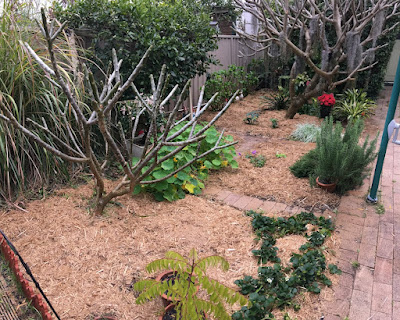
Mid August and both the frangipanis are asleep, so it looks a bit bare. In the foreground the bonsai curry leaf tree has enjoyed the winter, and in the right foreground the strawberry patch is flowering and looking promising. That's Pam's nasturtium patch middle-left, and middle right is the hardest working part of the garden, the pots of rosemary and thyme.

On the right ride of the garden is another of Pam's nasturtium patches, while behind them the Geranium 'Big Red' patch continues on its merry spreading way. The only care it needs is cutting back. Right foreground, the remains of our two very productive broccoli plants. The stumpy/stalky one on the right looks like that because this week we cut off all the leaves and cooked them up, Southern USA "collard greens" style — and they were delicious.

So that's your introductory guided tour. In coming days I have lots of spring flowers to show you, plus some garden jobs to do now, lots of problems in the succulent patch, South Africans at their glorious best, Pam's mum's garden refugees, crops on the go, garden critters, and I am sure several more things that I'll come across as spring warms up.

Hang in there locked-down gardeners! If you have a garden, even if it's just some pots on a balcony, they're the perfect project to take on now. Spring is well and truly in the air, the temperatures are rising so any effort you put into getting plants to grow will be rapidly — and beautifully — rewarded.

Wednesday, September 13, 2017

From disgraceful to graceful


While I spend an inordinate amount of time tending to my backyard, I am afraid I am guilty of neglecting my front yard. It's so easy-care that I don't water it, and feeding is a once-a-year thing. And guess what? It looks neglected ... in fact parts of it are a disgrace, and so recently, at Pam's prompting, I've given part of the front yard a much-needed makeover.

Here's a photo of how it looks, if you're a pedestrian in our street. That enormous blue-grey thing is a "groundcover" Cootamundra wattle (Acacia baileyana) that doesn't like to be confined by walls and so has grown into a 2m tall, 4m wide spreading monster. I have to cut it back regularly. However, the truly disgraceful thing is what was growing under the wattle: weeds, lots of weeds.

While I am not averse to publishing weed photos on my blog, it's usually done in the interests of either "what weed is that?" or "gosh I hate this weed". Today's weed photo is a simple 'hang your head in shame Jamie" shot of a neglected, weedy patch that's largely out of sight ... well, out of sight if pedestrians don't look as they walk by.

Two hours and eight bags of wood chip mulch later, it looked like this. Much better.

Pammy's great idea was to grow ferns under the dappled shade of the wattle, and so I went fern hunting. The little pots at the front are from Bunnings, Australia's hardware/homeware/garden warehouse behemoth retailer. The taller things at the back are from a local old Greek guy who sells all sorts of plants from his backyard. These look like fishbone ferns, they're considered a weed by many but they almost certainly won't die no matter what. 

I also found a great source of ferns at a little garden centre in South King Street in Newtown. The staff there were lovely, knowledgeable and I wish I had bought everything from them. If you live in my Sydney inner-west area, do check out this nursery. It's near the intersection with Alice Street, you can't miss it. Nice place to shop.

Next I adopted my old boss, Don Burke's great garden design/planting principle of "put and look". All you need to do is get all your plants in pots, and put the pots where you think they should go, then see how they look, then rearrange them until you've got the spacings, heights and other factors sorted. Then go around and plant the pots where they are. Works a treat.

Here's how it all looks when planted out. I'm not sure how big everything will grow, but that doesn't bother me much, as I'm also not sure which ones will survive and thrive, and which ones will die. I know the fishbone ferns won't die ...


... and I am also confident that the bird's nest fern (the one at the back with the wider foliage) will also not die and will probably grow quite big, at least 1m in all directions, up across and sideways.

As soon as I saw the label on this little guy "Macho fern" I had to have it. Whether it lives up to its tough-buy name is another matter, but I bought two and so I'll let them duke it out with the elements over the coming summer.

While I have tried to choose ferns with different shapes and forms of foliage, for variety, I decided a bit more foliage colour would be a welcome addition. Now, this next photo below is of my "hopes" not of what I planted. Projectionist, next slide please ...

Regular readers of my blog with excellent memories might recognise this Begonia maculata and its wonderful spotty foliage (and pretty white dangling earrings of white blooms) as it was my Garden Amateur Plant of the Year for 2015. Sadly, these were its glory days when it loved its first Sydney spring and summer, after being planted out as one of Pam's ex-office plants that grew too well under her care. The last two winters haven't been kind to it, but it is still alive, and so my brilliant plan is to take numerous cuttings from the parent plant and hope that a few of them grow on to become a chip off mum's award-winning block.


And so this is how they looked yesterday. A bunch of cuttings (there are several more). To cover all options I have some cuttings in pots in a mini greenhouse, I have also shoved several more straight into the front garden soil, saying a hearty "good luck" to them all. And a few more will sit in jar of water, in the hope that roots will sprout that way (my Googling of begonia propagation says it's a good bet).


As well as adding a dash of begonia magic, I've raided our plentiful supplies of Spanish moss, and now the craggy undersides of the wattle are festooned with thin tresses of grey Spanish moss. Good luck to them, too, I say.

So my job is to break a habit of the last several years and actually get out there into the front garden much more often, turn on the hose and make sure all the ferns get a goodly drink. If it all goes well, I am sure I will provide an update in a few months' time. 


Tuesday, August 15, 2017

Mulch, let me count the reasons why ...


Yesterday, compost. Today, mulch. We're getting back to basics here this week, but these two topics are the heart and soul of healthy soils, and that's where happy gardens thrive.

To get started on my mulching post, I trotted out to the backyard, confident as could be with a trusty trowel in one hand, mini camera in my pocket. I peeled back a layer of mulch, dug down a few inches, and this is what I saw ...


One of the reasons I am a keen mulcher is this person, and his/her million brothers and sisters. (Hang on Jamie, I think worms are hermaphrodites, so I'll change that to the much safer and more accurate "siblings".) 

I just knew if I lifted up some mulch and dug down that I'd find worms. They love a cool blanket covering their soil. In fact, I've noticed (completely unscientifically mind you) that in the places in the garden where the mulch has thinned out, there aren't so many worms when I dig there. In the heavily mulched spots, worms are plentiful. I do like the idea that they move around, and they have opinions.

If your soil has lots of worms, you're in a good place. Almost anything and everything you plant into soil thriving with worms should grow there. So that's the first reason I love to mulch my garden. It makes worms happy!

Another reason I love mulching my garden is that it just looks good. Sure, it's bit of a superficial thing to say, but I just love the way mulched beds look, especially when I use my favourite straw-look mulch, which here in Australia is sugar-cane mulch.

Speaking of sugar cane mulch, this is the stuff I bought on Saturday. I think it's a new brand, or different packaging, but I have no brand loyalty whatsoever to any one brand of sugar cane mulch.

However I am fiercely loyal to a price point of no more than about $16 per bale. Any more than that and I won't buy it, any cheaper and I am your man. I love it when I can get a bale for $12 or even less. In our small garden, one compressed bale like this covers pretty much all the beds I mulch with hay. 

I don't spread it too thick, either — just two or three inches — as there's plenty of evidence that a too-thick layer of mulch can prevent the water from lighter showers of rain ever reaching the soil below — and you don't want that to happen.


Our fruit trees, like this Tahitian lime, are mulched year-round, and it definitely helps to suppress weeds and retain soil moisture. This is the reason the advertisers always trot out, and they do over-claim its benefits in the hope of attracting lazy gardeners. Take it from me, weeds will still appear, and you will still have to water your garden regularly. And the mulch will eventually break down, and you will have to top it up regularly. I kid you not, mulching is just another gardening chore. It isn't a magic work preventer.

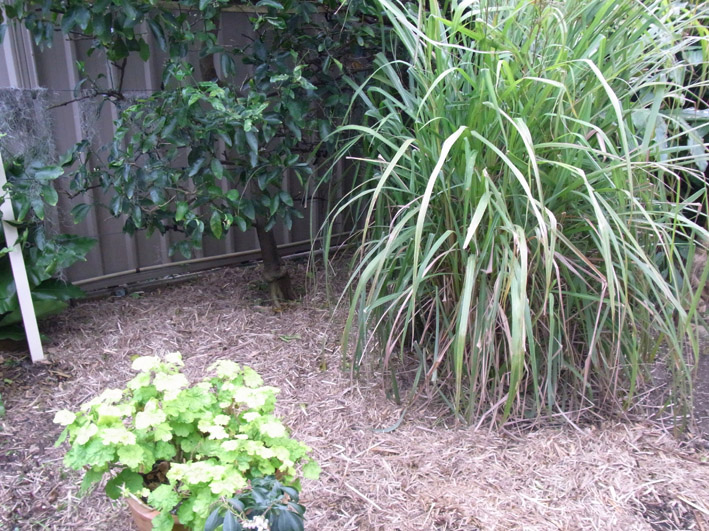
What's that big thing on the right? That's my lemongrass plant, and in about a week from now it will be getting its annual cut-down-to-the-ground trim, and it will be back to its beautiful, fragrant, willowy best by midsummer. It doesn't mind a bit of mulch around its root zone, either.

Finally, this is my other favourite use for mulch: to keep weeds down in all my bigger potted plants. This is my Thai lime tree, and ever since I started mulching it with sugar cane the weed problems have been halved. Oxalis still spreads itself around, but it is fooled into thinking the layer of mulch is "soil", and so I find it's now much, much easier to pick out long strands of oxalis now.

As for the mulch retaining moisture in the potted plants, I guess it does that, but I find potted plants need a power of watering to stay happy in Sydney, so no layer of mulch is ever going to stop my watering program. However, the mulch does provide some peace of mind if I go away for weekends.

Sure, there are other mulches, such as lucerne mulch, which the expert gardeners recommend. But have you seen how much that stuff costs? I am too much of a cheapskate to ever use lucerne mulch. 

And pebble mulches, they look really cool. My whole succulent garden is covered in pebbles, and they are a truly hopeless mulch if you're hoping to suppress weeds. Onion weed just brushes pebbles aside. 

At least the pebbles don't stay wet, like normal mulches do, and so the succulents don't get hopelessly soggy and die during one of Sydney's horrible wet weeks of constant downpours, which happen a few times every year.

And I do use coarse bark mulches in other spots where it's not so visible. It has the advantage of lasting much, much longer than sugar cane so it's a good investment if your budget is tight, but I find it a bit depressing to look at if there is too much of it. 

But everywhere else, give me sugar cane mulch every time. I love the farmyard look when it's freshly spread, and my little mates the worms love it, too, which is good enough for me.


Sunday, September 28, 2014

Mulching by instalments


Our extremely soggy August provided some of the best conditions for weeds to grow in living memory, and trust my luck that at the same time I have been on what might be called 'light duties' lately – forced to rest up while my arthritic old ribcage tries to mend itself. And as a compulsive gardener, I sometimes forget that I am on light duties, I see something "out there" that I just have to attend to … and I hurt myself again. Back to square one ...

And so it has come to this. When in my prime I could mulch whole acres in a day (OK, slight fib) right now I am doing it one square metre at a time - per day. Talk about slow progress.

When I talk "mulching", that really is gardening code for "lots of weeding for 90% of the time taken (to get rid of the onion weed, oxalis, chickweed and other uninvited greenery) followed by a short, triumphant spreading of the mulch as a grande finale". 

I use three different mulches here in our garden. All the food
plants are mulched with sugar cane mulch. The purists, who must
also be quite rich, insist on lucerne hay, but the poor, ordinary
folk-on-a-budget of this world use sugar cane mulch in Sydney.
The ornamental flowering beds are mulched
with some kind of composted bark, such as
this freshly laid pine bark around this gardenia.
Here it is in close-up around our newest acquisition, a
Grevillea 'Pink Lady' ground cover.
The third type of mulch in use here is the
off-white pebbles in the succulent patch, and
it has proved to be a hopeless mulch. All
weeds love it. Here's some onion weed brushing
the pebbles aside.
The oxalis skips across the top of the pebbles like Ginger Rogers
and Fred Astaire. Oxalis just adores pebble mulches.
My favourite mulch by far, the sugar cane mulch, is full of fresh,
farmyard handsomeness for the first two weeks after it is
spread. Thereafter it goes grey and lifeless, and as it breaks
down quite rapidly it needs regular replenishment. But I do
love the look of a freshly mulched vegie patch!
And so today I weeded and mulched the spot where I planted the perpetual spinach and Serrano chilli (pictured above). Next chance I get, it's the strawberry patch (another square metre owned by Emperor Oxalis). After that, maybe next weekend, another square metre around the clivias and frangipani. I think I am slowly catching up to the August explosion of weeds, but please Huey, no month-long downpours this spring? Please, my ribcage couldn't stand it!


Saturday, August 31, 2013

Spring started weeks ago!


One of the fortunate things about my new life as an erratically employed freelancer is that I get more time off to do gardening, whether I want the time off or not! The pay is lousy but the lifestyle is terrific. As a result, my garden looks rather tidy at the moment. As the heading for this post says, spring started weeks ago, so this posting is nothing more than a wander around my happy and unusually tidy spring garden. 

For me, this light, fresh green is the true colour
of spring. In this case it's the top leaves of my
potted Turkish Brown fig.
Flowers do announce the new season nicely, and our potted native
orchids are producing sprays of these tiny, fragrant little blooms.
Small but perfectly formed orchids less than an inch across
from side to side, the other nice thing about them, speaking
as a gardener, is that they are very easy to grow.
Our two lavender bushes have been blooming
their heads off for a month, the bees love them
and they aren't looking like slowing down any
time soon. I've added its fellow Mediterranean
classic, the rosemary, to keep them company.
Wet weather can truncate the show of the superb
scadoxus, but with hardly a drop for the last few
weeks they're putting on their best show ever.
Our self-sown strawberry patch (which came
up out of some compost spread in this spot) is
still rudely healthy. Its spot is a bit too shady
in winter so it's content to snooze then, but now
the amount of sunshine it's getting is growing
daily it is flowering (with liquid feeds from me
to help the cause) and the first fruits are forming.
The end of winter is one of the two times of the
year when my in-ground citrus are fed, and a
week ago our garden was resplendent with the
heady aroma of chicken poo. Now the Eureka
lemon is flowering its head off quite fragrantly. 
Our potted Thai lime is clapping on a lot of
deep maroon new growth, but as it's in a pot I
feed it lightly once a month, unlike the other
citrus trees growing here.
I sometimes channel a bit of Basil Fawlty when
I am yet again caring for my potted mint, as
what mint needs "is a damned good thrashing".
What I mean by that is mint needs constant
taming and cutting back, sometimes all the way
down to pot-rim level. I did that for the
umpteenth time about three weeks ago, and
since then with regular watering and liquid
feeds, it has bounced back nicely yet again.
It's a high-maintenance herb, mint, but it
does look and smell lovely in these peak times.

I'm not going to say too much about the passionfruit vine
trained on my neighbour's garage wall, other than to report
that it's ludicrously lush and green, and has no flowers and
is doing sod-all in the way of producing fruit yet.
The small gaggle of garlic plants raised from
sprouted supermarket cloves is growing on well.
I told you the garden looks neat and well mulched at the moment.
I pulled out the winter crop, dug it all over as usual, then planted
seedlings of lettuce, basil and chillies, along with pretty little French
 marigolds for some colour. The round bare patch on the right
rear is where I am raising Collard greens direct-sown from seeds.
The Collard greens came with the Soulicious eBook cookbook 
Pam and I bought from our friend Awia Markey.
New plants have been added recently, too.
This row of four Gardenia magnifica should
grow to about 2m tall and cover up that
white Colorbond fence. I am hoping for dense
glossy green growth, white fragrant flowers
in summer and no problems, please!
And finally, if it all grows too big and everything
gets out of hand – start again! That's what we
are doing with a potted bay tree. Our last one
was here for ages but grew too big, then became
pot-bound then got sick and ugly. All my fault.
So here is "Son of Bay", my attempt to make
amends for all my bay-tree growing mistakes
perpetrated over the last 20 years. Whether I find
redemption or not remains to be seen, but I do
like adding just a touch of epic theme to
gardening here. It puts things in perspective.


Sunday, September 16, 2012

Got it covered


Oh what a difference mulch makes! We've all been indoctrinated in recent decades to value mulch for its ability to disappoint weeds and to keep the soil moisture where it's needed around the plant roots, but today I looked back on a couple of hours of mulching (after a lot of planting) and the thing that really hit me was how much better a garden looks with a fresh layer of mulch. It hides all sorts of blemishes. And down at the landscape supply place it's clear that there's a couple of dozen different mulches to choose from. It actually took me a while to decide, too.


In the foreground, a fresh layer of fine
pine bark mulch around the purple patch
of lavenders and tibouchinas. Much better
looking than plain, dark brown earth. In the
background, the succulents' pebbly cover.

All the vegie/salad/herb beds are mulched with straw.
It's a nice farmyard look on the day it's laid down,
but this stuff breaks down fast, so it'll need topping
up in a month or so. No worries with that, as I keep a
big bag of sugar cane mulch in the shed for this routine
job, but that bag of mulch also comes in handy as a
magic ingredient in making compost. Every few days I
spin the compost tumbler bin, like a good boy should,
but before I do I add a very generous handful of straw
to the bin, which is mostly full of wet vegie/fruit scraps.
The dry straw balances out the wet-dry mixture, and
ever since I started this habit several years ago,
the quality of my compost improved enormously. 

This is just my excuse to run another photo of my pebbly
little succulent patch. All seems well here, in fact I am
sure some of them are showing signs of growth already.

I've used the fine pine bark mulch around
today's plantings of Lomandra 'Tanika'
(the low grass in front) and the Tiger
Grass behind. This 'Tanika' stuff is evergreen
so it doesn't go through a crappy looking
phase each year. It's almost indestructible,
and is often seen in traffic islands and other
very inhospitable spots. I want my garden to be
much lower maintenance, and I'm hoping that
the Tanika, backed by the bamboo-like tiger
grass, will be the least of my worries over
the coming months and years. Time will tell
whether this works or not. It almost feels like
cheating or laziness to plant Tanika – heck, we
keen gardeners are meant to take on impossible
challenges! Well, this keen little gardener with a
dodgy back is simply hoping for a lighter workload. 
I think I've got off track in this post... where was I? Oh that's right, mulch! Without me thinking about this fact too consciously, it has worked out that a key part of the design for this little backyard makeover is that it's the mulch which defines the various beds. Pebbles for succulents, straw for food plants, and the foliage-only and flowering plants are mulched with fine pine bark. Works for me.

Saturday, February 19, 2011

Plugging the gaps


Well, hello everyone. I've been away from blogging about gardens for a month and a day, although I don't think anyone actually noticed. The odd thing about being absent from my blog for this short period is that during that time, the number of hits on my blog slowly but steadily increased. If I stay away forever I might eventually have a hit on my hands...

I don't think so, and so let's get down to the business of today's topic: plugging the gaps. In this case, it's a fairly big gap. Let me explain.

Now, this is not a recent photo of my front garden. It was taken back in April 2009, when everything was going well with these outrageously healthy and vigorous natives. The blue-grey thing spilling over the front fence is an alleged 'groundcover' version of the Cootamundra wattle, according to the plant label. It's a monster, but it is a beautiful monster. But see the big grey plant behind it, in the centre of the photo? That's now the gap in question. It has carked it. Died. It is an ex Correa alba. It started to get the wobbles this time last year, and for a while I thought it had survived, courtesy of my nursing talents. But this summer I lost my grey native patient and it just faded and faded, and so this morning I pulled it out.

Now I have a very large gap to fill. That's a big gap, isn't it! I could do nothing and just let the monster wattle fill the whole area, and that's not a bad plan at all. We might do that. But Pam and I just can't help discussing alternatives. We could plant a dwarf gum tree there, the one with the lurid vermilion flowers, for example. Not sure what we'll do, but there's no rush. February is a stinker of a time to plant anything in Sydney. I regard February as the one true "killer" month we have here in Sydney each year. Hot and humid, it gets at plants' roots, gives them diseases, and pests are everywhere. I've attended more plant funerals in February than at any other time of year. So I'll wait till it cools down, late March or April, before I plug the 'gap' with something else.

Right now, I've also been filling a few other gaps in the backyard in a very stop-gap way. To other Sydney gardeners, all you have to say is "that hot Saturday" and they all know what I mean. On that unbelievably hot day in early February, the temperature went past 40°C everywhere, and my little digital thermometer in the shade peaked at 41.5C (which is 106.7°F). And it wasn't dry heat either, it was humid heat, awful debilitating heat.

Fortunately, all the major plants here survived, the goldfish in the water garden even made it through (thanks to some timely shadecloth cover), but all the annual flowers which were past the half-way point of their short seasonal lives suddenly heard the referee blow "full time, game over" and down they slumped, deep-fried by sunshine.

So this is the scene this morning in the backyard. Mulcherama. Everything was pulled out, the soil has been dug, composted, limed, watered and mulched. And I'm not planting nuthin until March. I don't trust this weather. It's deadly. What little gardening I'm doing is happening before 9am, or after 6pm. When March comes I'll be planting vegies and flowers again, as I always like to, but until then I'm cruising, watching mulch break down.

So there's not really all that much to blog about here at Amateur Land at the moment. When the weather cools down next month there'll be all sorts of things to post about, so I might just wander off for another month and a day, and watch my web stats keep on mysteriously rising.


Saturday, July 11, 2009

The Rudd garden


Not sure if you've noticed or not, but apparently there's been this thing called a Global Financial Crisis (GFC) happening lately. It's a bit like swine flu, but economic. With both epidemics, most countries have had their dose, or are still doing so. Some have had it worse than others, and each country is responding (and suffering) in its own way.

As for the GFC, our Australian Federal Government, led by Prime Minister Kevin Rudd, decided to stimulate the economy with a cash injection by giving every taxpayer a cheque for $900. The idea was for us to spend the money like good consumers should, and stimulate the retail economy in particular: ie, buy a plasma TV, get the kids new sneakers, mend the fence, etc. Well, I decided to spend a good slice of my little undeserved windfall on my mother-in-law, Val, who I've blogged about before, here. The garden at the back of her house is basically fine, but it needed a makeover. Pensioners aren't taxpayers and lots of them didn't get any cash. That offended my sense of fairness!

So, a few weeks ago I spent a day cutting back some of the overgrowth in the back garden, and then we paid a guy to haul it all away (and he also did a bit more cutting back and carting away). Today, I removed all the weeds from the pathway at the back, covered it with new woodchip mulch, planted two roses, lavender, roses and various herbs. Here's the 'rose garden' section at the end of the day.

The mulch on the paths is chipped hardwood that will last for ages. It will break down slowly, but the odd annual top-up should keep it in good nick.

It's midwinter here in Australia now, and so the garden centres are full of bare-rooted roses. These are two really lovely hybrid tea roses: 'Just Joey' an apricot coloured rose with a superb sweet scent, and 'Friesia', a pure yellow rose with an equally wonderful perfume. I have a standard 'Friesia' in my own garden and our hallway smells so nice when Pam cuts a few roses and pops them in a vase. Pam's mum Val is also a great one for filling vases with blooms from her garden and I'm sure she'll love both of these.

Val used to have a lavender bush, but it was a victim when the new green steel fence went in. So I bought her a French lavender plant. Unlike Italian and Spanish lavenders, which tend to flower mostly in spring, and English lavender, which simply dies in Sydney, French lavender flowers all-year-round in Sydney. It's a wonderful plant with one little problem: it's fairly short-lived in Sydney – only four or five years, on average, in my experience. They usually cark it during the worst of February's heat, rainfall and almost subtropical humidity.

I also bought Val a rosemary bush, as she's a keen cook and needed a new bush to replace an old, tired one which had succumbed to too much shade from the overgrown trees which we cut back a few weeks ago. Both the rosemary and the lavender are in pots, as the soil is pretty horrible clay here. Roses don't seem to mind clay, but lavender and rosemary don't thrive in heavy soils. They're better off in pots.

And so here's the colourful scene late afternoon (sorry about the shaky focus, but the light was low and the camera's shutter speed was down to super slow by the time I got around to happy snap time). I actually ran out of redgum mulch and had to dash off to the garden centre for more, and it was only when I emptied this stuff out of the bag that I realised what a truly lurid red colour it is. Val loved the colour (or at least was good enough to say so!), but it should lose its ultra-saturated colour over the next couple of months' worth of Aussie sunshine. No colour lasts in the Aussie sunshine, especially anything red.

Val's a very good cook and loves to use herbs in her soups, casseroles, salads and with her vegetables, too. Her herb pots needed some TLC, so from left to right: thyme, mint, curly parsley and chives went in, along with new potting mix and some fertiliser.

And finally, Pammy asked me to see how the japonica was going and take some snaps of it. These are also known as flowering quinces, and they flower here in winter. So far it has barely started flowering. For some reason this was the only cluster of blooms, but I thought I'd finish off with them simply because they're growing at Nanna's and they're lovely, just like Nanna!

A funny little postscript to this garden – it's famous! Well, if being mentioned in the newspapers means you're famous, then it's famous. Val was at a community event attended by various politicians, including the Federal local member (Julie Owen) and a senior Federal minister (Jenny Macklin). The pollies were asking the audience what they were doing with their $900 cash stimulus cheques and Val (never a shy one at community gatherings such as these, which she often attends and sometimes helps to organise) piped up with her story of her son-in-law spending some of his cheque on her garden makeover. Always the one with a good one-liner, Val added that it had been named "The Rudd Garden".

Well, the local media, presumably bored to tears by the not-very-exciting community meeting with the Federal pollies, decided that "The Rudd Garden" was the best story to come out of the event, and so it made into a couple of the local papers as the lead item in the report on the visit by the Federal Minister!