Showing posts with label coriander. Show all posts

Wednesday, September 15, 2021

What seeds have taught me about patience


One very strange thing I haven't been doing lately is visiting gardening centres. Prior to all this covid disruption, you'd probably find me browsing through a garden centre at least once a week. They were right up there with bookshops for me: regular haunts. But that was back then, and I haven't been to a bookshop for quite some time, either.

So, instead of picking up a punnet of seedlings at the local garden centre, for the last few weeks I've either been sorting through my stash of seed packets, searching the small section devoted to seeds at my local supermarket, or — by far the best fun of all — I've been browsing seed catalogues online, placing orders, then waiting for our poor overworked Postie to deliver me the goodies.

Another small padded envelope of seeds arrived in the mail today, and so I thought it's about time to share with you "What seeds have taught me about patience". It's not all good news, but it isn't a disaster story, either. 

On with the slide show.


I love the way coriander seeds hang around on top of the baby leaves until the very last moment. It looks like the baby plants are telling the seeds to "buzz off, now scram!"
It's a tiny bit late in the season for coriander — I normally start sowing seeds in autumn — but this will be my last batch for 2021. They have just a couple of months to grow into lovely leafy herbs before summer comes on. O
nce things get seriously warm they go berserk, become seedy in no time, and the leafy herb I love is no more.

I only sowed these basil seeds last Monday, and they're up as fast as those other legendary quick sprouters, rocket. I'm looking for a crowded pot of little plants that will look very photogenic for a few weeks and supply lots of leaves for tossing into the mix with tomatoes, especially. What a team!

I'm not fussy about where/who I get my seeds from, and my seed tin stash has all major and minor companies represented.

These English spinach seedlings came up only a day after the basil, and it's a good thing they're making a fast start. They're another crop which does better in the autumn and winter months, but I've got them in a partly shaded spot to avoid the heat, and I plan to fertilise the daylights out of them to make them grow faster. If we get a good crop, there's nothing Pammy likes more than a Japanese style Gomayagochi spinach salad with her grilled Teriyaki salmon. Home-grown spinach flavour here we come.

Once you get addicted to growing plants from seed, as well as actually planting some of the seeds (eg, the spinach, silver beet and spring onions in the top row) you also end up buying packets of seeds in a "seemed like a good idea at the time" kind of way. I fully intend to grow leeks, lettuce and radish some time soon, I hope. No reason why not, really ...

Here's one of those lessons in patience that seeds have taught me. Usually I am dead lazy about growing chives. Every winter my pots of chives turn into dense, unhappy clumps that turn yellow and look crook. Always a glutton for punishment, I have tried de-potting the clump, diving up the plants and replanting them in fresh mix, and the results have never been all that great. So most years I just buy a fresh punnet of little chives, plant them in a pot and they zoom away! This time, I decided to do it with seeds, and what do you know? (See below) ... 

It takes 14-21 days for the seed to sprout, and this pot took all 21 days to sprout (that was all of July). Now, 6 weeks later, we're in business snipping chives to go into Pammy's scrambled eggs on Sunday morning. But the lesson I have to share with slow-sprouting seeds is to know this in advance, plan well ahead, and try to see the year in three-month-long blocks of time. Impatient "days and weeks" thinking is just too hurried. If you grow chives from seed, think "third quarter of the year" as chive time.

Much more fun, quicker and prettier to look at, the wonderful world of lettuce is a great place for beginners to get started with seeds. There's a zillion varieties to choose from, especially when you start shopping online, and usually lettuce will sprout for you quite quickly.

I've been growing spring onions/scallions/shallots (call them what you will) from seed for several years now. My problem is that I hate wastage, and buying just one punnet of seedlings gives me about three times more seedlings than I have space for them, so I raise small batches from seed each time I start a crop. I cook with them all the time, adding them to salads and stir-fries, as well as using them as a mildly oniony substitute when I don't have any onions at hand. And that classic Chinese ginger and shallot dipping sauce for poached chicken is just heaven on a plate. I miss Yum Cha!

This is what arrived in the mail today, from my favourite online seed supplier, Eden Seeds. Like all the good quality specialists they have a wide range to choose from, and their customer service and delivery speed is reliably very good. This time I succumbed to the lure of two very pretty loose leaf lettuce, and a packet of the hard-to-find, tricky-to-grow and finely flavoured herb, chervil. I've been banging on for years about how good chervil is and so far I think I have convinced no-one. But Pammy loves chervil too, and that's all I need to know to enjoy its flavour. Its lightly aniseedy delicacy is superb with mild-tasting vegies such as zucchini and squash. Transforms them from bland to beautiful.

As well as being a sucker for lettuce varieties in seed catalogues, I am also very susceptible to limited edition tins of biscuits or other products on supermarket shelves. My shed has a goodly number of "collectable" supermarket tins filled with glues, nuts & bolts, and seed packets. All the cricket heroes on this Weet-Bix tin have long retired but this tin has aged nicely, with almost all the colours fading to a bluey-grey, as if there has been a printing mistake at the factory. Inside that tin is a cornucopia of seed packets that is constantly being added to ... more Aladdin's tin than Aladdin's cave.

Last but not least in the slide show is confirmation that not everything in that Weet-Bix tin is an edible. I know that cosmos is a bit weedy, so I have planted a row of cosmos seeds at the back of my Big Red geranium patch. So the plan is this summer the cosmos will add cheery yellow and orange flowers towering over the scrambling concourse of red geraniums, and then after the cosmos season has ended, the Battle Royal will ensue as weedy cosmos grapples with ever-spreading geraniums.

So, even though growing everything this year from seed is like gardening in slow motion, time ticks over steadily. It's spooky, like it has something to do with the position of the sun in the sky or something.

If you are impatient, don't even think about growing chives, chervil or parsley from seed. They're seeds of patience, for the long-term planners.

If you are impatient, get out there and start sprinkling around the basil seeds, the spinach, the lettuce, the rocket. There'll be something happening before one week has passed. 

I'm somewhere in between when it comes to patience. I do have some patience, but not a lot. So I do love it when seeds come up fast.

But I have learned that there's a deep satisfaction when real patience, the long-waiting, not-much-happening-yet kind of patience is rewarded. It's as if time has become an old friend with whom I am strolling through the year, hand-in-hand. 


Saturday, September 26, 2020

Sowing seeds to ease the covid boredom


First up, a big, warm THANK YOU everyone for all your lovely messages saying things like “welcome back” “wondered where you got to” “was thinking of you only the other day” etc etc. (Not one saying "oh no, he's back"). You’re such nice people! 

On with the show.

Last posting I mentioned that I was going to do something about growing things from seed, because that’s been my main activity ever since the COVID-19 pandemic turned the whole world upside down early this year.

Like all other sensible people, I’ve been avoiding crowded spaces wherever possible. I do my supermarket shopping (mask on!) in the early morning hours, when it's fairly empty, and I haven’t been to a major gardening centre for more than six months — and yet I’ve been very busy growing crops of herbs, vegies and flowers during all this time.

The reason for that is simple: seeds. I’ve bought some of the seeds I need at the supermarket, and others that I can’t find there I have bought online.

So what have I been raising from seed?

Mesclun: this is just a mix of different salad greens, including several varieties of lettuce, plus rocket, lamb’s lettuce, a small Asian green like tatsoi, plus sharper tasting mizuna and red radicchio. Each seed supplier has its own mesclun mix. I'm growing mesclun in long, deep planter troughs that edge our outdoor entertaining area.

Coriander: one big pot is all I need. I sowed a batch in April, then when it started to tire in July, I sowed another batch.

Chives: this is the first time I've sown chives from seed, and it's worked so well I might do it this way every year. My chives pot always loses the will to live in midwinter, when it becomes a solid clump of pot-bound roots in its pot. In previous years I've either divided up the clump and replanted the best ones, or I've taken the lazy route and just bought another punnet of seedlings. From now on, it's seeds, ho!

Parsley: this is a pain to do, as parsley can take 3-4 weeks for the seeds to sprout, but it's a good reliable way to rejuvenate the parsley patch if you get started in late winter.

Poppies: usually I buy seedlings of Iceland poppies to grow for Pammy, but this year I started them off from seed a few months ago, and they're blooming nicely now. Nowhere near as easy and convenient as buying seedlings in late April, but not difficult to grow from seed, either.

Sweet peas: after last year's success with my first sowing of seed, I've expanded the size of the sweet pea patch and moved it to a sunnier spot. So far, so good.

Shallots (green onions): the thing I hate about buying punnets of shallot seedlings from garden centres is that even one punnet has too many seedlings, so I've got into the routine of sowing a small number of seeds every few weeks to keep production going. During the pandemic lockdown my culinary adventures have included lots of stir-fries, and learning all sorts of noodle dishes, and you end up getting through a lot of shallots when you start cooking a lot of Asian food.


Sowing seeds in pots

Sowing seed is easy in pots using my ‘scatter and cover’ method. Here's how I do it (I'm sowing coriander seeds, simply because they are pale and big, so you can actually see them in the photos). The basic principles apply to all sorts of other seeds (ie, chives, shallots, basil, parsley, chillies, tomatoes, lettuce, mesclun).

First up I smooth out a bed of fresh potting mix so it is flat and even, and reaches almost near the top of the trough, but not quite. 

Then I scatter the seed from the packet as evenly as I can, making sure to err on the side of scattering too many seeds, rather than too few (I can thin out the crop a few weeks later on). 

Here's a cool trick ... read the instructions! Seed packets will tell you how "deep" to sow the seeds. In this case, with coriander, it's 5mm deep.

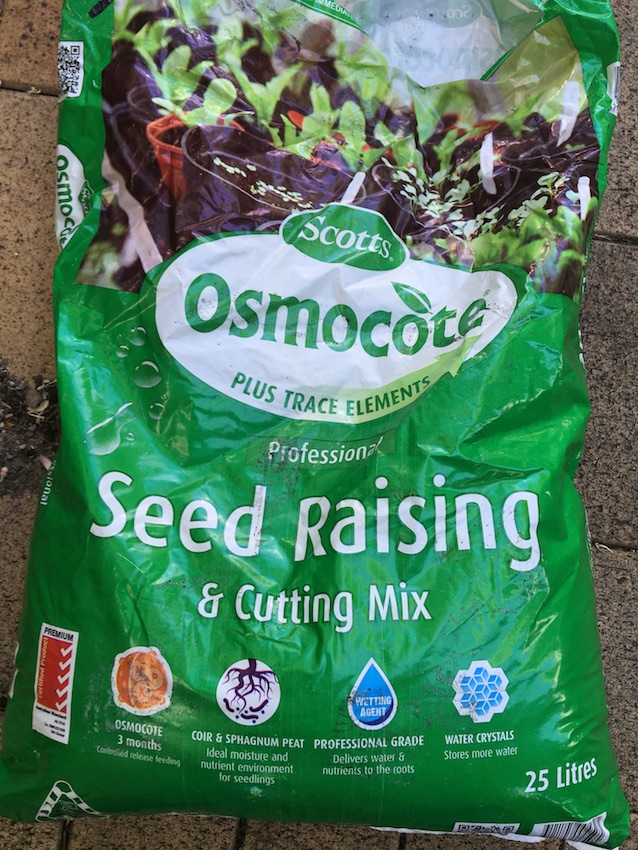
So, I scatter seed-raising mix* fairly thinly over the seeds, about 5mm deep in this case (without getting too anxious about how accurate you are). But do make sure it's enough to cover the seeds so you can’t see them anymore. 

* (By the way, for people outside Australia, seed-raising mix is a very fine-grained potting mix. Maybe a cuttings or propagation mix is the closest thing if you can’t find seed-raising mix.) 

Finally I use a mist spray setting on my fancy multi-setting hose nozzle (that I bought in an Asian Bargain Shop for $8, and which has worked well for years) to dampen the soil well but not drench it messily.


I mist the pot every morning until the seeds sprout. And if I can manage it, I like to keep pots out of the hot sun in a shaded area until they sprout, then expose the pots to more sun as the plants grow. Sometimes, with big heavy troughs, that isn't possible, so I just make sure to keep seedlings exposed to full sun well watered at all times.


Here's how the mesclun trough looked like after about two weeks, with lots of babies coming up. With a mesclun mix the fast-sprouting seeds like rocket and mizuna are up within four days. Some of the other seeds can take several days more to appear, sometimes up to two weeks. 

Coriander grows at a more leisurely rate, taking about 10-12 days to appear, but it looks lovely when fully underway, like this pot full of babies that are probably about a month old.

With my first trough of mesclun I learned that I needed to keep a close eye on which plants are bullying the others and grabbing all the space, and that meant I had to occasionally pull out an over-eager bully plant so the tiddlers lower down could get going.

After a few weeks of sorting out the squabbles between competing plant egos, they all settled down to make the most picturesque and delicious mixed leaf salads. A mature pot of mesclun is so photogenic, and if you just use a pair of scissors to give the pot a light haircut you’ll have a nice mixed greens salad ready to go, with replacement leaves growing back rapidly in the next few days. Regular (fortnightly) liquid feeds keep the production humming along.


The alternative to mesclun, and also worth growing, is simply to grow several different lettuce varieties in the one pot. Though nice to look at and easier to manage, what a mixed lettuce salad lacks is a bit of that tasty pepper and spice in the leafy mix that you get with mesclun.

Managing the competition

The one trick to remember with my ‘scatter and cover’ method is that it's likely that you will have sown too many seeds, so you will at some stage (say, in the third or fourth week after sowing) have to play at being Charles Darwin and pull out several weaker plants so there is enough room for the healthy ones to grow on. Don't be squeamish, just imagine you are the David Attenborough of salad greens, observing that only the strong survive while you watch on, fascinated.

Breaking news ...

I am also growing basil from seed, just because I don’t want to visit garden centres to buy seedlings, not because basil doesn’t grow well from seedlings. 

All the seeds came up beautifully, they looked as cute as fat babies, but a few nights back the slugs ate everything. It was my fault — I had sat the basil seedling pot up on top of the soil under a potted lime tree, so it got nice dappled shade on a warm day, and I forgot to move it back to a safer space that evening. I found a bunch of slugs living under the rim of the lime tree pot, sneaky slimy seedling munchers ...

There was nothing left, just pathetic little white stumps where leaflets used to be. Such is life, and gardening, so start again …


Sunday, September 20, 2020

Has it been that long?


Hi everyone, how have you all been keeping? It has been a while since I last posted anything here at Garden Amateur ... *checks* ... has it been that long? Really? Just a few months short of two years? How time rushes forward slowly sometimes.

The reason I'm back here for at least an update post is that one of my readers, Jenny, attended an art class run by my darling girl, Pammy, and Jenny asked what was happening to my gardening blog.

I've wondered the exact same thing myself sometimes. All I ever intended to do when I wrote my last posting at the end of 2018 was to take a break, a sabbatical, and get back into garden blogging again "one of these days", as the saying goes. And here we are, with me starting up blogging again due to popular demand of one. Thank you Jenny.

Well, the short version is that all is well with Pammy and me. Both of us are healthy (which has risen in importance in 2020 in particular) and both happily occupied in a variety of different ways.

Pam is particularly busy as an art teacher these days, doing all sorts of watercolour art classes in a range of venues. You can check her out at her website, https://pamelahorsnell.org but if you are in Sydney some (but not all) of her courses are listed on Eventbrite.

Me, I'm retired! Hooray! Which means more time for gardening of course, but also more time for reading and cooking, but lots of my time is also taken up as being Pammy's support person, as I can drive a car and she doesn't. So we work as a team, which is what we've been doing for the last 30 years anyway. The teamwork never stops, but the projects are always changing.

"But what's happening in the garden?" you ask, as, after all, this is a gardening blog and not a Christmas-time catch-up letter sent out to all and sundry, whether they're interested or not.

The garden, like us, is happy. Right now it's the beginning of springtime, so it's time for a few photos with captions of random gardeny things that have either happened in the last two years, or are happening now.


All the garden favourites have flowered right on schedule, such as this
blue Louisiana iris, which has just started to bloom this week.


However, I am still impatiently waiting for the white Louisiana iris
to pop out. It always does its thing a week or two after the blues begin.


Last year (2019) I tried sweet peas for a change, and the results
were lovely. I've planted even more this year, and they are just
starting to bloom, but won't be in full bloom for another month.


Last year's Shirley poppies were all razzle dazzle, but for no
good reason I never got around to sowing their seed this year.
Never mind, there's always next year (I hope).


I was very pleased with my purple cauliflower. The seeds were
given to me by a wonderful gardener, Kerryn Burgess, who I met while visiting
friends Amanda and Mike in Kyneton in 2018. I'm a keen follower of Kerryn's
amazing Instagram feed at @kerryn.burgess where she is a virtuoso of all
the gardening arts. Superb espaliers, wondrous orchard and much more ...


Our succulent patch continues in its own quirky way, with oddball
dazzlers such as this stapelia bloom. But, to tell the truth, the supposedly
easy-care succulent area is a lot of work, primarily because of onion
weed and a rotten, fast-growing grass that can take over in no time. 
The succulents themselves need little attention, but the weeding!


I've just realised that this 'update' posting could turn into a marathon if I'm not careful, so I'll finish off here with a final trio of photos that summarise what I have mostly been doing during the COVID-19 pandemic. I've been growing lots and lots of things from seed. 

It's slow, it gets easier the more you pick up the skills, and as I have oodles of time on my hands, raising plants from seed is a perfect garden project. I can guarantee you no instant gratification whatsoever with seeds. You have to learn to be patient, and savour the very real pleasure on those mornings when you first discover that your latest sowing of seeds has produced babies.  


This is our second pot of seed-grown coriander this cool season.
We ate the first lot, mostly in curries and stir-fries.


The chives are belting along, just a week or two away from ending up
in their favourite dish, Sunday morning scrambled eggs.


Baby spinach and yet more lettuce. The spinach is great in sandwiches.

So that's your update for now. Once I get my act together with photos, I'll fire up the Blogo-Matic 3000 ideas generator and will post something on seed sowing soon. 

See you then.

Wednesday, August 8, 2018

Cooking bibles & coriander


It was only recently, on June 29 in fact, that I was writing something about growing coriander. At the time I was berating myself for not having much faith in my ability to save coriander seeds and then raise new plants from them. Well, as it turns out, I was happily wrong once again, and all the coriander plants are doing well. 

Too well in fact. So now I have a bit too much coriander. Here's the pix to show my very minor predicament.


The larger pot of shop-bought coriander seedlings has been harvested a few times, and with follow-up liquid feeds, plentiful water and a very sunny Sydney winter, it has grown even more lushly. I don't really need much more ... but ... 


... the pots of baby seeds are rapidly turning into two more gluts of leafy coriander. It's not really a problem, but with too much coriander there is but one course of action ... turn to my beloved cooking Bible for a favourite recipe to use up large amounts of coriander in one delicious hit.


Here's my Asian cooking Bible. It's "The Complete Asian Cookbook" by Charmaine Solomon. Mine is an early paperback edition from 1978 (the original came out in 1976). Battered looking, but still in use all the time.


A HUGE thrill for me was back in 1996, when I was deputy editor of House & Garden magazine, and I went out to Charmaine Solomon's Sydney house to do a cooking and gardening story. Of course as a fan-boy I took my copy of her book with me, and she signed it for me. Wow, this kitcheny, gardeny boy was star-struck. 


Then Charmaine had some fun flicking through the book to see which recipes I had used the most. There are lots of turmeric-stained pages, but she found this one, all splattered with spice dust, with two of my favourite chicken dishes. Tandoori chicken (the dish I cooked for Pam on our first date back in early 1989 when she came around to my place for dinner) and Chicken and Yoghurt curry, easily my favourite mild chicken curry.

And so, to use up some of my excess quantity of fresh coriander leaves, Charmaine's books offers countless different delicious ways to do it — including that chicken and yoghurt curry, which uses up 1/2 cup fresh coriander leaves — but I have chosen instead her fresh coriander chutney (from spice-spattered page 88), a simple, dollop-on condiment that goes beautifully with so many dishes from the sub-continent. 

Fresh coriander chutney (Dhania Chatni)

1 cup firmly packed coriander leaves
6 spring onions (scallions or green onions) cut into smaller pieces
2 fresh green chillies
1 clove garlic
1 teaspoon salt
2 teaspoons sugar
1 teaspoon garam masala
1/3 cup lemon juice
2 tablespoons water

Make this in an electric blender. Put everything in a blender (you can cut down the chilli heat either by removing the seeds or limiting it to just one chilli). Blend it all to a smooth, green paste. Once made, put into a small bowl, cover and chill in the fridge until needed.

PS: you can make a “fresh mint chutney” by substituting mint for the coriander, or you could even use 50:50 coriander and mint for another variation.


Friday, June 29, 2018

Oh Me of little faith


After all these years pottering around our garden, you'd think I could trust myself to grow some coriander without it turning into a drawn-out saga. But the magic ingredient in this story is faith, or a complete lack of faith in myself, I'm sad to admit.


It all began with my being late to get any coriander going at all this year. In April or May, I usually sow some of the seeds I've saved from the previous year's crop, and pictured above, here's a nice close-up of them. The problem was that April and May in Sydney were unseasonably hot, and heat is not a good thing to have too much of when growing coriander in Sydney. It's a much better autumn/winter/spring crop. And so it wasn't until mid-June that I finally scolded myself with "Coriander, Jamie, what are you doing with coriander this year?".


This is where my complete lack of faith in myself kicked into overdrive. Sure, I sowed some seeds, in fact lots of seeds, but I knew that a very chilly June isn't anything like the right time to sow seeds. They should have come up in 10 to 12 days, but it was only after 18 days, this morning, that I spotted the first little coriander sprout rising up to greet the day (pictured above). Better late than never ...


However, by last week I had convinced myself that my saved seed was perhaps never going to come up. It was not so much panic as anxiety spiced with urgency that made me do it, so I went to the garden centre and bought a packet of Yates coriander seed and sowed them, too. They're in the pot in the foreground, and so far nothing has happened, but it's a bit early for them to show. 


I'm trying to mollycoddle them as much as possible, sitting them up in a sheltered spot under our covered pergola, on our outdoor table, in their own mini greenhouse. Nasty cold winter winds aren't going to hurt my babies.


The back of the Yates seed packet says the ideal time to sow coriander in Sydney is definitely not now. Spring (September) through to autumn (May) is recommended. But since when have I allowed a mere seed packet to run my life? I'm in charge here!


My coriander seed-saving and sowing routine has been humming along nicely for several years, and it's only because they were slow to come up in the colder weather that I foolishly didn't trust my own saved seeds this time round. When you consider how much coriander seed in a packet costs (you get hardly any seeds) this brown paper bag full of my saved seeds is probably a hundred bucks' worth. Untold riches ...

Worst of all, and I am saving the worst till last, I spotted a punnet of coriander in the garden centre where I bought the seeds, and though as a general rule transplanted seedlings of coriander don't last as long as plants left undisturbed in the pot where they first sprouted, I decided to get these as well. If you're a generous soul you might consider this to be sensible insurance, but I'm not feeling generous today I know it is pure faithlessness and nothing else.

The main reason I grow coriander is to have little handfuls of it on hand when cooking. When I am cooking a curry that requires a cup or two of chopped coriander leaves to go into the blender with all the onion, garlic and chillies etc, then I can buy a bunch of coriander from one of our many local Asian shops.

But when I don't really need a whole big bunch of coriander, and all I need is to snip off a handful to toss into a stir-fry or to use as a garnish, it's nice to be able to wander out into the garden to get some, rather than trudge up to the shops once more.

Should my lack of faith in myself prove to be a shameful episode, and all my sown seeds sprout and I have coriander pots galore  (well, three of them to be precise) then it all should last through winter and spring. Then, in the early summer when the weather warms up, they will all turn into spindly-leaved flowery plants that eventually produce masses of seeds that I harvest and dry.  

And so the cycle of the seasons and life goes on, but next year I plan to trust myself a little more ...


Sunday, June 17, 2018

The 10-Year Rewind – Part 16 – Chermoula


Every day this month I am looking back on the 10 years since I started this blog in June, 2008. Part 16 is this one — Chermoula — from May 2010. Over the years I've done occasional cookery postings, and this is one dish I still love to make from scratch, starting the time-honoured way with a mortar and pestle.


With more than a week of relentlessly wet weather drenching the garden and ruining that kind of fun, there is but one thing for this boy to do – cook! But something new, something different. For our 20th wedding anniversary last year, Pammy bought me a lovely Scanpan Tagine plus a big, beautiful Moroccan cookbook, and that's where I went to for inspiration. Hmmm, "chermoula" – a classic North African spice/herb blend – that sounds nice. I have most of the ingredients either in the pantry or growing in the garden. Let's go.

I'll give the recipe at the end, but here it is in its prettiest stage, just after I added ground cumin, paprika and cayenne pepper to the garlic. But I am already getting ahead of myself.

Here's the makings of my chermoula. Coriander, parsley and lemon (all home-grown), garlic, paprika, cumin, cayenne pepper, olive oil, and mortar and pestle.

Oops, forgot to mention the salt. In fact the salt is a magic ingredient, as it helps to turn garlic to soft mush with just a few thumps of the pestle. It's just like a little chemistry lesson on its own, the way salt disintegrates garlic.

Then you add the three spices mentioned earlier.

Then add chopped parsley and chopped coriander, plus some lemon juice, then at the end, some olive oil.

Traaa daaaa! Chermoula. It wasn't that hard to do, but the trick is to not add all the bulky parsley and coriander in one go. I added it in small batches and it quickly pounded down. Total time taken to pound it all down to a paste was about 5 minutes. Good village-style peasant work, and good rainy-day work, too. I suppose you could do it all in a blender, but it wouldn't come out like this, with the little chunky bits here and there.

The next step is to coat the "meat" with some of the chermoula. This in fact is a beautiful fish called Bass Grouper (it's similar to blue-eye cod). It comes as big, thick steaks from which I remove the bones, then cut it into chunks. It holds together beautifully in cooking and remains moist, never seems to go dry. However, this recipe would work equally well with other meats, such as chunks of chicken or pork, for example.

Next, the vegies. Here, I cut up slices of potato, red and yellow capsicum, zucchini, and tipped in a can of diced tomatoes, then stirred in the remainder of the chermoula and a few leftover scraps of parsley and coriander.

Big spoon to toss all the vegies together, plus a grind each of salt and pepper, and a drizzle of olive oil.

Any casserole dish will do, of course, but I do think my tagine looks snazzy.

Into the tagine I scooped in half the vegies to layer the bottom, then covered these with all the fish (which had been marinating in the chermoula for the half-hour it took to prepare all the vegies), then I covered the fish with the rest of the vegies. Lid on. Bake one hour at 180°C (350°F) and it's ready. Serve with couscous on the side.

Halfway through eating it, I said to Pam: "Oh oh, I forgot to take a photo of the finished dish". So you'll just have to imagine the results. It tasted yummy, though. Anyway, here's the amounts for the chermoula. As for the vegies, I just made all that bit up as I went along.

Chermoula
2 garlic cloves, roughly chopped
1/2 teaspoon salt
3 tablespoons chopped flat-leaf parsley
3 tablespoons chopped coriander (cilantro)
2 teaspoons paprika
2 teaspoons ground cumin
1/2 teaspoon cayenne pepper
1 tablespoon lemon juice
2 tablespoons olive oil

Method: pound the garlic with the salt until mushy, then add the paprika, cumin, cayenne pepper and lemon juice to make a paste. Then add the parsley and coriander in batches, and pound until reduced in bulk. Finally, work the olive oil into the mixture in stages, until blended nicely.

(For Aussie readers, this recipe is from the excellent book, "The Food of Morocco" by Tess Malloss, published by Murdoch Books, ISBN 9781741960341).