Showing posts with label Sydney gardens. Show all posts

Saturday, August 24, 2024

Asleep at the wheel


Spring has a way of waking you up like no other season. It brings you outside, don't forget the camera, "oh look over there that one is flowering too". You know the kind of thing. For a gardener it's called excitement.

And so this morning I spent the first hour of daylight wandering around the place capturing the morning glow. So come take a walk with me around our little Marrickville garden — all 7m x 10m of it — and say hello to the first of our spring flowers.


Our Scadoxus patch is steadily increasing in size. I could only fit in nine of the 11 flowers we have, and down at ground level there's another dozen babies doing well. Too small to flower yet, they'll eventually flower at some stage. Not sure when. That's half the fun of growing these things. I barely know what I am doing, but it's working.


This wobbly pano shot shows where the Scadoxus live, under the big old frangipani (that's the ideal place for Pam to hang her forests of Spanish moss that she loves). This is a super shady place in summer but it's well lit in winter once the frangi drops its leaves. To the left of the birdbath those strappy looking things are bromeliads, and they love it here too. I never touch them and they're happily thriving. 

While we're under the frangipani tree, here's another flowering bulb from South Africa (as is the Scadoxus). This is Veltheimia, given to us by our good friends John and Liz, so it always reminds us of them.

The final South African residents happily multiplying under the care of the big old frangipani tree are the yellow clivias. Their flowers should pop out any day now, so the combination of yellow clivia trumpets and dazzling scadoxus fireworks is well worth seeing, and waiting for each year.


Speaking of yellow-flowered people, down the other end of our garden, near the house, the Mardi Gras style blooms of the native Sydney Rock Orchid, Dendrobium kingianum, are in full glory right now. The miracle of this performance is that last year these plants were being attacked by orchid beetles, little chompers that love to dine on unopened flower buds, and so the shows weren't as good as previous years, or this year. These beetles are impossible to control with organic sprays, and I'm not prepared to buy or use the bee-killing commercial sprays (containing Carbaryl) that can control these beetles. So I don't know why the beetles haven't attacked this year but I'm glad they haven't.


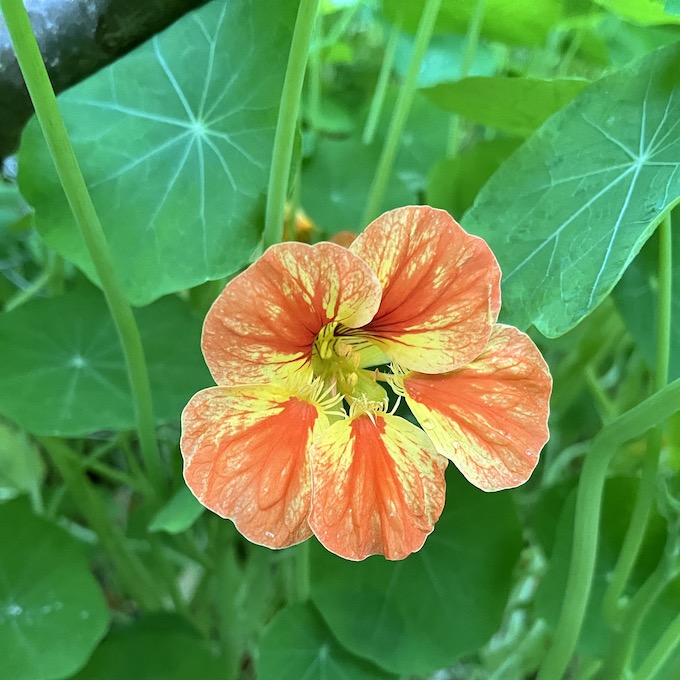
I couldn't decide which Nasturtium flower to show you so here's two: there are dozens of them and no two seem to be the same, although they come in all possible combinations of yellow, red and orange, maybe a bit of black trim. Pam and her watercolour art students absolutely adore nasturtiums as a painting subject, and as a gardener I do appreciate the way that nasturtiums suppress other weeds, but they do like to spread out and bully every other plant they come near. I cut them back every few days and they just merrily bounce back without a care in the world. They never complain, they just grow back each time.

We grow our Italian lavender in a pot and it likes it there. There's also a white-flowered type that Pam asked me to get, and it is slower off the mark and probably won't be in flower for another month or so.

One of the hardest flowers to photograph is this thing, a hellebore. That's because the flowers point down to the ground, and I'm too old to take photos lying on my back, so I hold up the flower's foliage with my hand, quickly take a snap and then edit out my finger from the photo. 


I'll finish off with two "panorama" shots of our small inner-city garden, just to give you a bit more context for what I have shown you already. To see the "pano" view, just double click on the photo itself and it will show the much wider shot (hopefully).


This first pano shows the left side of the garden looking out from the back of the house and its covered pergola. 


And this second pano is of the right side of the garden with lots of succulents in pots, more bloody nasturtiums trying to take over. The largish round white pot on the centre right is a native flannel flower bush that flowered beautifully last year and we are hoping will do so again this year too.

Finally, I actually have a couple more blog postings waiting to go. Our front garden is looking lovely but it has not worked out as I had intended, not at all. I'll fill you in on that bit of gardening fun next time.

Tuesday, November 21, 2023

Front garden makeover update


There's a lot to be said for rainy mornings. For one thing it means the gardener gets the morning off from hose-pointing duties, as Huey the rain god turns on the heavenly sprinklers for a few minutes.

And so it was this morning, but in addition to thanking Huey for the favour, I was reminded yet again that the best thing about rainy mornings is how nice gardens look when they are wet. 

This November morning I enjoyed the perfect type of rainy morning: showers. So it rains for a few minutes then it stops raining. That means you can go outside and not get wet but you can enjoy the garden, maybe even take a few photos of something that catches your eye. 

So here we are in Garden Amateur blog land, checking out the latest photos of our front garden makeover. Lots of unexpected flowers, lots of colour and lots of pleasing progress. 


In the foreground, the creeping thyme plants are spreading rapidly and joining up. It's hard to know how far apart to plant them, as "online research" only confuses you with all the options. Some say 60cm apart, others 80cm, a few say 100cm, the full metre. I chose 80cm, and as the plants are already joining up, I should have gone for the metre!


There are three varieties of creeping thyme in the garden. Of them, the "common" creeping thyme (8 plants) is flowering its head off very nicely, while the other two varieties are growing well but showing no signs of flowers. I'm happy to let the mystery be on that one.


By far the star of the show at the moment is the Australian native violets, Viola hederacea. These are remnants of the old front garden, where they thrived in the shade of the wattles and ferns. Impossible to dig out or control, they have merrily spread themselves throughout the new garden and are flowering so prettily. A very unscientific straw poll of comments by neighbours passing by agrees that the native violets look wonderfully pretty, and that the mauve creeping thyme flowers are the perfect complement to the native violets' white & purple blooms. I didn't plan it that way, honest. Just a happy accident.


Wait till the neighbours see the orange-blossomed dwarf gum tree spring into bloom this summer! The healthy little thing is covered in several of these missile clusters ready for launch. This is one of "Pam's plants" that are highlights in our garden. With certain plants she makes "I want one" style comments and I am happy to oblige. In the back garden Pam's plants include frangipanis, flannel flowers, Spanish moss galore and a white hydrangea – happily all doing well – and now out the front there's a dazzling dwarf gum tree to entertain passers-by. 

So that's it, the front garden makeover is looking great right now. The harsh reality of a hot and humid Sydney summer lies ahead, but right now in a warm, moist yet sunny spring in this lovely climate, gardening seems, dare I say it, almost easy.


Friday, September 24, 2021

Small change, big difference


These YouTube videos are making a lazy blogger of me!

Yesterday, for reasons unrelated to gardening (ie, I was changing where I parked my motorcycle in the backyard) I ended up moving my potted Thai lime tree from the spot it has occupied for the last five years to a new spot just four or five feet away.

And this morning, when I stepped out into the backyard I was taking in a much more colourful, flower-filled view of Garden Amateur Land than I have ever enjoyed before. The spring flowers no doubt help, but moving a "blocker" from the foreground has worked wonders.

And the only thing that prevents me from changing my name from Garden Amateur to The Lazy Garden Blogger is that I am too lazy to make the change right now. It's sunny, 27°C, light winds, perfect picnic weather, and a 30-second video is all I can muster the energy for right now. 

https://youtu.be/ihNpO2ohP0o


Monday, September 20, 2021

The bare and the beautiful


There is no time of day to compare to the mornings in our garden. As you stand at the back door and look out, the low morning sun appears in the far right corner of the north-facing property and steadily lights up every plant as it rises.

However, as an early riser who's often out there before the sunbeams appear, the truly best time to view it all is that gentle brief time between dawn and the moment the sun starts casting shadows. 

That soft, low morning light allows the many different greens and the subtle greys to do their version of glowing, before old shiny guts appears over the fence and starts bleaching the light for the rest of the day.

So, early this morning was the ideal time to attempt my next video of the garden, and my focus this time was on the bare beauty of our two frangipani trees. They're all just branches right now. It'll be another couple of weeks, early October, before the leaves appear, followed by the fragrant flowers in November.

So for this next attempt at a low budget, iPhone video production, I've learned my lesson and will only post a link to the YouTube video, all 1 minute 19 seconds of it.

Here's where you click and watch the show: https://youtu.be/L0MDdvFZGAE

Meanwhile, here's a few photos of what to expect later this spring, plus as a special bonus for language lovers, one of my favourite pieces of wordy trivia.

The 'big' tree grown from a cutting is the classic Sydney frangipani, the white one with the yellow centre. I love it.


The smaller tree, also grown from a cutting supplied by a local art studio where Pam teaches, is a much more tropical looking, colourful piece of confectionery. I've called it Frangipani 'Serendipity' because it has been such a happy discovery.


And now for my favourite piece of English language trivia. 'Serendipity' is an invented word, and we can almost trace it back to a specific day and date: January 28, 1754, in a letter written by Horace Walpole to a friend. Pictured above is the page from The Oxford English Dictionary's definition of Serendipity.

The word Serendip is the ancient Persian word for the beautiful island we know of today as Sri Lanka, and as Walpole explains in his letter, in the fairy tale 'The Three Princes of Serendip' the heroes were always making discoveries by accident, of things they were not in quest of. Happy accidental discoveries, if you will. And to describe that fortunate phenomenon, he invented the word 'serendipity'. 

What all this has to do with gardening is precisely nothing, other than for the fact that whenever I go out into the garden I don't always think about gardening.

Take yesterday morning as an example. There I was pulling out all the weeds growing around the base of my little tropical frangipani, and instead of contemplating the exacting business of pulling out weeds, I was thinking of dictionaries, writers, Sri Lanka and invented words. 

And before I knew it the drudgery of weeding was over and it was time for a cup of tea.


Thursday, September 2, 2021

A resounding shambles – sorry about the video links ...


Hi everyone

Apologies!

Just a short (for me) and apologetic posting to everyone who subscribes to my blog via email. Apparently lots of you have been getting the text, but instead of the videos there's just a huge black box with nothing in it.

That wasn't the plan!

So, to repeat the video postings of the previous two days for anyone interested in spending five minutes on YouTube looking at my guided tours of Garden Amateur land, here are the links, just as old-fashioned links to click on.

Handy hint: turn the volume of the sound up!

Here's a link to the first one (west side of the garden)

And here's a link to the second one (east side)


Wednesday, September 1, 2021

First day of spring: a video on the other half of our garden


After showing you briefly around the western half of our small Sydney garden in the video I posted yesterday – the last day of winter – today I have another little video showing you the highlights of the eastern half of Garden Amateur land on this, the first day of spring.


Tuesday, August 31, 2021

And now for something completely different: a short video

 Late this afternoon I decided to do a short experimental video, wandering around part of our garden.

And so here is "And now for something completely different" a short walk around one part of our tiny garden on August 31, the last day of winter.


Sunday, August 29, 2021

Five garden jobs you can do this spring


How's that gardening motivation level going? Out of 10? Locked down by covid and nothing to do, lovely garden out there and you're still a motivational "1" out of 10?

If you can get yourself all the way up to a "3" or better, doing that first gardening job might just propel you to the dizzy heights of 5s or 6s. So here's a short "to-do" list just in case the spring weather starts getting to the gardener in you.


Plant some spuds

Spring is the ideal time to get some spuds planted. The good thing is that specialist spud suppliers have been taking orders online for many years, so that's how to get started.


You can of course grow spuds in the ground, but a big pot works fine, so does a large "grow bag" that has holes included to help water drain away.

To get started on your 2021 Spud Mania, try these links to well known suppliers:

Garden Express:  https://www.gardenexpress.com.au/shop/edible-produce/certified-seed-potatoes/


Sow some seeds

Spring is the ideal time to sow seeds of so many delicious crops, such as all salad greens, tomatoes, shallots, basil, silver beet, carrots, eggplant, cucumbers, zucchini — there are countless others — and the good news if you are locked down is that major supermarkets often stock the seeds you are looking for. I bought my Yates seeds for these babies pictured below at my local Woolies supermarket. 

On the left are some shallot seedlings enjoying the morning sun, while on the right are seedlings of "mesclun" salad greens, which is a mixture of different greens. After sowing the seeds the fastest ones – the rocket (or arugula) – came up in just four days. The slowies took two weeks. The shallot seedlings came up in 7 days, so on each and every morning I was out there misting the seedling trays with water, there was something new coming up.

After about three weeks the seedlings are ready for more sunshine, so in my garden a lovely half-way house is under the dappled shade of my potted Thai lime tree. The seedlings get a bit of direct sun on them during the day but big brother lime tree shades them most of the time. In two weeks from now, they'll all be much bigger and potted up in their troughs in full sun, ready to roar away as spring warms up.


Sowing seeds is a bit hit and miss sometimes, but I find I get 10 hits to every miss, so give it a go, the odds of succeeding are really good.

Salad greens like mesclun, rocket, lettuce etc are very reliable and worth a try.

Basil is a good bet once the weather becomes truly warm.

If you're nervous about tomatoes give cherry tomatoes a try.

And if you want to fire up your lifestyle, chillies are so much fun to grow from seed. So many types and, given you probably only need one or two plants of each variety to knock your socks off, you're bound to have lots of success.


Go potty

Spring is a good time to do a bit of repotting. Here's one simple job I did this week, part of my succulent and cactus patch renovation.

God knows how many years ago, these three were tiny, cute midgets in baby pots that could sit on a windowsill. So I put all three in the one pot, put it out in the garden and forgot about them – and my, haven't they grown. Time for an upgrade in accommodation. 


Half an hour later each plant has its own home, and if I manage to neglect them for the next decade they'll probably need an upgrade in size by then. Without repotting, each plant would have crowded the other and all three would have suffered and probably died in the end.
This way, all three will just keep on growing.

So if you have a single plant that has grown too big for its pot, or you have too many plants in the one container, do everyone a favour and remove all the plants from the pots, upgrade their accommodation, and they'll be with you for many years to come.


Renovate your compost bin

Smelly compost? Open the lid and a cloud of little flies swarms out? Chances are your compost is too wet. What it needs is more dry matter to balance things out. And for me, the easiest source of dry matter is my big bag of sugar cane mulch. 


So I've been adding a few generous handfuls of mulch to my tumbler compost bin, giving the lot a twirl so it all mixes up nicely, then adding some more mulch a few days later. 

If, like me, your kitchen fruit and vegie scraps bin is the main source of new materials for your compost bin, your compost bin is in danger of being too wet. When that happens composting slows down and things can get smelly. Add some dry matter (raked up autumn leaves if you have any), but if you have a bag of mulch, it's the easiest and quickest way to get your compost bin back in business. 


Feed everything!

Spring is fertilising time, so get out there and do it. Doesn't matter what you use, usually, but there are so many specialist types of fertiliser to choose from it's easy to become overwhelmed with choice. 

The only plants you need to be extra-careful with are natives, and they definitely need specialist native-friendly food that won't harm them but will feed them. The good news is there are many native friendly plant foods around now.

The best rule to follow, apart from reading the instructions on the packs, is that it is much much better to under-fertilise than overdo it. More is not better with fertiliser. So treat the maker's recommended dosages as the "maximum" dose at all times, and there's nothing wrong with lighter, half-dosage feeds, either.

To keep things simple I mostly just use a liquid food (mixed up in a watering can) for all my edibles. Leading brands such as Dynamic Lifter, PowerFeed, Charlie Carp all do the same kind of job, and there are several others in the same category. In the growing season (ie, now) I liquid feed crops once a fortnight.

For most of my potted plants I use slow-release fertilisers, brands such as Osmocote and PowerFeed leading the field. These are almost "set-and-forget" in that you apply the little pellets, then you don't need to re-apply for months after that. Read the instructions and you'll see that some last 3 months, others 6 months. That's about it.

And for general garden use and feeding citrus trees I use organic-based pellets such as Dynamic Lifter. The good thing about chicken poo style fertilisers and other organic-based products is that they also feed everything that lives in the soil, not just the plants.

Compost is a fabulous fertiliser for feeding the whole of the soil, so is blood and bone. Seaweed is a superb soil health tonic too. 

All the pure organic, or organic-based fertilisers are the best long-term option for improving the overall health of your garden soil. The benefits don't happen overnight, but over the years they are the outstanding option.


So get out in the spring sunshine, plant some crops, visit your growing babies each day to care for them, then start harvesting the organic home-grown goodness that you've raised yourself. It's a satisfying feeling in a trying time. Give it a try.


Friday, August 27, 2021

Gladiator V Onion Weed

Pictured below is nothing less than a disgrace. A weedy disgrace, a total temporary victory by the evil onion weed.

And so last week I decided I had to do battle with this almost invincible foe, or die in the attempt. More to the point in my current state of health, I didn't so much fear death by onion weed than a relapse in my recovery from the broken foot/wrecked ankle. Neither happened, I'm still here. I won (kind of), and here's what happened in the Coliseum Match of Gladiator V Onion Weed.

Neglect onion weed for a few weeks so it gets a foothold in your garden, then wait for a thoroughly wet week or so of rain and suddenly you have this appalling problem to deal with.

And this is how it looked about three hours later. Every plant removed from the patch, plus half a wheelie bin full of onion weed. And as well as getting the big strappy leafed onion weeds with the bulbs on the bottom, of course there are approximately one million baby bulblets left behind, waiting for their chance to make my life a misery. I managed so sift out a few hundred thousand bulblets, but have no illusions about the task ahead. All the white dots you can see on the soil surface are the remnants of my decorative pebble mulch that has never managed to suppress a single weed in the last decade. Pretty, but useless ... 

Apart from leaving in place one large Crassula shrub and a pretty Kalanchoe 'Copper Spoons', I pulled every other succulent out of the ground. This trug full of haworthias isn't all of them by any stretch. These things multiply almost as well as onion weeds.

Little guys like these sempervivums somehow survived the smothering weeds, but from now on they are going to be growing in their own comfy pots.

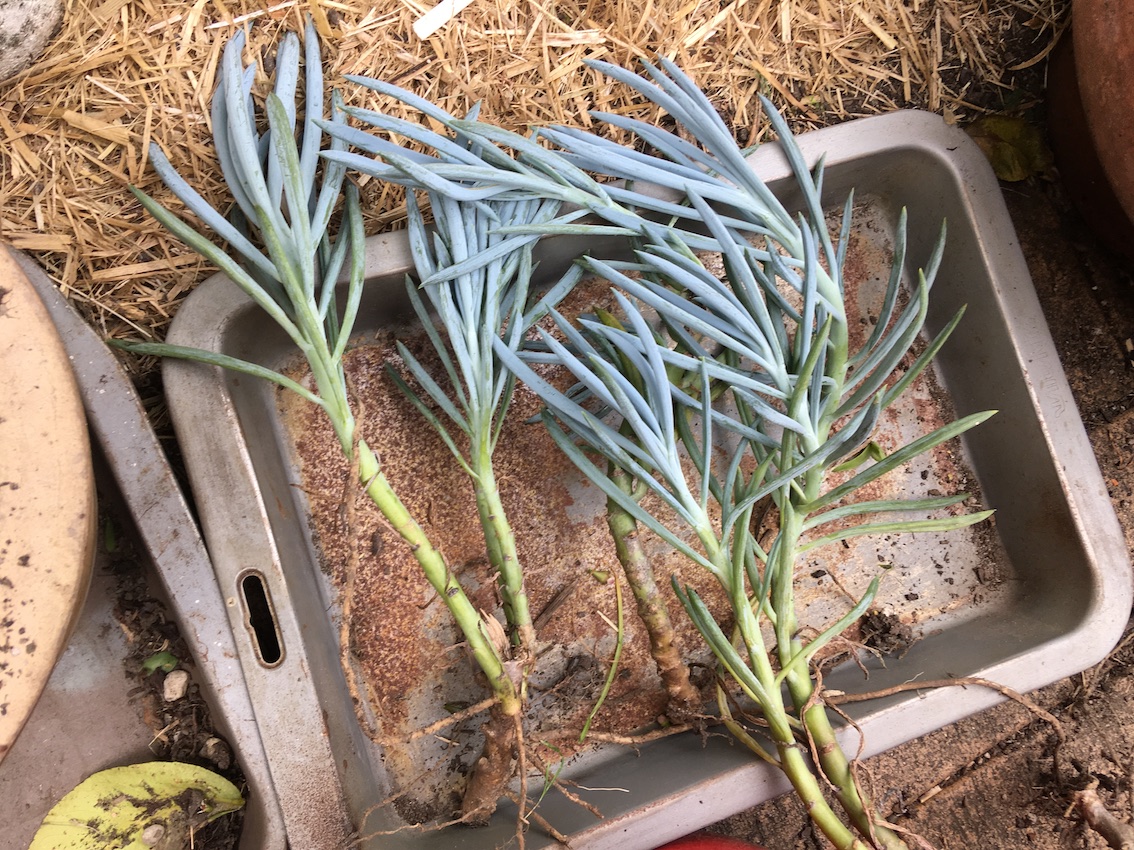
Some of these Senecio 'Chalk Sticks' will be popped into pots, and a few put back in the ground. Lovely grey-blue colour.

I don't look like much of a Gladiator, but it was a torrid battle that lasted most of the day in the end. One of the things I like about digging soil is coming across all the worms and other little critters who call this soil home. I suspect they were all very upset by my presence. 

So the brilliant new plan is to grow many more succulents in pots, and only the very hardiest things (like those multiplying haworthias) in the ground. I've alway grown a small selection of cacti in pots, and the succulents make perfect company for them.

I used up every spare pot I could find in no time. The best ones for growing succulents are the "wide and shallow" ones. And I used up all my special Cacti & Succulent potting mix in no time, and most of these are now growing in good old ordinary potting mix, which will probably suit them just fine anyway (but it was all I had in the shed, so I couldn't be fussy).

As mentioned earlier, I have left the established 'Copper Spoons' shrub where it is, in the ground. Love the coppery colour of the new foliage. Every now and then a few leaves that fall off soon sprout into new plants on the ground, without any help from me.

Years ago when I first started this blog I made it a mission to find out the actual botanical names of my succulents, and it was no easy task. I tried hard but did get several wrong and was then corrected by succulent specialists who got in contact to set me straight. I am almost back where I started, though, as I now have half a dozen succulents, including this handsome one, whose name I don't know. I call him 'Pagoda guy'.

Since I renovated the succulent patch I've only been disappointed that there's still no sign of the first onion weed shoot popping up through the soil. I'm keeping a close watch and heaven help that first sprout! However, the real test will be whether I can keep up the vigilance if warm spring and summer weather gets wet. That's when the onion weed will really get cracking and try to take over again.


Thursday, August 26, 2021

Shade-loving flowers on song


A rare event is happening out there in our garden this week. All the shade-loving flowering plants are singing from the same song sheet: they're all flowering at the same time, and it's never happened before.

You'd think if someone said to you "here's three different spring-flowering, shade-loving plants for you to grow" you'd naturally enough picture all three of them in glorious bloom together: in this case a golden orange, a pale yellow and a dusky pink.

Yet over the years I've had these three growing in the same spot, the best I've managed is two at the same time, with the third missing in action. Not this year! The full orchestra is on song, and it's looking lovely.

This is Scadoxus puniceus, otherwise known as the paintbrush lily or the Natal paintbrush, and you'd be right in guessing that it's originally from Natal and other provinces in South Africa. I'm just pleased to get one flower this year, as earlier the year while my ankle was in plaster we got in some boys to cut back hedges etc, and they stomped all over the Scadoxus bulbs and left them poking sideways and looking the worse for wear — such a shame. I replanted them when I was able to in early winter, but they don't like being disturbed, and I was fearful that none might flower. There's lots of babies, and at least I have 14 bulbs growing now. Four are 'adult' sized, and the other 10 are bubs which might take another 4-5 years to flower. So there's a good reason to live right there! Imagine 14 Scadoxus in flower — can't wait till I hit my mid 70s! 

This pink person is Velthemia bracteata, and as well as producing dusky pink blooms it has the added bonus of always reminding me of our good friends John and Liz, who gave us three bulbs, all of which are flowering nicely. And it's another South African, from the Cape Province and elsewhere.

Rounding out our trio of spring flowers is, very suitably, another South African shade-lover, Clivia miniata. This is better known to most people as an orange-flowered, strappy-leaved clump-forming perennial, but at a flower and garden show several years ago I came across a guy with a clivia stand and had to buy these yellow ones, just to be different (who, me?). The clumps are slowly spreading, so I am hoping that coming years will be even yellower.

Finally, here the view from the clivia end of the patch. All three plants are growing in the shade of our frangipani tree, which is bare of foliage right now. You can see the Scadoxus baby plants and their upright clumps of leaves growing happily around the big flowering adult plant. On the left, barely visible, is a tall murraya hedge that shades the plants from the northern sun, so it's shady in here most of the year. 

This 'South African' part of the garden is not in deep, dull shade, though. In fact I love to stop here in summer when I am filling up the birdbath with fresh water and have a look inside this tiny 2m x 2m shady zone. Under the full foliage of the frangipani it's like a peaceful little shady forest with bright green light, hopefully somewhere these shade-lovers can grow and thrive for many years to come.

Last but not least, I love this little patch of my garden because of the memories it conjurs. As I mentioned earlier, when I see the Velthemia I think of John and Liz, who live almost nearby in Sydney but under these covid restrictions, they're too far away for us to get together.

And when I see the Scadoxus I am reminded of a lovely co-worker, Geoffrey, an expert horticulturist who just bought in a bag of scadoxus bulbs one day and left them on my desk, with a very Geoffrey "see me" note attached. After expert tips on where and how to plant them, they have thrived. I haven't seen Geoffrey for quite a few years now, but I have thought of him often.

And when I look at my little South African patch I think of our dear friend Amanda, who's a whole border crossing away in Kyneton, Victoria. She's a mad keen gardener too, and I'm just hoping that she'll see this little patch of South Africa and think of us, just as we often think of her.


Tuesday, August 24, 2021

It's citrus feeding time, folks!

Don't you just love it when a plan works? I do. Last week, looking at the weather forecast, I spotted the magic word "rain" predicted for Tuesday August 24. And Huey the Rain God didn't let us down. The rain started late yesterday and it's still raining. 

A creature of gardening habits, I knew that the weeks spanning the end of August and the beginning of September are the ideal time to fertilise my citrus trees, so it was always at the top of my "to-do" list. All I needed was to wait for a good day of rain to come along, because that way the rain will water in the many handfuls of fertiliser I scattered around my Eureka lemon, Tahitian lime and Thai Makrut lime trees.

While I was at it and had plenty of fertiliser to spare, I scattered it around all manner of other plants that could do with a boost in spring, but the main game was feeding citrus. If you have a lemon, lime or other citrus tree in your garden, try to get out there over the next few days (showers are forecast through to the weekend) and your citrus trees will reward you with bumper crops.

I love a shiny footpath and water dripping off foliage. It means I have a day off from watering the garden, and I can watch the rain do the last stage of fertilising for me.


Both the lemon tree (pictured) and the lime are covered in flower buds right now, so a big feed is all they need to turn flowers into fruit.

The Eureka lemon is the ideal variety for Sydney gardens. In cooler climates the Lisbon variety is preferred, while the Meyer lemon is great in pots in all climates.

As is the Tahitian lime the ideal one for Sydney.

And this wrinkled weirdo is the Thai Makrut lime (also called the Kaffir lime), whose culinary value lies in the grated rind of the fruit (it produces hardly any juice), and the wonderfully aromatic foliage, which I toss into all sorts of South-East Asian curries and stir fries. The Thai lime is a great choice for pots, too, because it's naturally quite small.

This is my preferred citrus food not only because it's organic-based and the smelly aromas don't last long. It just happened to be what I had in the shed. 

Right now it's hard for locked-down gardeners everywhere to visit one of those big Hardware superbarns such as Bunnings. I actually bought my Dynamic Lifter a while back at my local Woolworths Supermarket, so try there if you don't have any in your garden shed at the moment.

There's also a small but well run local garden centre which I support by paying a bit more for the mulch, fertiliser, plants and seeds they stock, and it's still open. So maybe there's a small garden centre near you that is still open, or at least open for a click-and-collect shopping expedition?

In these difficult times, it doesn't really matter what you feed you citrus trees with. Almost any fertiliser I can think of is better than no fertiliser at all. If it says something about "fruit and flowers" then this is the good stuff, but even if the fertiliser just says "general purpose" you are in the citrus-feeding business.

Try to read the instructions on the pack before you get started. If you do your fertilising now, while the ground is wet and more showers are forecast, all you need to do is wait for a break in the rain, get out there like a mad person, laugh at the sky if the neighbours are watching, and scatter the fertiliser around the base of the tree. 

Don't direct the fertiliser at the tree trunk itself — there's no roots there. Instead, spread it out under the whole canopy of the tree, and especially around the ground directly below the outer edge of the canopy (that's called the 'dripline', because that's where most of the rainwater drips onto the ground).

The dripline area is where a healthy tree has oodles of roots. Direct your fertiliser there and let Huey the Rain God do the rest.

And after you've done the job and the poor locked-down neighbours with nothing to do are still watching, permit yourself to send one last chuckle skywards. All your gardening mates will know exactly how you feel.


Monday, August 23, 2021

Pam's plants

For those of you new to this blog, a little bit of recent history to start with. Late last year I stupidly broke my foot and in the process damaged a bunch of tendons and ligaments in my ankle, and so I was sidelined from gardening for months.

With my leg in a cast and reduced to camping out on our living room sofa for weeks on end, my intrepid wife Pammy took over garden maintenance duties with a dedication and competence that, quite frankly, surprised and delighted me at the same time. She's a real gardener, and a good one!

Pam has always been deeply involved in our garden, but for the first 30 years here it was largely a "hands off" role. I was the one covered in dirt, pulling the weeds and spreading the fertiliser. She was the one who spotted pests and other problems, suggested new plantings, came up with the idea for the complete re-design of the garden about 15 years ago, and turned so many details of our garden into beautiful paintings.

Until Covid struck, our garden had been the venue for many of Pam's art classes, and even after covid limited the numbers of students who could attend, the garden still provided a really lovely venue for small watercolour art classes.

So, that's the background to who this "Pam" of today's topic, "Pam's plants", is. Ever since we moved here Pam has taken a special interest in certain plants. Sometimes she has straight-out suggested we buy something. Other times she just comes home with a plant in a pot and says "I have an idea where this might go". 

And even if I bought a certain plant, planted it and cared for it, at some time in its life it became one of Pam's plants. 

So, on with some examples of all these stories of "Pam's plants".

Thank goodness this person started flowering just this morning, right on time for this blog posting. This is Convolvulus cneorum, and around the middle of last year, Pam came to me with a newspaper advertisement from Flower Power nursery, with the photo of Convolvulus cneorum circled, and asked "can we buy this?". 

Given it was in the middle of a not very strict set of covid restrictions on shopping etc, I knew this wasn't an ordinary request. Bought it home, planted it in a sunny spot, and it then proceeded to flower its head off with these charmingly simple white disc flowers with a yellow splash in the centre. 

Then it did the unexpected and faded, wilted, looked a bit sick, sickened a bit more, wilted a touch more ... and the conversation had to be had. Do you think it will survive? Let's give it another week or two. It was never going to be my decision to give up on it. It was one of Pam's plants ...

Thank goodness we gave it a reprieve, as it bounced back in autumn, kept on growing a bit in winter in a weird, leggy kind of way, and now in early spring it's flowering. Yay! 


Pam recently brought this dazzler home from a local florist's shop, saying that our main frangipani tree, bare of foliage and flowers in mid-winter, was a good spot for a hanging basket of flowering Kalanchoe. It's the first thing you see when you enter the garden.

Pam has always loved nasturtiums and I've largely resisted growing them, because they spread and, well ... basically they are pleasant looking weeds. But as her reward for being such a great gardener during my long convalescence, I bought her a packet of nasturtium seeds, and said "you can plant these and let's see what happens". Well, nasturtiums happened, that's what! They do look nice with raindrops on them in the morning.

And the flowers produced by our little seed packets come in quite a variety, and they are a favourite subject for Pam's watercolour art students too. They love wandering out into the garden, picking a flower, then doing a painting of it. Good for the soul, painting.

Ever since Pam and I visited the United States in 2011, she has been in love with Spanish moss. All through the Deep South you'd see masses of this ghostly grey "air plant" draped over the branches of giant live oak trees. The streets of Savannah, Georgia, are one of the most unforgettable things I have ever seen on my travels. We came home in love with a plant, and it's been in our garden ever since.

The flowers of Spanish moss are so tiny, about a quarter of an inch across (that's about 5mm) and so Pam's gorgeously detailed painting of a Spanish moss bloom celebrates our garden's tiniest flower by allowing you a glimpse into its small but perfectly formed beauty. Time for a shameless plug, but if you want to see more of Pam's work, pop over to Instagram where she is at @pamelahorsnellartist

Bending the rules slightly here, as our main frangipani tree has no leaves, no flowers and is still asleep. But it's the biggest of Pam's plants in our garden. She loves this frangipani ...

... and she also adores this colourful frangi (also bare in winter) that she brought home from the nearby art studio, called the Bakehouse Studio, where she teaches painting. The parent of this tree is in the backyard at the Bakehouse Studio, so when they trimmed it back one year they turned them into lovely big cuttings which they sold to raise funds for a local school. Pam had always had her eye on this frangipani tree, so she brought it home. 

Like the frangipani trees, our New South Wales Christmas bush is not in flower, but it is definitely one of Pam's plants. This poor thing has been having a great time in its pot for the last few years, but it took ages to find a spot where it was truly happy, and every time it was unhappy, where pests attacked it, or the tree itself just looked sick, Pam was onto me. "It's not happy, what's wrong? Let's move it somewhere else? Is that pot big enough? She's taken a special interest in its welfare, and it's rewarding her with better and better colour shows each year.

Finally, one of the most recent additions to the roster of Pam's plants is this gorgeous, fragrant jungle of lemon grass. When we planted it, it wasn't an official "Pam plant". It just grew like mad and every now and then we'd cut a stalk when the Asian recipe we were cooking called for lemon grass stalks, chopped. 

Then, late last year, when my leg was in a cast, I was sidelined and Pam was looking after the garden, the lemon grass needed cutting back. It looked wonderful though, sending up super tall grassy flower spikes high into the air. But to keep the lemon grass clump down to a manageable size and keep it producing those juicy stalks, it needed cutting back. "I guess we could get someone in to do it" I foolishly suggested. "Nonsense, what do you have to do?"  

And that's when the lemon grass became Pam's plant. After describing what was involved in cutting back the big, tall, unruly clump of tropical grass, I thought I had put Pam off the idea of doing it herself. Then one morning I could hear telltale sounds coming from the garden. Clip, snip, clip clip. Foliage rustling. More clipping ... she was in there! The clump was a decent size, made up of three plants. It'd be no surprise if a tiger sprang out of the foliage in a surprise manoeuvre.

But in no time at all Pam had conquered the lemon grass clump, reducing the jungle from six feet tall down to a clump of obedient 12-inch stumps.

That photo of the lemon grass flower heads was taken this morning. I'm almost of a mind to ask Pam if, come October, when it's time to cut it back again, would Pam like to do the honours?

I'm afraid those days are over. She has proven that there's no job she can't tackle in the garden. It's just that with a willing fool standing next to her who's keen as mustard to get stuck into all the gardening jobs, why would she?

No, we're back to our happy zone. Me covered in dirt, her keeping an eye on things.