Showing posts with label chives. Show all posts

Wednesday, September 15, 2021

What seeds have taught me about patience


One very strange thing I haven't been doing lately is visiting gardening centres. Prior to all this covid disruption, you'd probably find me browsing through a garden centre at least once a week. They were right up there with bookshops for me: regular haunts. But that was back then, and I haven't been to a bookshop for quite some time, either.

So, instead of picking up a punnet of seedlings at the local garden centre, for the last few weeks I've either been sorting through my stash of seed packets, searching the small section devoted to seeds at my local supermarket, or — by far the best fun of all — I've been browsing seed catalogues online, placing orders, then waiting for our poor overworked Postie to deliver me the goodies.

Another small padded envelope of seeds arrived in the mail today, and so I thought it's about time to share with you "What seeds have taught me about patience". It's not all good news, but it isn't a disaster story, either. 

On with the slide show.


I love the way coriander seeds hang around on top of the baby leaves until the very last moment. It looks like the baby plants are telling the seeds to "buzz off, now scram!"
It's a tiny bit late in the season for coriander — I normally start sowing seeds in autumn — but this will be my last batch for 2021. They have just a couple of months to grow into lovely leafy herbs before summer comes on. O
nce things get seriously warm they go berserk, become seedy in no time, and the leafy herb I love is no more.

I only sowed these basil seeds last Monday, and they're up as fast as those other legendary quick sprouters, rocket. I'm looking for a crowded pot of little plants that will look very photogenic for a few weeks and supply lots of leaves for tossing into the mix with tomatoes, especially. What a team!

I'm not fussy about where/who I get my seeds from, and my seed tin stash has all major and minor companies represented.

These English spinach seedlings came up only a day after the basil, and it's a good thing they're making a fast start. They're another crop which does better in the autumn and winter months, but I've got them in a partly shaded spot to avoid the heat, and I plan to fertilise the daylights out of them to make them grow faster. If we get a good crop, there's nothing Pammy likes more than a Japanese style Gomayagochi spinach salad with her grilled Teriyaki salmon. Home-grown spinach flavour here we come.

Once you get addicted to growing plants from seed, as well as actually planting some of the seeds (eg, the spinach, silver beet and spring onions in the top row) you also end up buying packets of seeds in a "seemed like a good idea at the time" kind of way. I fully intend to grow leeks, lettuce and radish some time soon, I hope. No reason why not, really ...

Here's one of those lessons in patience that seeds have taught me. Usually I am dead lazy about growing chives. Every winter my pots of chives turn into dense, unhappy clumps that turn yellow and look crook. Always a glutton for punishment, I have tried de-potting the clump, diving up the plants and replanting them in fresh mix, and the results have never been all that great. So most years I just buy a fresh punnet of little chives, plant them in a pot and they zoom away! This time, I decided to do it with seeds, and what do you know? (See below) ... 

It takes 14-21 days for the seed to sprout, and this pot took all 21 days to sprout (that was all of July). Now, 6 weeks later, we're in business snipping chives to go into Pammy's scrambled eggs on Sunday morning. But the lesson I have to share with slow-sprouting seeds is to know this in advance, plan well ahead, and try to see the year in three-month-long blocks of time. Impatient "days and weeks" thinking is just too hurried. If you grow chives from seed, think "third quarter of the year" as chive time.

Much more fun, quicker and prettier to look at, the wonderful world of lettuce is a great place for beginners to get started with seeds. There's a zillion varieties to choose from, especially when you start shopping online, and usually lettuce will sprout for you quite quickly.

I've been growing spring onions/scallions/shallots (call them what you will) from seed for several years now. My problem is that I hate wastage, and buying just one punnet of seedlings gives me about three times more seedlings than I have space for them, so I raise small batches from seed each time I start a crop. I cook with them all the time, adding them to salads and stir-fries, as well as using them as a mildly oniony substitute when I don't have any onions at hand. And that classic Chinese ginger and shallot dipping sauce for poached chicken is just heaven on a plate. I miss Yum Cha!

This is what arrived in the mail today, from my favourite online seed supplier, Eden Seeds. Like all the good quality specialists they have a wide range to choose from, and their customer service and delivery speed is reliably very good. This time I succumbed to the lure of two very pretty loose leaf lettuce, and a packet of the hard-to-find, tricky-to-grow and finely flavoured herb, chervil. I've been banging on for years about how good chervil is and so far I think I have convinced no-one. But Pammy loves chervil too, and that's all I need to know to enjoy its flavour. Its lightly aniseedy delicacy is superb with mild-tasting vegies such as zucchini and squash. Transforms them from bland to beautiful.

As well as being a sucker for lettuce varieties in seed catalogues, I am also very susceptible to limited edition tins of biscuits or other products on supermarket shelves. My shed has a goodly number of "collectable" supermarket tins filled with glues, nuts & bolts, and seed packets. All the cricket heroes on this Weet-Bix tin have long retired but this tin has aged nicely, with almost all the colours fading to a bluey-grey, as if there has been a printing mistake at the factory. Inside that tin is a cornucopia of seed packets that is constantly being added to ... more Aladdin's tin than Aladdin's cave.

Last but not least in the slide show is confirmation that not everything in that Weet-Bix tin is an edible. I know that cosmos is a bit weedy, so I have planted a row of cosmos seeds at the back of my Big Red geranium patch. So the plan is this summer the cosmos will add cheery yellow and orange flowers towering over the scrambling concourse of red geraniums, and then after the cosmos season has ended, the Battle Royal will ensue as weedy cosmos grapples with ever-spreading geraniums.

So, even though growing everything this year from seed is like gardening in slow motion, time ticks over steadily. It's spooky, like it has something to do with the position of the sun in the sky or something.

If you are impatient, don't even think about growing chives, chervil or parsley from seed. They're seeds of patience, for the long-term planners.

If you are impatient, get out there and start sprinkling around the basil seeds, the spinach, the lettuce, the rocket. There'll be something happening before one week has passed. 

I'm somewhere in between when it comes to patience. I do have some patience, but not a lot. So I do love it when seeds come up fast.

But I have learned that there's a deep satisfaction when real patience, the long-waiting, not-much-happening-yet kind of patience is rewarded. It's as if time has become an old friend with whom I am strolling through the year, hand-in-hand. 


Saturday, September 26, 2020

Sowing seeds to ease the covid boredom


First up, a big, warm THANK YOU everyone for all your lovely messages saying things like “welcome back” “wondered where you got to” “was thinking of you only the other day” etc etc. (Not one saying "oh no, he's back"). You’re such nice people! 

On with the show.

Last posting I mentioned that I was going to do something about growing things from seed, because that’s been my main activity ever since the COVID-19 pandemic turned the whole world upside down early this year.

Like all other sensible people, I’ve been avoiding crowded spaces wherever possible. I do my supermarket shopping (mask on!) in the early morning hours, when it's fairly empty, and I haven’t been to a major gardening centre for more than six months — and yet I’ve been very busy growing crops of herbs, vegies and flowers during all this time.

The reason for that is simple: seeds. I’ve bought some of the seeds I need at the supermarket, and others that I can’t find there I have bought online.

So what have I been raising from seed?

Mesclun: this is just a mix of different salad greens, including several varieties of lettuce, plus rocket, lamb’s lettuce, a small Asian green like tatsoi, plus sharper tasting mizuna and red radicchio. Each seed supplier has its own mesclun mix. I'm growing mesclun in long, deep planter troughs that edge our outdoor entertaining area.

Coriander: one big pot is all I need. I sowed a batch in April, then when it started to tire in July, I sowed another batch.

Chives: this is the first time I've sown chives from seed, and it's worked so well I might do it this way every year. My chives pot always loses the will to live in midwinter, when it becomes a solid clump of pot-bound roots in its pot. In previous years I've either divided up the clump and replanted the best ones, or I've taken the lazy route and just bought another punnet of seedlings. From now on, it's seeds, ho!

Parsley: this is a pain to do, as parsley can take 3-4 weeks for the seeds to sprout, but it's a good reliable way to rejuvenate the parsley patch if you get started in late winter.

Poppies: usually I buy seedlings of Iceland poppies to grow for Pammy, but this year I started them off from seed a few months ago, and they're blooming nicely now. Nowhere near as easy and convenient as buying seedlings in late April, but not difficult to grow from seed, either.

Sweet peas: after last year's success with my first sowing of seed, I've expanded the size of the sweet pea patch and moved it to a sunnier spot. So far, so good.

Shallots (green onions): the thing I hate about buying punnets of shallot seedlings from garden centres is that even one punnet has too many seedlings, so I've got into the routine of sowing a small number of seeds every few weeks to keep production going. During the pandemic lockdown my culinary adventures have included lots of stir-fries, and learning all sorts of noodle dishes, and you end up getting through a lot of shallots when you start cooking a lot of Asian food.


Sowing seeds in pots

Sowing seed is easy in pots using my ‘scatter and cover’ method. Here's how I do it (I'm sowing coriander seeds, simply because they are pale and big, so you can actually see them in the photos). The basic principles apply to all sorts of other seeds (ie, chives, shallots, basil, parsley, chillies, tomatoes, lettuce, mesclun).

First up I smooth out a bed of fresh potting mix so it is flat and even, and reaches almost near the top of the trough, but not quite. 

Then I scatter the seed from the packet as evenly as I can, making sure to err on the side of scattering too many seeds, rather than too few (I can thin out the crop a few weeks later on). 

Here's a cool trick ... read the instructions! Seed packets will tell you how "deep" to sow the seeds. In this case, with coriander, it's 5mm deep.

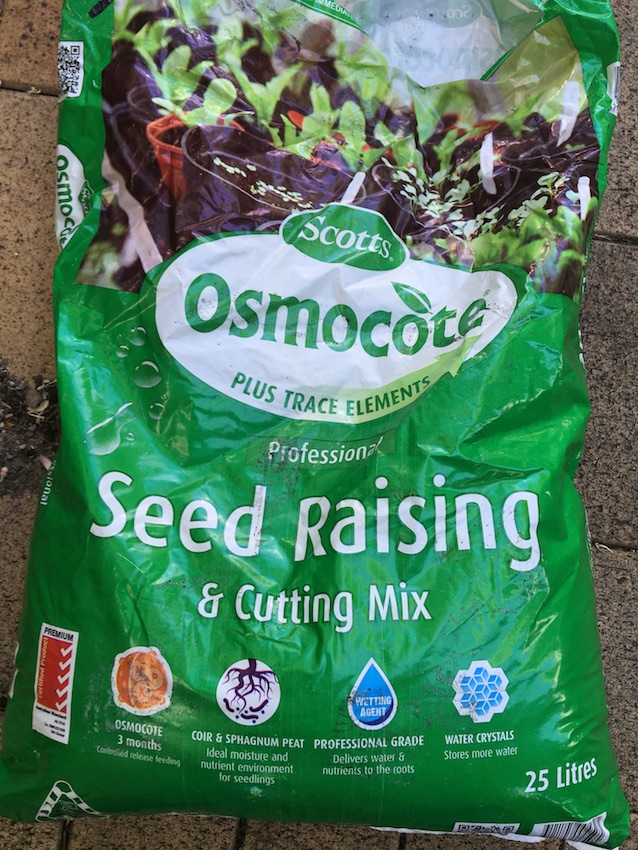
So, I scatter seed-raising mix* fairly thinly over the seeds, about 5mm deep in this case (without getting too anxious about how accurate you are). But do make sure it's enough to cover the seeds so you can’t see them anymore. 

* (By the way, for people outside Australia, seed-raising mix is a very fine-grained potting mix. Maybe a cuttings or propagation mix is the closest thing if you can’t find seed-raising mix.) 

Finally I use a mist spray setting on my fancy multi-setting hose nozzle (that I bought in an Asian Bargain Shop for $8, and which has worked well for years) to dampen the soil well but not drench it messily.


I mist the pot every morning until the seeds sprout. And if I can manage it, I like to keep pots out of the hot sun in a shaded area until they sprout, then expose the pots to more sun as the plants grow. Sometimes, with big heavy troughs, that isn't possible, so I just make sure to keep seedlings exposed to full sun well watered at all times.


Here's how the mesclun trough looked like after about two weeks, with lots of babies coming up. With a mesclun mix the fast-sprouting seeds like rocket and mizuna are up within four days. Some of the other seeds can take several days more to appear, sometimes up to two weeks. 

Coriander grows at a more leisurely rate, taking about 10-12 days to appear, but it looks lovely when fully underway, like this pot full of babies that are probably about a month old.

With my first trough of mesclun I learned that I needed to keep a close eye on which plants are bullying the others and grabbing all the space, and that meant I had to occasionally pull out an over-eager bully plant so the tiddlers lower down could get going.

After a few weeks of sorting out the squabbles between competing plant egos, they all settled down to make the most picturesque and delicious mixed leaf salads. A mature pot of mesclun is so photogenic, and if you just use a pair of scissors to give the pot a light haircut you’ll have a nice mixed greens salad ready to go, with replacement leaves growing back rapidly in the next few days. Regular (fortnightly) liquid feeds keep the production humming along.


The alternative to mesclun, and also worth growing, is simply to grow several different lettuce varieties in the one pot. Though nice to look at and easier to manage, what a mixed lettuce salad lacks is a bit of that tasty pepper and spice in the leafy mix that you get with mesclun.

Managing the competition

The one trick to remember with my ‘scatter and cover’ method is that it's likely that you will have sown too many seeds, so you will at some stage (say, in the third or fourth week after sowing) have to play at being Charles Darwin and pull out several weaker plants so there is enough room for the healthy ones to grow on. Don't be squeamish, just imagine you are the David Attenborough of salad greens, observing that only the strong survive while you watch on, fascinated.

Breaking news ...

I am also growing basil from seed, just because I don’t want to visit garden centres to buy seedlings, not because basil doesn’t grow well from seedlings. 

All the seeds came up beautifully, they looked as cute as fat babies, but a few nights back the slugs ate everything. It was my fault — I had sat the basil seedling pot up on top of the soil under a potted lime tree, so it got nice dappled shade on a warm day, and I forgot to move it back to a safer space that evening. I found a bunch of slugs living under the rim of the lime tree pot, sneaky slimy seedling munchers ...

There was nothing left, just pathetic little white stumps where leaflets used to be. Such is life, and gardening, so start again …


Saturday, September 12, 2015

Salad season


Tonight's mixed home-grown garden salad, but before we
get to that bit ...

I can't begin to tell you how much I enjoy Saturday mornings, especially ones as lovely as today's, where Sydney is working its way into a perfect, sunny spring day.

The shopping is great, for one thing. It's a 15-minute walk along bustling Illawarra Road to Banana Joes, the fruit, vegie and grocery hub to thousands of locals. Today I lashed out and paid 10 bucks for a kilo of fresh broad beans.

I love cooking something special for Saturday nights, for me it's the perfect way to finish off a day pottering in the garden. Pam sometimes laughs and says I'm a glutton for punishment, with the trouble I go to for some meals just for two, but it's my favourite dish – dinner for two, with Pammy.

And those broad beans will take some preparation, too. One friendly young Vietnamese girl manning the checkouts in Banana Joes sometimes asks me how do I cook certain vegies which aren't part of her mum's repertoire at home. In the past we've had some lovely chats about quinces and celeriac, for example, and this morning she wanted to know about broad beans.

So I explained how I open the big, long pods to extract the beans (gave her a demo on one pod!). Then how I blanch the beans in boiling water and peel them again, to expose the gleaming, shiny inner broad beans (didn't do a demo on that ...). It seemed to her like so much work that she couldn't help laughing a bit, but the old Greek mumma behind me in the queue, who was patiently enjoying the conversation, backed me up and said that's the way she prepares them, too.

That's one of the things I like about Banana Joes and Saturday mornings ... the conversations with the people you meet.

My bought broad beans (didn't grow any this year) will be going into the pot at the last moment, where lamb pieces will have been cooking for a few hours in a Moroccan spice mix, along with some zucchinis, tomatoes, eggplant and potatoes.

On the side I thought I'd offer up a light little salad of home-grown fresh mixed salad greens. With the tomatoey, spicy sauce surrounding the main dish, the salad doesn't need much dressing at all. 

And so that's my home-grown content in tonight's dinner: the salad. What follows is just a few photos of how I am going about making my salads a bit more interesting. 


The pot of 'mesclun' mixed salad leaves is coming along nicely. I just bought a packet of Yates Mesclun French Salad Mix seeds, sowed some, covered them lightly with seed-raising mix and watered the pot with a fine spray (for non-Australian readers, seed-raising mix is a light, fine potting mix that's very like a propagating mix). 

The trick is to keep it steadily moist for the first few weeks. The seeds take about 7-10 days to sprout, then a few more weeks to get to this size. If you're slack about watering pots, your potted salad will probably cark it, but if you can remember to water it most days, it's easy to grow. A liquid feed or two helps a lot. There's all sorts of different leaves in the mesclun seed mix (Yates says it has endive, corn salad, rocket, chicory and lettuce) so if you only have one salad pot growing, make it mesclun and you're in business. 


But we're watching a glutton for punishment in action here folks. Here's a pot of cultivated rocket. This stuff is fabulous as a salad on its own, provided you harvest it very young, like it is now. Later on the leaves will be too peppery when they get bigger. 


Our wild rocket, which is a perennial plant, has awoken from its midwinter slumber. I ended up cutting it almost to the ground in mid July, but with feeding and watering once the weather warmed, it's becoming prolific again. Just a few leaves of this peppery zinger in a salad adds real flavour and character to your bowl of rabbit food.


Adding colour to a salad always helps, and so this red-stemmed baby spinach does the trick. This is a type of spinach called 'perpetual spinach' and it truly lasts for months. In its early days the baby leaves are fine in salads, but once they get bigger treat them like normal spinach and cook with them. 


The old standby of mixed lettuce leaves helps when you're making bigger salads for bigger groups, and I've been a loyal buyer of the 'Combo' lettuce punnets from garden centres for many years. Every now and then I grow more interesting lettuce from seed, but when feeling a bit slack and lazy I just grab another Combo punnet and whack them in the ground. Never fails. 


A few herby leaves never go astray in a mixed salad, adding a lot of flavour – but of course the trick with herbs is not to be heavy-handed. Just a little. My potted chives usually look disgustingly sad in midwinter, so in late July I routinely take them out of their pots, divide the crowded clump into individual chive plants, then I repot them into new, fresh potting mix. Six weeks later, with plenty of water and some liquid organic food applied, they're back in business. We roadtested our chives in last Sunday morning's scrambled eggs for breakfast, and Pammy gave them the tick of approval. 


A little bit of chervil adds an aniseedy tang. Our little chervil border, grown from chervil sprouts bought from the supermarket, is looking truly luscious at the moment.


Slower to get going but now making steady, promising progress, our flat-leaf parsley border (also grown from supermarket sprouts) will also eventually make a contribution to some of our salads.

And it being early spring, there's no better time to grow some salad greens. Summer is a tougher task as it gets too hot, but right now we're truly enjoying our salad days.


Friday, September 27, 2013

Spicing up the herb garden


I've been waiting for a chance to do an update on my herb garden, as it has changed a lot in the last year. The big change is that almost everything is growing in pots now, instead of in the ground. Now is the perfect time for the update for two very good reasons. The first is that it's spring, so everything is growing well and looks nice for photos. 

The second reason is that a new book on herbs and spices, by Don Burke, is going on sale next week, and as I worked behind the scenes helping Don to put the book together, I want to tell you all about it. Pictured below is the book cover, but I'll tell you all about it at the end of this blog post. Before my not-very-amateur burst of rampant commercialism, it's onto my potted herb garden show-and tell.


French tarragon is happy as larry in its new, wider pot,
replanted there during midwinter when it was just a bunch
of snoozing bare roots and runners. It has such a nice
mildly aniseedy flavour that is heaven with chicken, or eggs.

Oregano, grown from seed just on a whim, looking lovely
right now. It was looking straggly about six weeks ago, so
I cut it back all over and now it's at its finest. That's the big
secret with herbs in general, but potted herbs in particular:
cut them back often, a light cut once a month works wonders.
Chives in front, lemon thyme left and sage in flower, right.
The sage is from my original in-the-ground mother plant. I dug
up a section with a rootball and potted that up. It took a while to
bounce back, but it's happy now in its terracotta pot.
Another 'sprog of mum' plant, my common thyme is a roots-
and-all chunk of the former large mother plant, replanted and
doing well in a wide, shallow pot. This is one plant that I
cut back very regularly, to keep it low, dense and bushy.
The rosemary is a cutting grown from the monster size parent,
and I am cruelly trimming it to encourage dense, low growth,
as it can grow to silly sizes if you let it go unchecked. Rosemary
has such a strong flavour you never need much in any dish.
Moist mint is happy mint. I have two pots here, one with common
mint, the other with spearmint, and both need major cutbacks
about three or four times a year. I cut the whole plants down
to pot-rim level, back to just stumps, then give it a good feed.
I love the look of the two pots when they're in their pomp.
I still have a few herbs in the ground, including this chervil,
which I didn't plant here. It turns out that chervil is so happy
here it's behaving like a weed and self-seeding all over the
place. It has a lovely, light aniseedy flavour.
Also in the ground and "on the way out" is this patch of
coriander, which is starting to go to seed as the weather
warms up. The patch has been here for a few months now,
as coriander loves our mild winters the best. That's the
time to grow it here in Sydney. If you grow it in summer,
you'll have to sow, grow and harvest three or four crops
each summer season, as it goes from leafy to seedy in
no time at all during steadily hot summer weather.
That's enough for my own personal update on the herb patch. It's time to show you Don's new book, priced at $29.95 in hardcover, which goes on sale on October 1. It's published by New Holland Publishers, is 304 pages long and has entries on virtually every useful herb and spice you can think of, plus lots that you might not have heard of. Here's the cover.


With only a few exceptions, each herb is covered in what's called a 'double-page-spread' of two open, facing pages. Pam did some of the illustrations used in the book, and my wide-ranging contribution to Don's text goes under the heading of "editorial consultant". Don loves to get down to the practical nitty-gritty of gardening, so he offers tips on how to grow each herb, best varieties, how to harvest and dry or prepare it, then how best to use it in the kitchen. He also quite frankly tells you whether it's worthwhile trying to grow each herb or spice in the garden (as some are hopelessly impractical to grow in backyards while others are dead-easy). 

And Don loves a good debunking of myths, too. This is a no-mumbo-jumbo book! Instead of mindlessly repeating all the ancient myths about herbs and spices being good for curing ague, plague or whatever, he's gone straight to modern scientific research to find out whether each herb really is beneficial or not. (The good news is that many are very useful.) However, this is also where Don's book is full of new, fresh info that might contradict some of the very unscientific mumbo-jumbo that has been long attributed to the healing powers of various herbs and spices. Some traditional 'medicinal' herbs are actually unsafe for human consumption, and several are simply useless. While researching this subject area I was struck by how many herb experts writing their books had unquestioningly just repeated the traditional folk myths about the medicinal benefits of herbs and spices. So I say good on you Don for turning to science for your evidence in this area. I learned a lot at this stage of the project.

And did I tell you it's full of delicious recipes and gorgeous colour photos? And if you like to brew interesting cups of tea we've got the tea brewing recipes for you too.

OK, so I am a bit biased, but it's a new kind of herb and spice book, a deliciously practical one. A few enjoyable months of my working life went into helping Don research and prepare the text for this book, and I am very pleased with how it has turned out. Go check it out if you can. 

I've noticed that while it doesn't 'officially' go on sale until October 1, it's already up and available for pre-order on websites such as Amazon, the ABC Shop site here in Australia, and numerous other book sellers' websites. Just search for 'Herbs & Spices' by Don Burke and you'll find it.


Saturday, August 25, 2012

Heavy lifting


It's a glorious, sunny Saturday afternoon and here I am inside blogging on my computer, when I should be outside weeding, digging, planting and, well you know... gardening! Never fear I am just giving my poor old back a long, late lunch break before I saunter outside for a final burst of activity. But I haven't been slacking this morning: I've been doing some heavy lifting, all in a good cause.

I went out to Turtle Nursery at Rouse Hill in north-western
Sydney. It's about an hour's drive from my inner-western
former crime den now trendy village of Marrickville. I
was on a mission to buy some sand, the right sand, for
my succulent beds, and Turtle Nursery is the place to go,
so I've been told. As Turtle also has the pebbles and
manures I also need, I loaded up my poor little Citroen
with about 380kg of bagged garden goodies there, then
slowly drove home, my little car looking like a lowered
hot-rod, when the truth was a lot slower.

Once I got home, the serious heavy lifting began.
Eight 20kg bags of 'P-Coarse' sand, at $6 a pop. It's
the right stuff: nice, clean, washed, coarse-grained
river sand, ideal for adding to potting mixes or to make
soils sandier. Not having a trolley or barrow at hand,
I pressed our wheelie garbage bin into service, popping
two bags at a time on the lid and wheeling each load up
the narrow passage along the side of our house.

Six 20kg bags of 10mm-size Cowra white pebbles,
at $10 a pop: the future mulch around the planted
succulents. An organic mulch (eg, bark chips, leaf litter)
would hold too much water during one of Sydney's week-
long drenchings that happen a few times every year.

Six 25-litre bags of aged cow manure,
at $6 a bag. These are to enrich the soil
where I will be planting the gardenias, and
the leftovers will go into the vegie patch,
along with lots of home-made compost.
Well, that's the heavy lifting done: I'm going to give my back a rest today and begin on the digging in and spreading around chores tomorrow. In the meantime, there is still plenty more to do in the way of removing existing plants, weeding and cutting back. 

I'm making progress on this garden renovation every day now. As I work from home it gives me the chance to do a bit of gardening in the early mornings, just an hour of activity before I start work each day. And yes, it's hard to drag myself back to the desk sometimes. I'm in the mood to be out in the garden all the time, right now. I think I've got my gardening mojo back!

Almost everything in this photo had to go. Pam has
never liked the mother-in-law tongues in the background
here, although I admired their tenacity, if not their looks.

Gone now, the mother-in-laws and the money tree.
The mulched foreground was once occupied by quite
a large sage bush, but it is making way for that
purple-flowered tibouchina on the left. I've dug up
a small piece of the sage bush with a good root system
attached and new baby leaves all over it, so I hope sage
junior keeps up the fine tradition set by its parent plant.

All is not sand, manure and destruction here right
now. The potted herbs are all off to an early spring
start. I already had a packet of chive seeds, so I
combined a cheap new pot of chive seedlings with
a surrounding sprinkle of seed. The seed has come
up nicely, the seedlings are happy and this should
be a nice, dense clump in a month or so.

The common mint and spearmint are both thriving
in their new potting mix and the regular liquid feeds
haven't done any harm, either. Happy plants.

A few weeks ago, I saw a Mr Fothergill's packet of
coriander seed set into little circular pads of seeds
(like seed tapes, only round). I've never used seed tapes
much and so something in me said 'give them a try' and
they seem to be working quite well.

Finally, the rest of the garden is very
definitely of the opinion that spring has
sprung. My potted Turkish Brown fig,
which was Underperformer of the Year
in its first year in the garden last year,
is off to an early promising start in its
second growing season. Good!

Well, lunchtime is over, my back seems (touch wood) to feel fairly normal, and I'm back out into gardener's playland for an afternoon session. I think I'll stick to weeding, though. That's enough heavy lifting for one day.