Showing posts with label Scadoxus. Show all posts

Saturday, August 24, 2024

Asleep at the wheel


Spring has a way of waking you up like no other season. It brings you outside, don't forget the camera, "oh look over there that one is flowering too". You know the kind of thing. For a gardener it's called excitement.

And so this morning I spent the first hour of daylight wandering around the place capturing the morning glow. So come take a walk with me around our little Marrickville garden — all 7m x 10m of it — and say hello to the first of our spring flowers.


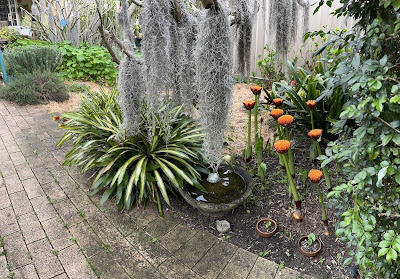
Our Scadoxus patch is steadily increasing in size. I could only fit in nine of the 11 flowers we have, and down at ground level there's another dozen babies doing well. Too small to flower yet, they'll eventually flower at some stage. Not sure when. That's half the fun of growing these things. I barely know what I am doing, but it's working.


This wobbly pano shot shows where the Scadoxus live, under the big old frangipani (that's the ideal place for Pam to hang her forests of Spanish moss that she loves). This is a super shady place in summer but it's well lit in winter once the frangi drops its leaves. To the left of the birdbath those strappy looking things are bromeliads, and they love it here too. I never touch them and they're happily thriving. 

While we're under the frangipani tree, here's another flowering bulb from South Africa (as is the Scadoxus). This is Veltheimia, given to us by our good friends John and Liz, so it always reminds us of them.

The final South African residents happily multiplying under the care of the big old frangipani tree are the yellow clivias. Their flowers should pop out any day now, so the combination of yellow clivia trumpets and dazzling scadoxus fireworks is well worth seeing, and waiting for each year.


Speaking of yellow-flowered people, down the other end of our garden, near the house, the Mardi Gras style blooms of the native Sydney Rock Orchid, Dendrobium kingianum, are in full glory right now. The miracle of this performance is that last year these plants were being attacked by orchid beetles, little chompers that love to dine on unopened flower buds, and so the shows weren't as good as previous years, or this year. These beetles are impossible to control with organic sprays, and I'm not prepared to buy or use the bee-killing commercial sprays (containing Carbaryl) that can control these beetles. So I don't know why the beetles haven't attacked this year but I'm glad they haven't.


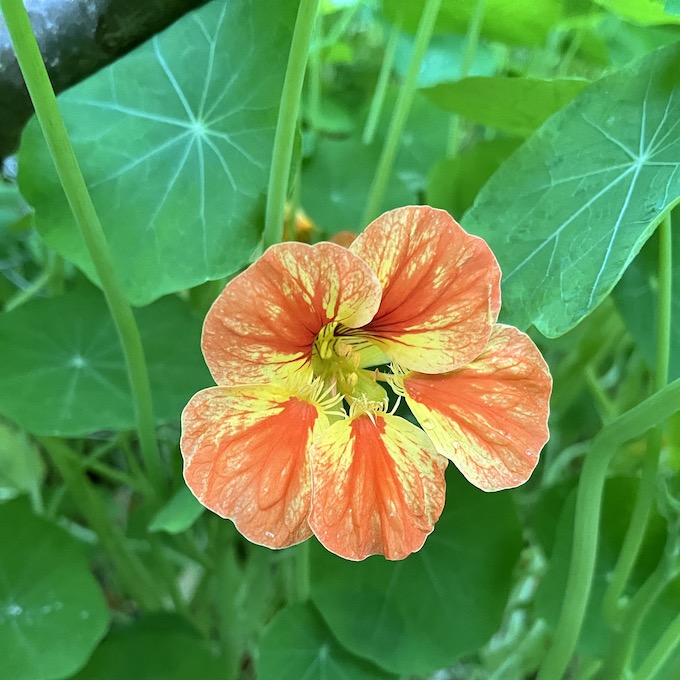
I couldn't decide which Nasturtium flower to show you so here's two: there are dozens of them and no two seem to be the same, although they come in all possible combinations of yellow, red and orange, maybe a bit of black trim. Pam and her watercolour art students absolutely adore nasturtiums as a painting subject, and as a gardener I do appreciate the way that nasturtiums suppress other weeds, but they do like to spread out and bully every other plant they come near. I cut them back every few days and they just merrily bounce back without a care in the world. They never complain, they just grow back each time.

We grow our Italian lavender in a pot and it likes it there. There's also a white-flowered type that Pam asked me to get, and it is slower off the mark and probably won't be in flower for another month or so.

One of the hardest flowers to photograph is this thing, a hellebore. That's because the flowers point down to the ground, and I'm too old to take photos lying on my back, so I hold up the flower's foliage with my hand, quickly take a snap and then edit out my finger from the photo. 


I'll finish off with two "panorama" shots of our small inner-city garden, just to give you a bit more context for what I have shown you already. To see the "pano" view, just double click on the photo itself and it will show the much wider shot (hopefully).


This first pano shows the left side of the garden looking out from the back of the house and its covered pergola. 


And this second pano is of the right side of the garden with lots of succulents in pots, more bloody nasturtiums trying to take over. The largish round white pot on the centre right is a native flannel flower bush that flowered beautifully last year and we are hoping will do so again this year too.

Finally, I actually have a couple more blog postings waiting to go. Our front garden is looking lovely but it has not worked out as I had intended, not at all. I'll fill you in on that bit of gardening fun next time.

Tuesday, September 25, 2018

Blink and you might miss it


As we travelled the last few miles at the end of our recent 3500km driving holiday in southern Australia, Pammy said "I wonder what has changed in the two weeks since we left?" She was referring to anything and everything in our local area. "Look, that shop has closed down" ... "and finally they've taken down all the ugly hoarding around that construction site — that new apartment building is almost finished."

No matter how little time you spend away from your home base, in a fortnight something always changes.

And that proved to be true for our little garden. During our two weeks away, one of our garden's best flower shows reached its peak and then quietly faded (just like they do in the forest). New things burst into full bloom, and seeds sprouted. And we weren't here to see any of it. We blinked and missed it all.

Still, it's an interesting thing to do ... leave your garden to its own devices for a while. And so here's what we missed out on over the last couple of weeks.

In the foreground, our usually fabulous scadoxus looked like the stragglers on the morning after a very memorable party. Frazzled, tousled and tired, but they did have fun for a while. In the background, the yellow clivias were in a similar tatty condition.

Poor yellow clivias, they'll be back same time next year, and hopefully there'll be more of them next time (and there'll be an old blogger there to photograph them in all their glory and lavish them with praise).

The one very good thing about the scadoxus section of the garden is that all the baby plants are thriving. In recent years I have been painstakingly raising them from collected seed, and this spring they are growing stronger than ever. There's more than a dozen newbies here and there. I'm just hoping these are not plants that need 10-15 years in the ground before they do their first flowering. I'm not sure if I'll live that long to see all my work come into glorious bloom!

In other pleasing baby news, all the flat-leaf parsley seed which I scattered in a few spots a few weeks before we left have sprouted up through the sugar cane mulch and seem to be powering along. This year all I did was open the seed packet and shake it here and there in the mulched vegie area, then say "you're on your own, kids; good luck". I think this has been my most successful seed-sowing method yet for parsley.

Upon our return we were greeted by some new blooms, including these little mint bush beauties ...

... and all our hanging baskets of pelargoniums perked up in the spring sunshine. 

But the flower show which impressed us the most was this (next) unexpected one ...

Our broccoli patch was in its full glory as adult plants, and the loud humming of the bees all around the broccoli's yellow blooms was a clear signal from the bees to me to "leave our broccoli flowers alone". 

They're perfectly correct, of course. While we grow broccoli with the mindset of "food/vegetable" and tend to look upon these flowers as a signal to replace the crop, the bees adore this plant's flowers, and so until all the flowers fade our broccoli plants are staying right where they are, as a bee temple.

So that's my little report on how our little garden looks after a few weeks of slight neglect (although our wonderful neighbours Nick and Katerina did their usual great job watering the garden for us).

Oh, so how was the holiday? Great! 

I'm still sorting through the thousand or so photos that we took along the way, and once that's done I'll show you some of the highlights, especially the lovely gardens we visited and the new people we met (hi Kerryn in Kyneton!). 


Monday, August 28, 2017

Good old scadoxus, right on time


Nobody seems to have told our Scadoxus plants about how global warming is stuffing up all the other garden plants' annual timetables. Here they are flowering again, last week of August, just like they did last year and the year before that ...

And what a welcome sight they are, too. Even though they're the stars of our garden, few friends manage to see them at this time of year. It's cold and wintry, and so we don't host many barbecues or lazy lunches outdoors, where our friends might see the amazing scadoxus show for the brief few weeks when it's on each year. 


Slowly but surely, the number of flowering plants is growing. This year we have seven, and judging by the willing growth of the baby scadoxus, in the long run we might end up with a dozen, maybe two dozen with their orange torches blazing with colour as the sunshine reaches their shady spot for a too-brief hour at the end of the day. 

Pammy and I are lucky to share this garden with our scadoxus. They ask very little of us in return, and yet give so much. Some relationships are like that.


My sole contribution is to help their family grow, by harvesting their seeds, propagating them, then planting them out once they have grown into healthy, bulbous babies. All of the babies planted in early winter are sending up healthy green leaves. They won't produce flowers for years, so for the next several seasons they will just grow, produce leaves, then grow some more. They're plants which are not in a hurry, and I like that.


They're also tenacious plants. When I unpotted the seedlings a few months ago, I almost didn't plant a few scrawny little tackers which looked like they were no more than slightly swollen streaks of a root-ling. I'm glad I planted even the most unimpressive babies, as they are all sending up leaves and promising that despite their slow start, they too will end up being a majestic spring flower one of these days. 


Monday, July 3, 2017

Slow progress, chapter 982


I'm only kidding, this isn't really chapter 982, but it is slow progress. I'm just trying to scare off those online gardening browsers whose attention span can only deal with 20 words at a time. You see, what I'm doing right now is using my blog as a diary, just updating the record on how things are going in a very long-term project to raise some flowering beauties from seed. 

Regular readers will be almost sick of this photo by now, but if you're new here, welcome to the wonderful world of Scadoxus, a spring-flowering bulb from South Africa which is the star attraction in our garden when it puts on its show each September.


Right now, our Scadoxus are almost dormant here in midwinter Sydney. No flowers at all, no leaves in fact, just some encouraging signs of growth from the bare older bulbs, which poke out above the ground.

Pictured above, this is what I mean. That red-topped point on this mature bulb will start to shoot up in August to become an 18-inch long, thick green stem, topped by a fist-sized flower head that then takes its own good time to open, usually a few weeks.


Once the fabulous razzle-dazzle of that orange bloom ends, the rest of summer is all green foliage down below, topped with a straggly, messy tangle of fading filaments covering the developing green seeds, only some of which have been fertilised by the bees.


By midsummer some of the once-green berries turn red, to show they're ripe, and that's when I have been picking them and potting them up for the last two years. Around the same time last year I posted about the progress up to that point, and today it's time for the potted up babies, who have grown handsomely, to be transplanted into the ground.


This is one of the babies, from a pot that is just one year old. A small but perfectly formed little Scadoxus bulb.


The two-year old pot was decidedly root-bound, and at first I thought I had blundered. However, with some very gentle wriggling and coaxing I managed to break them all up into half a dozen separate bulbs, each with its own tangle of thick roots firmly attached.


There's seven new bulbs from the two-year-old pot, and five from the one-year-old pot. I think leaving them in the pot two years was a bit of a boo boo, especially as the pot was small, and the one-year-old bulbs seem quite viable. The sooner they get into their natural home in the garden soil the better, I suspect.


Prior to planting I dug over the soil and spaced them out so they have room to grow in coming years, although I have noticed that each adult bulb sends up "pups" which hug close to their parents, so I expect that overcrowding may be the Scadoxus way of life.

Each bulb should be planted with about half the bulb (and all the roots of course) beneath the soil. 

As it's a bulb it carries with it its own storehouse of food, so all I did was water them all in with some seaweed solution, which encourages the roots to grow.

The general position in which the Scadoxus thrive is full, but fairly well lit shade (not the dim, dark stuff). The soil itself is good rich stuff, too, which I am sure helps them thrive. 
Sydney gets plenty of rain every year, so I never water them. 

Even the potted babies (which are in the same, shady spot) only get the occasional watering and no other help from me.

From what I've read about the seeds, the main thing is to harvest and plant them as soon as they turn red, as they don't stay viable for long. So I guess the main tip is to be "Jenny on the spot" and plant them early on.

I am sure that I have worn down even the most loyal readers by now, but if by some miracle you are still with me at this stage of my diary update, the whole thing is "slow progress" because I honestly don't have a clue how many years it will take these babies to turn into flowering adults. I do know that some of the smaller Scadoxus bulbs, which have been here for several years, still haven't flowered, so I truly don't know if I will even be alive to see my babies bloom! Maybe they're like Agaves and only bloom after half a century? Who knows.

I am just thankful to have some lovely mature bulbs here that put on stunning shows every spring. As for the little ones, I'm already deriving quite a bit of pleasure just raising them. And besides: babies are gorgeous, so enjoy raising them to the best of your ability ... but who really knows how one's children will really turn out in the long run? It's up to them.


Wednesday, August 31, 2016

Just a little bit obsessive ...


What can I say? Guilty as charged, just a little bit obsessive about my scadoxus, the flowering bulbs from South Africa. 

Every year around late August, early September, our garden is bedazzled for a few weeks by these glowing golden-orange Scadoxus flowers. I know I posted something about the baby plants like, well ... two postings ago, and here I am at it again, now that the adult flowers are open and the 2016 spring show is underway, bigger and better than ever. And the pots of baby scadoxus are growing up rapidly, too. So instead of saying any more, here's the photo show, folks.


Thursday, August 25, 2016

Springing open


It is nice having a full set of senses – you know, smell, sight, touch, taste and hearing – but when it's spring if you were a poor unfortunate down to just one sense or two, you'd definitely know that spring has arrived.

Take smell, for example. It's the worst one to start with because your sense of smell would tell you that this keen gardener has sprinkled far too much chicken poo under his citrus trees, and it is taking days for the farmyard stench to die down. I know this might seem a tad unsympathetic, but bad luck! The limes and lemons need a feed ...

So let's move on that far more delightful sense of sight, and I'll show you some nice photos of spring flowers doing their thing in our garden at the moment.


Now, this one is an official "Pammy plant". It's her potted Pieris japonica, and it seems like the position we have for it in morning sun, with afternoon shade, is just what the Zen master ordered. Though it's Pam's plant it is of course my sacred duty to keep it happy, and so far it hasn't been too onerous a task, even if it remains a heavy responsibility.


A much lighter and cheerier story is the rebirth of our potted New Zealand Christmas bush (Metrosideros), which always flowers months ahead of the baby Jesus' birthday. A year ago this pot plant looked like it was gone for all money, so I cut off the top three-quarters of it, repotted the stump into fresh mix, plied it with Seasol and soothing vibes, and like Lazarus, it's back!


And it's not just a couple of flowers, either. The whole thing is covered in buds, and we're back in the Kiwi flower business.


And yes, my favourite flowering plant in the whole garden is doing its thing again. Last time I did a blog, which was a month ago, it was about this Scadoxus and its little clump of babies, so I thought I'd slip it down here to Page Five of this blog, just so I don't seem too obsessive about them. But the flowers are all about 90% open right now, and the show is on again.


You can always rely on our succulent patch to have something interesting or weird (or both) happening, and right now the yellow blooms of our Kalanchoe 'Copper Spoons' are the star attraction. 


Finally, good old Geranium 'Big Red' is in bloom not quite "again" ... it's more like Big Red never stops blooming, and so it's "still" in bloom. Every now and then it has a pause-ette for a breather but then it's back in action pumping out the red highlights in no time. What a wonderfully healthy, fuss-free, colourful and happy thing it is. 


And so that's an update on the beginning of spring here. I know that I won't be able to resist showing you more of the Scadoxus once the whole tribe has opened up, and the Pieris japonica deserves a posting, too. I'm hoping to lift my current sluggish rate of one post per month back up to a more respectable one per week, but no promises, mind you. I kind of like this "monthly" pace, it suits my semi-retired lifestyle.


Saturday, July 23, 2016

Clumping together – how exciting!


I'm afraid that this is what passes for excitement in my quiet life ... my scadoxus clump is getting bigger.

Fatherhood might have eluded me in my human attempts at propagation (although as an Uncle I am proud to have achieved greatness, thanks to my productive nieces and nephews). So the only chance I get to wear the label of "proud father" is when a seed I have planted miraculously survives my care and turns into a plant. And that's happening now. So, without further ado, let me explain ...

Exhibit A: scadoxus in bloom in September each year

Purely to set the scene, and besides, it's the most spectacular
photo in this posting, so it comes first. Each flower head is
about four inches (10-12cm) across, sitting on top of a 30cm
(12-inch) stalk. They're a South African native, and the blooms
absolutely steal the show for about 3-4 weeks each year.

Exhibit B: close-up of flower, where the seeds form


Exhibit C: seeds ripen from green to red (much later on, in summer)

Looking like a morning-after party animal, at first all seeds
are green ...
... then slowly but surely, by midsummer a few seeds remain
and have turned red. So I plant these straight away into a
pot of potting mix. Next, I do nothing for 6 months.

Well "do nothing" is not strictly true. I do occasionally water the pot if rain hasn't done its duty, but that's it. And I leave the little pot of potted-up seeds out in the garden, in the same shady spot where the in-ground scadoxus live.

And so here we are, midwinter, and the pots of scadoxus seeds are sprouting!


Meanwhile, in the official scadoxus patch a few feet away ...


From the original three bulbs given to me by former Burke's Backyard gardening editor, the excellent Geoffrey Burnie, back in 2009, we now have at least five adult scadoxus blooms forming, plus another nine "children" who may or may not flower this year. I'll just have to wait and see in early September.


Add to that the two pots of seedlings (I can see eight coming up so far) and our little clump of easy-care, shade-loving scadoxus is thriving nicely.

I'm not sure when I'll plant out the seedlings in the pots. I think it'd probably be wise to leave them in their pots for all of this spring and summer, then in autumn (when I harvest the next batch of ripe, red seeds) I'll plant out the seedlings and pot up next season's seeds.

As I mentioned earlier on, this is all rather pleasing and exciting to me. Gardening's like that, something you can still get excited about, just like a kid, but without injuring yourself in your fragile old age.