Showing posts with label zucchinis. Show all posts

Tuesday, December 8, 2015

Lebanese flavour


Here in Australia, and in my part of Sydney in particular, we have a sizeable Lebanese community, and they're wonderful, hard-working people. As is the case with many established Anglo Aussies (like myself) and migrant communities (such as the Lebanese) where we first get to know a bit about each other is in our shops and restaurants. 

Pam and I love Lebanese cuisine. As well as their famous kebabs and koftas, their many vegetable dishes are superb. Our supermarkets always have in stock big piles of Lebanese cucumbers, Lebanese eggplant and Lebanese zucchini. These vegies aren't just sold to people whose family's roots are in Lebanon. Everybody buys them, and that's because the Lebanese people have bred over the centuries a wide range of vegetables that presumably suit both their climate and their palates. 

And so this year I'm having a go at growing the little pale green Lebanese zucchini, and so far the results have been delicious. I prefer them to the prolific, larger, dark green 'Blackjack' zucchini which I have grown here in previous years.


Here's two zucchinis with the flowers attached
picked this morning. These aren't as prolific
in production as Blackjacks, but they keep
well. So, after washing and drying, I pop them
in a plastic container. After a few days we
have enough for a delicious side dish.

Here's the plants in the garden, with the mirror
on the shed wall making the plot look a bit
bigger. And no, they are not a special variety
with variegated foliage! Sad to say, they have
powdery mildew on the leaves, and nothing I
am doing is really helping much at all.
The powdery mildew is quite aggressive, and though I am
regularly spraying plants with an organic treatment, it doesn't
seem to get rid of existing mildew. All it does is slow its spread
to other zucchini foliage. I'm also careful when watering to
keep water off the foliage and direct it to the roots, so I can't
think of anything else I can do.


This is the product I am using. eco-fungicide.
It's organic, a powder that you mix up in a
spray bottle and spray all over the foliage, on
top and on the underside. It's based on
potassium bicarbonate.
In previous years I've tried the other well-known organic treatment of milk sprays, and they were even poorer in performance than the eco-fungicide. Pictured below is the healthy foliage of the other Lebanese zucchini plants which haven't yet succumbed to the powdery mildew. This is a much better result with the eco-fungicide than anything I ever achieved with milk sprays, so I am sticking to the eco-fungicide.

There's one or two faint spots of mildew on the
leaf on the right, but the foliage still looks good.
The good news is that the powdery mildew, while it slowly harms the foliage and the plant, isn't instant death or anything like that. The foliage on one plant has looked crappy for a few weeks now and the plant is cropping away happily. So mostly the powdery mildew weakens the plants, probably brings the cropping to an early end, and certainly looks very dodgy!

I've always said that the baby little zucchinis you get attached
to zucchini flowers in restaurants and supermarkets have a
much better flavour than the fully grown zucchinis that are
sold without (the short-lived) flowers. Well, it's the same with
the small Lebanese zucchinis. These never grow to any great
size anyway, and they are best harvested when only 3-4 inches
(75-100mm) long, and they taste great, whether you steam
them, fry them or cook them any which way. 


Saturday, October 17, 2015

So much happening


I am in awe of those garden bloggers who keep on slogging away, doing a posting every day. Me, I'm down to one posting a week at best, but at least I never seem to run out of things to write about and photograph. (I'd quickly run out of things to post about if I had to do one a day!)

However, right now, I could do a blog posting every hour, because there is simply so much happening in the garden right now. And don't be surprised if, over the next few weeks, I do individual blog postings on each of the plants I'm about to show you.

Just to make things easier for me to wrap my little head around the topic, I've divided this "so much happening" post into little categories.

First up, the NEW ARRIVALS


Not one but two new curry trees. I bought one
pot and realised it had two plants in it.
Fortunately their roots weren't entangled so
potting them up was easy. Expect a curry
tree blog posting soon, folks.
Our good friend Jolanda has a superb little
patch of mint bush by her front steps, and we
loved its purple spring flower show, so we have
planted three of these behind our geraniums. 
Pammy brought home a Pieris japonica in
flower a few weeks ago. We left it in its pot while
it was bloom, and now it's in a bigger pot and,
judging by the new growth, is happy enough.
Hardly the most exciting purchase, two punnets of blue flowered
salvias, but about two months from now they will start to flower
and they won't stop till autumn is almost over.

next, the FOOD GARDEN GETS GROWING


Lebanese zucchini, the light green, chubby smaller ones. So far
so good, with the first flower buds (boys only) showing.
A miracle! Our unproductive passionfruit vine, now into
its third summer, has for some reason decided to produce
quite a few flowers lately. Could this be our first decent crop?
Here's last season's crop in action. Yes, folks,
one flower and one - just one - fruit. This has
been my biggest dud of a food growing story
in 25 years, but I am determined to see this
thing finally produce a decent crop.
Just had to include this fragrant, lovely thing.
The more I water my potted rosemary bush,
the happier it seems to be. While in the ground
it's a classic "waterwise" plant that can survive
on rainfall alone, in a pot it's a thirsty sook.
Another miracle! Our Serrano chilli bush has
somehow survived winter. I gave it the mother
of all cutbacks five weeks ago and for a while
it didn't look like it was going to bounce back,
but now it's producing foliage and flowers,
and so I think it's a red hot goer for this summer.
And the first strawberries of the season are starting to appear
and colour up. As is a tradition in our garden, our strawberry
plants come up as "volunteers" out of our homemade compost.

Finally, FOLIAGE AND FLOWERS


The Louisiana iris is slowing down, but there
are still new blooms to enjoy every morning.
One of the greatest concentrations of onion weed and oxalis
in the Southern Hemisphere – our succulent patch – has been
cleared (temporarily I am sure) of the weeds and a new (and
prettily ineffectual) layer of pebble mulch has been spread.
At least it will look very nice for at least the next month!
Just like our sooky, thirsty, rosemary plants, our supposedly
waterwise trailing pelargoniums absolutely love a drink.
It's an Australian thing, I guess, once someone arrives in
Australia they just seem to start drinking more ...
Be careful if you are buying pots of Lamb's Ears (Stachys).
This is what one 3-inch pot planted in Spring 2014 has
turned into, without any encouragement from me. This lovely
grey beauty looks like it's about to flower, and from previous
experience seeing it in flower in other gardens, bees love this
plant's flowers in a big way, so I am hoping it will attract a
zillion bees that will then fertilise all my passionfruit flowers.
And last but definitely not least, what I like to
think of as "Pammy's office garden" has survived
the winter and is now ready to enjoy the summer.
Why "Pammy's office garden"? Well, all the
plants here have done too well inside the house in
Pammy's studio/office, getting too big for their
pots, and so when that happens they are retired
out here, where they are then cared for by me.

As I mentioned long, long ago at the beginning of this posting, don't be surprised if you find yourself reading another posting on these individual plants over the coming weeks.

I never go out into the garden thinking "gee, what am I going to blog about next?". I never know in advance. Something just catches my eye, or happens, or doesn't happen and most of my blog postings just write themselves, and are mostly already written in my head before I ever head back inside. But this morning it was a simple case of "so much is happening" that I realised I had a good dozen or more blog posting ideas all at the same time.

Spring is like that ... so much happening in the garden. It's wonderful.

Saturday, November 29, 2014

Delicious surprises


Regular readers of this blog will know that Pam and I have been on a short holiday break. Well, when we returned home we had a few delicious surprises in store for us. One was the amazing way our zucchini plants have grown and started to produce crops, and the other pleasant surprise was a package containing a new kitchen gardening DVD created by the man I worked with for many years, Don Burke. But first the zucchinis, then I'll tell you about Don's new DVD...

Our neighbour Katerina always does a brilliant job watering
our garden while we are away, but this time she excelled
herself. When we left the zucchini (courgette) plants were still
relative babies, but in just one week they had turned into monsters
and were starting to produce both flowers and fruit.
A small harvest for dinner that night: small zeeks with the flowers
still attached. Pam loves these! These vegies can grow into monster
marrows, of course, but they do taste best when small, like this.
Meanwhile, out in the garden, lots more little zucchinis are
already popping out. Yes, we're going to have a zucchini glut!
One extra detail that I am pleased about is that the chervil I sowed
to go with our zucchinis is starting the thrive. The chervil plants are
in a row of pots in a semi-shaded spot under the lemon tree
 and just behind the zucchinis. So, when I pop out to harvest more
zucchinis I also harvest a handful or two of chervil, a herb with
a delicate, slightly aniseedy flavour which teams superbly
with zucchinis. Isn't it nice when plans work out well!  

And now, for the second delicious surprise awaiting me when we got back from holidays was a little parcel containing this new DVD by Don Burke. It's called "Backyard Farming: Back to the Kitchen" and so it's all about my favourite topic, which is growing your own food, then harvesting it to enjoy in the kitchen. As you can see there's a chook on the front cover, so Don has also included some segments on keeping chooks so you can have a supply of freshly laid eggs to accompany your homegrown organic produce.


I'm sure many many readers of this blog were also fans of the popular 'Burke's Backyard' TV show that was for many years a regular part of Aussie Friday nights at home with the family, watching the television. This DVD is what I would call "classic Don Burke". He really knows his stuff and deals with an incredible array of backyard farming topics, and the treat is the sense of fun and good humour he brings to every segment. It's very easy to watch, very enjoyable viewing – just like tuning in to the Burke's Backyard TV show once again.

While I scored a freebie from Don, it won't set you back much – just $24.95 – to enjoy the fun of watching the DVD at home. At this time of year, of course it's a great Christmas gift idea! Either drop some major hints around the home, or buy a copy for a gardening friend (or do both). You can order it direct from the Burke's Backyard website, www.burkesbackyard.com.au, but you'll probably also see it sold at leading retailers such as ABC shops, Sanity and various other outlets. If you Google "Backyard Farming: Back to the Kitchen" you'll get lots of hits from all sorts of online retailers, so it's very easy to get a copy.


Tuesday, September 21, 2010

Herb of the Year


Well, it's my herb of the year, simply because I've really come to appreciate chervil so much more in these last 12 months. It's not as if 'Herb of the Year' is any sort of official title. Chervil is just Herb of the Year here in Amateur Land.

The citation would read something along the lines of: "For services rendered making bland vegies such as zucchinis (courgettes) so much more interesting; for growing in those semi-shaded spots where hardly any other herbs grow; for looking pretty in pots; and for being easy to grow from seed." I hereby award chervil with this barely prestigious award. All the other herbs are jealous, of course. Basil is such a prima donna sometimes!

For this little blog posting I plan to celebrate this fine little herb, with a recipe at the end, of course. Here is a crop from last year, looking very nice in a glazed green bowl.

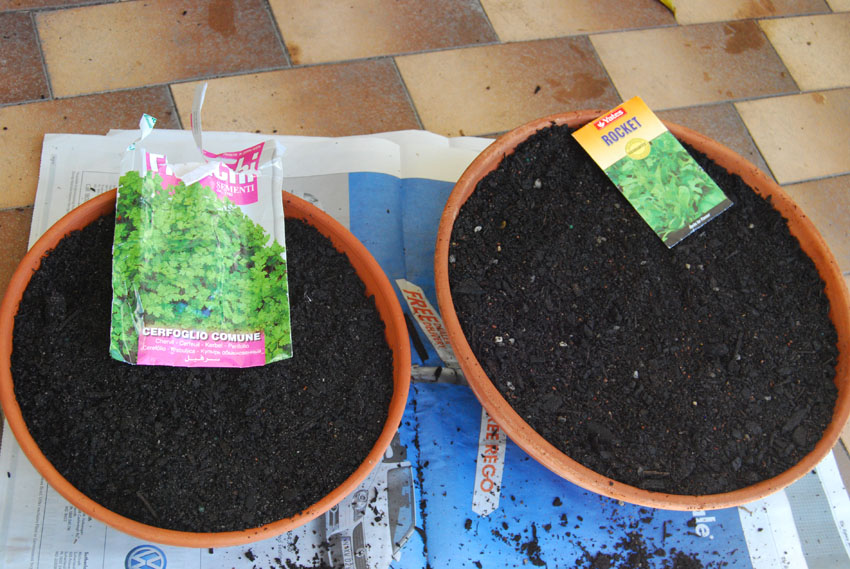
I have something else going in that nice green bowl, so to stop chervil getting a big head as a result of its recent HOTY award, I have consigned it to a humble terracotta bowl this time round. Last Saturday I sowed up a pot of chervil seeds (on the left), along with yet another batch of good old rocket seeds. By the way, Australian readers, that Italian 'Franchi' packet of chervil seeds contains about one zillion seeds and only costs $4.50 ordered online from The Italian Gardener, a seed shop based in Wollongong. These super-generous Italian seed packets are great value, so if you have several friends who'd like some seeds of all sorts of vegies and herbs, order one packet of each and there will be plenty for everyone. It's a shop well worth checking out (and, of course, this is not a paid commercial – I paid for my seeds).

This is what chervil seeds look like. Long, dark and thin.

I didn't really intent to sow them so thickly, but no harm done. The germination rate isn't 100%, and I'll just thin out the seedlings (with tweezers) in two or three weeks' time.

After scattering the seed I cover them with a fine layer of seed-raising mix (I know seed-raising mix isn't available in some countries, so any very fine, sandy potting mix is roughly the same thing). The layer of seed-raising mix is just barely enough to cover the seeds. Water in with a very fine, light spray of water, then leave the pot in a well-lit spot away from full sun. Germination takes about 10-14 days, depending on the weather.

The first leaves are long and fine, like the seeds, so it's the second and subsequent sets of leaves which start to look like chervil. Once it's growing well, I keep it happy with an organic liquid feed once a month. I use anything that has plenty of nitrogen in it (there are lots of those to choose from these days). Here in Australia, Nitrosol, Seafeed 3-in-1, and all the other fish emulsions fit that bill.

The foliage is a bit like a cross between parsley and coriander, although it's most like curly parsley which has been uncurled, if you know what I mean. The flavour is very mildly aniseedy. Some say that it's 'delicate' but I think that is almost synonymous with 'boring', so I'll stick with 'mildly aniseedy' thanks.

Just for the record, chervil does produce flowers at the end of its season (it's a short-lived herb, like parsley, coriander, basil, dill, etc). Each batch of chervil provides a pretty good supply of leaves for about three to four months on average. Then I sow another pot.

There are two great things about chervil worth concluding with. The first is that it's a food plant which does well in semi-shade. The full blast of Sydney's summer sun all day is too fierce for it. If I can, I grow it in spots which get lots of morning sun, but no afternoon sun.

The other great thing about chervil is its flavour, especially in our case the way it has made bland-ish vegies such as zucchinis (courgettes) and other watery squash-type vegies interesting. So, it's on with the recipe!

Zucchinis with chervil
Serve this as a vegetable side dish.

4 zucchinis (courgettes)
salt
knob of butter
black pepper to taste
2 tablespoons chopped chervil

1. Grate all four zucchinis using a cheese grater. Sprinkle with salt, mix together with a fork, and let the zucchinis shed some liquid with the salt for a while (eg, 20 minutes or half an hour).
2. Next, rinse the zucchini of the salt under running water, and let it drain off the excess water in a colander.
3. Heat a knob of butter over gentle heat in a saucepan, add the grated zucchini and let it slowly cook for 10 minutes, stirring occasionally to ensure even cooking. Don't add any more salt, but add as much or as little ground black pepper as you wish. It's hard to overcook the zucchini over gentle heat, so the timing isn't that important.
4. Just before serving, sprinkle the chervil over and mix through. Serve straight away.
The chervil becomes the star in this recipe, with the zucchini just the chorus.

Chervil of course has many other uses. It's great with egg dishes such as scrambled eggs. You can stir chopped chervil into a mayonnaise to serve beside all sorts of fish dishes. In fact you could sprinkle chopped chervil straight over Atlantic Salmon and you'll be glad you did so. It's also worth a try over steamed chat potatoes. And some chervil leaves added to a tossed green salad will have the foodies asking "what's that lovely herb?". And you can answer "Oh, that's the 2010 Herb of the Year, chervil".


Saturday, November 14, 2009

Some like it hot


There's one sure-fire way to turn me into a lazy lay-about on the weekend, and that's heat, and today there's just the right dose of it – 30°C (86°F). I managed to score one garden brownie point this morning before I wilted - I trimmed the hedge which screens the composting area. But then my inbuilt, generations-old Celtic heat sensors went off and said "it's a wee bit tae hot for thee laddie" and so I have downed tools until late afternoon at the earliest, maybe for the day. And with a cup of tea to cool me, the fan on and a bit of blogging to catch up with, I thought I'd admire some of the plants which, unlike me, actually enjoy the heat on a day like today.

In the background is the crisply trimmed hedge with which I earned my brownie point this morning, and in the foreground is our frangipani, which can take any dose of heat Sydney cares to throw at it. Sydney has the ideal climate for frangis, they're everywhere in this town, and the ones doing best are usually the most neglected. I try my best to neglect mine at all times, so the regime here is simple: no fertiliser, no water except rain. Nothing. It's working so far.

I only planted this zucchini seedling two weeks ago and this morning it's having its first babies. Outrageous behaviour! Zucchinis love sun, but not the humidity that comes later on in January and February, so I am going to let this crop like mad from now until New Year then call it quits. Besides, we're 'zucchinied-out' by then.

My Beaver Lodge Slicer tomatoes are belting along in the heat. These are meant to be rapid-cropping 'cool climate' tomatoes suited to Canada (the seedlings were planted on October 3, six weeks ago). I thought I'd try them as a fast-cropper before all the summer bugs arrive to chomp our tomato crops. So far so good, but I was in roughly the same position last year with other varieties, just weeks before most of my crop succumbed to a mystery disease. Boo hoo! Glutton for both punishment and home-grown tomatoes, I am.

My wife Pammy asked me to repot into a much bigger pot this, her favourite pelargonium with the dark leaves and the salmon-pink flowers, as it is rapidly getting bigger in all the heat and sunshine. The trouble is that I repotted it only a month ago, and that was about a week after she first brought it home. This plant really loves the sun, but something tells me I had better keep this plant happy and healthy at all times, as it is her favourite child.

Our New South Wales Christmas Bush is in full sun-loving 'bloom' right now. In the same way that a bougainvillea's colourful 'flowers' aren't really flowers and are in fact coloured bracts, so too the NSW Christmas Bush. Its flowers are white and small, but the bracts are a ruddy pink, lovely and plentiful. It's a bit early for Christmas, but it always colours up at this time of year for us.

If I'm celebrating sun-lovers I have to slip in at least one succulent photo. Needless to say all my potted succulents are thriving in the sunshine.

Finally, I thought I'd finish off with high hopes for my favourite sun-loving flowers, blue salvias. I've just planted a batch of seedlings a few weeks ago and they're all still small but are growing well, loving the heat and sunshine, as salvias do. As this sparse patch of mulch dotted with tiny seedlings is hardly the prettiest way to end a celebration of sun-lovers, I thought I'd dip into the archives and drag out a couple of shots from last year of what I am hoping for again from my beautiful, sunny salvias.

Essentially this: pleasing light green foliage and spires galore of cool blue flowers.

But get up really close and a salvia blue is as cool and refreshing as an ice-cube.

Speaking of ice-cubes, I think I'll tinkle up something cooler to drink now and sit back in my cane armchair in the shade with a book and do very little for the next few hours, apart from looking up occasionally and watching my garden soak up the sunshine. As far as I am concerned, a garden isn't quite complete without a comfy chair.

Saturday, December 6, 2008

Organised mayhem


It's amazing how rapidly things can change in a potato patch, and how rapidly the patch can go from looking very respectable to utterly disreputable. And while it's probably a bit early to harvest all the spuds, quite frankly I'm sick of the look of those scruffy plants now. They've got to go! And we've been zucchini-ed to death as well. So this sunny Saturday is organised mayhem day. Out with the spuds and the zeeks, in with summer flowers, chillies and beans.

Late October, all seemed not merely well in the spud patch, they were spiffy! People had told me potato plants were boring. Nonsense! Modest the flowers may be, but they score bonus points for simplicity in my book. And those adolescent leaves just radiate green goodness.

I was still something of an admirer of the potato patch at this stage, on November 13. But it must have been very soon after this photo was taken that the patch went rapidly downhill, while it made tubers underground.

This crappy spectacle would be fine in a large garden where you could let the spuds get on with their above-ground fading while they produced below-ground crops, but in tiny Garden Amateur Land they're centre stage. Pam and I just looked at the patch, looked at each other, and said "it's gotta go". So, though I know I should let the plants slog on for a couple more weeks before getting the maximum yield out of the patch, it's simply not worth it. Harvest, ho!

It's good, dirty fun harvesting spuds. I got covered in soil, compost and mulch but found plenty of them. Figuring what to do with the enormous hills of compost and sugar cane mulch is a bit of a problem now, but I made good use of my big plastic purple scoop. It was the ideal soil mover, gently picking up spuds without damaging the skins.

And here's the premature harvest. Total weigh-in is 6.2 kilograms. The big majority are King Edwards (4.6kg) with a measly, disappointing 800g of Kennebecs and 800g of Dutch Creams. If you add in the 900g of King Edwards which I prematurely harvested about 10 days ago, that takes the total harvest to 7.1kg. Not bad for an impatient, premature harvest but not great, either. As a spud newbie, I'm happy enough with the result, and I've learned a lot and at least have some fresh organic spuds to enjoy. By the way, the King Edwards have been lovely to eat, especially when baked or fried. Of course we can't possibly hope to eat all these spuds, so we'll just give lots of them to neighbours and friends, and try to get through as many as we can over the next week or so.

All my compost bins are now chock-full of the old compost and sugar cane mulch used to make the hills for the potatoes. The potato-growing compost is also full of worms, including some absolute whoppers, so this stuff should break down very rapidly in the summer heat. I'll make sure to tumble it over as often as possible, to help it along.

The zucchini patch was still going strong, with no sign of the cropping slowing down. But we are zucchini-ed to death. We've had them steamed, fried, baked and stir-fried. They've been teamed with tomatoes, feta, garlic, chervil, eggplant and countless other vegies. We've grated them and chopped them, sliced them and baked them whole. And no matter what we do we have too many zucchinis. Of course we've given them away to friends and neighbours, too. And still we have too many. The variety is Black Beauty and it's a terrific cropper. No complaints there.

It's incredible how the zucchinis keep on cropping despite the patches of powdery mildew here and there. I've posted before about using the organic milk spray to keep this disease under control, and it does work pretty well provided you never stop doing it. The limitation is that the milk spray reduces the spread of mildew to unaffected leaves, but the affected leaves do keep on going downhill and end up being cut off, purely because they look so sad and patchy.

I'm sure the ladybirds will be livid about me pulling out the zucchinis prematurely. Every leaf on the zucchinis had one or more ladybirds in attendance, so it was probably a day of infamy for them. The great zucchini massacre of summer 08.

Zucchini plants creep across the ground as they produce fruit. It seemed as if at virtually every stalk junction another zucchini fruit came up. We had a policy of harvesting them smaller than the usual shop size, as they have a better flavour when small, but if I missed a fruit somewhere deep inside the thicket of leaves, it would quickly streak away to jumbo marrow size in just a day or two.

One thing I won't miss is the prickly spines on the leaves and stalks of the zucchini plants. I came off second best every morning as I harvested them. If I ever see anyone with forearms covered in tiny scratches, I'll no longer suspect they're a junkie, I'll just give them the benefit of the doubt and think "there goes another zucchini harvester".

This is the former potato patch by late afternoon. Low-growing spreading groundcover style zinnias, Zinnia angustifolia (given to me by a friend and workmate, thank you Geoffrey!) on the left, a Habanero chilli in the centre, and more zinnias (another low-growing type, but Zinnia elegans, reaching about the same height as Z. angustifolia (about 20-30cm). Very easy-care, drought-hardy, colourful and long-flowering.

Up at the former zucchini patch, more Zinnia angustifolia from Geoffrey's leftovers. The pot in the background contains dwarf bush bean seeds, which hopefully will provide a crop of beans later in the summer if all goes well.

And so the organised mayhem of spud and zucchini evictions makes way for the comparatively docile look of hardy summer annuals surrounded by a sea of mulch. I'm ready for a lazy break during the heat of summer. This Saturday got up to 35°C and that was a bit too hot for me. I spent the rest of the evening drinking water, trying to replace the fluids I had lost during the day.

The zinnias thrive in the heat, so too the chillies and the beans. From now until late February, I'm planning on being a much lazier gardener. There's a crop of tomatoes to tend to, a potager patch to coax into prettiness, beans to harvest, salad greens to keep ticking over, and fruit flies to battle. That'll do me for a lazy gardening agenda.