Showing posts with label vegies. Show all posts

Saturday, June 7, 2014

Being co-operative – week 4


It's probably not that polite to say "hooray, it's over!", and besides, it's not really over. We still have to get through all this pile of vegies and fruit yet, but our little four-week foray into the world of being a member of a vegie co-op is drawing to a close, and we now know that two big boxes of fruit and vegies (not of our own choosing) every week is far too much for us to handle.


The theme for this week's cornucopia is "lots". In the sense of
lots of avocados (12) lots of bananas (10) lots of oranges (10)
lots of tomatoes (10) lots of mushrooms (dozens) – and that's not
to forget three sweet potatoes, four cobs of corn, two bags of
salad greens, a big bunch of celery, a bunch of beetroot, a
pineapple, some broccolini, a monster eggplant, and four very 

nice pears. All beautiful quality and very pleasing to behold.
How do two little lovers cope with all this food in just seven days? Easy, we give a fair bit away, which kind of ruins the economics of it all, but the warm inner glow of being a giver is worth it, of course. We need a couple of health-conscious and hungry teenagers to help us knock it all off, but as we don't have any of them lying around (and I have been led to believe that they actually do a lot of lying around...) that isn't an option.

So we give some of our bounty away. Last week it was to our favourite family of three, who live close-by, and this time Pammy's mum (a great fruit eater) will share in it, as will our starving uni-student nephew Neil, who never says no to a free feed.

The co-op thing has been more interesting than fun. In fact the most fun has been collecting the boxes on Saturday mornings, sorting through them back at home, then taking the photo and blogging about it on Saturday afternoons. The weekdays thereafter have been a harder slog.

We're really looking forward to choosing our own vegies again, creating our own menus for lunch and dinner once more. Over the last four weeks we've drifted into a zombie-like state of "must cook more co-op vegies" every night, and while it has introduced us to greens such as kale (verdict – quite nice, will probably buy some and cook some occasionally from now on) it has been a bit hum-drum in the limited choice offered up. More importantly, it has also kept us away from several fruits and vegies we much prefer, simply because each week we've had to eat our way through the co-op pile first.

I do like carrots and corn and apples and oranges, but I want to bake some quinces until they're ruby red, roast some parsnips, blend up a potato and celeriac mash, bake some cauliflower or Brussels sprouts in the oven – try either (florets of cauli or sprouts cut in half) tossed in oil, baked at 180°C for about 25 minutes – baked is best… or stir-fry some buk choy or take my time enjoying a ripe persimmon… the list goes on.

So the moral of the story, folks, is that it was interesting to find out how a vegie co-op works but we've learned that we really do prefer to choose our own fruits and vegies.


Saturday, May 31, 2014

Being co-operative – week 3


One very nice thing about the vegie co-op thing, at least the way my friends practise it, is the pleasant business of dropping around to someone's place to pick up the boxes of vegies. This is a leisurely affair, from beginning to end taking up about an hour of each Saturday morning. It's a relaxed social occasion, where co-op members enjoy some tea or coffee, biscuits or cake and a chat, prior to paying their dues and hauling the two boxes off to their car and returning home for the 'show and tell' with their partners/families back in their own kitchen. 


The "show and tell" is a very different story each week, as what
you get depends on whose turn it is to do the shopping. This
week's cornucopia includes lots of tomatoes, oranges, carrots,
potatoes, pears, apples, bananas, capsicums, Lebanese cucumbers
and a bunch of curly kale, half a Chinese cabbage (wombok)
a full butterhead lettuce, three baby butternut pumpkins and a
bag of small white mushrooms.
As far as our tastes go, this haul of goodness hits our tastebuds in the right spot, and has been voted by us as the 'best' haul so far.

I've been meaning to cook some kale, so now is my chance. It's ridiculously trendy here in Sydney right now, but lots of people are quietly saying "ugh" when asked how they like it. So it's not one of those vegies which appeals to everyone. I suspect it just depends on how you cook it, and perhaps what you cook it with.

My favourite inclusion this week is the wombok. I love it in salads (it makes the best coleslaw) and in stir-fries. But right now though, I'm off to eat a banana!


Saturday, May 24, 2014

Being Co-operative - Week 2


Go on, call me deadly dull, I don't care. I'm finding this vegie-co-op experience an interesting one. The way it works is that each week, a different couple from the co-op does the shopping at the markets, and so what you get each week differs quite markedly from the previous one. Here's what we found in this week's "chef's challenge" boxes.


A giant, deep green plume of silver beet, the leafies next to it
belong to golden beetroot. A huge bag of green beans, a small
bag of baby spinach, broccoli, lots of potatoes and onions,
sweet potatoes, red bullhorn capsicums, and a baby Cos lettuce.
In the fruit box, lemons aplenty, two small pineapples, Valencia
oranges, Imperial mandarins, Bartlett pears, Gala apples and
big, juicy tomatoes, all from an organic grower.
I just have to show you this architecturally fascinating sweet
potato. Wonder how that happened? Did it grow around an
old piece of root left in the vegie patch?
That sweet potato is a beautiful example of the delights of growing root vegies like parsnips, potatoes, carrots, sweet potatoes etc. Every now and then a truly mind-boggling weirdo makes its grand entrance. As I said earlier, call me deadly dull if you like, but weirdo root vegies do hold a modicum of fascination on otherwise quite and uneventful Saturday mornings.

Next week it's week 3 of the boxes full of edible surprises. It's a good thing we're in this vegie co-op caper for just four weeks, as I cannot see the novelty wearing off that quickly. Bring on the next one, I say!


Saturday, July 2, 2011

It's happening, just slowly


Winter gardens seem to be on Valium at times. Everything happens slowly. It's all quite calm, there's not the frenetic buzz of insects and birds like you get in spring and summer. It's all a bit slow. Suddenly my action-packed inner-city garden feels like it's a country town set to 'snooze' mode. But there are signs that things are finally happening, just slowly.

The Iceland cometh. Poppy, that is. There's a couple of dozen of these people lifting their heads at the moment, the start of another winter flowering season that I hope lasts for months.

These parsnips live life at a leisurely pace. It takes anywhere between three and four weeks for the seed to germinate, and now they are plodding along nicely, but harvest time is months away. The good thing is at least they don't need much care.

Next door the English spinach is stirring into action, after a slow start from seed. Crops will be a few more weeks away, but pickings of baby leaves for salads are getting close.

Next door to the English spinach a row of recently thinned-out carrot seedlings is finally getting down to business, but these too are several weeks away from harvest.

Last year I planted brodiaea bulbs at the recommended spacing of 10cm and the effect was hopeless. Easily the biggest disappointment in the garden last year. These flowering bulbs from South Africa were meant to produce pretty blue-star flowers, and they did, but each small bloom was so far apart from its neighbour that you barely noticed them. Nevertheless I saved the bulbs and this year I have jammed them into a pot like commuters on a Tokyo subway train. My only problem with this experiment is that I might be overseas when they bloom! Rats!

I reckon it's only a few more sleeps before these cinerarias begin their lurid winter colour show. These are growing in almost full shade, but they're one of those "will flower in shade in winter" kind of annuals, with the proviso that the colours aren't necessarily in the best taste. I don't mind, I just want some action here in Quiet Town!

Speaking of action, here some real excitement. When I went outdoors with my camera this afternoon I had already made up my mind that I was going to do a blog about how nothing is happening yet, and yet here's the first of the Iceland poppies cheekily saying "nyah nyah" to my theme while flashing a pure white smile.

OK, poppy, I stand corrected. There is stuff happening here. Just not much. Not yet. Patience is a virtue, but waiting is still a bore.


Tuesday, March 22, 2011

Suddenly, nothing much happened


I know that on many occasions I have sung the praises of growing plants from seed, because it's very satisfying fun to do so, but in the interests of fairness and balance, let me kick off this little posting about seeds from the other, grumblier end of the paddock.

Seeds can be frustrating things to work with at times, for various reasons, and out here in Amateur Land I am coming face-to-face with some of those frustrations. Let me explain...

First the good news. The coriander seeds have sprouted. (What's that organic looking brown packet of coriander seeds doing floating in mid-air? Have I discovered levitating seeds? No, it's worse than that. I have discovered Photoshop, and how to make all sorts of dastardly changes to simple, innocent garden photos.) Anyway, back to the seeds...
These are seeds I saved from my coriander plants last year, and they're sprouting at the rate of about 60% good 'uns, 40% duds. Not a bad germination rate for an amateur seed-saver. In fact I'm quite proud of the little dears. I have plenty of seeds left over, and I'll be sowing another batch a month or two from now, as coriander is a much better winter crop here in Sydney than it is a summer crop. Lasts for months in winter, does coriander.

However, that's the first frustration I have with seeds: germination rates. I won't bother showing you the boring little paper pots I have filled with brown potting mix, and no parsley seedlings where there should be parsley seedlings. How about a germination rate of 0%? I know parsley seeds are super-slow to germinate - around three to four weeks is average – but I'm up to five weeks now and not a sausage. Not one! So, all I can do is start again (with a completely different packet of seeds, of course). Next slide please, projectionist!

In the top right corner of this pic you can see the packet of the Shirley poppy seeds which I scattered here about five days ago. My Pammy loves poppies, and in previous years I have grown Iceland poppies for her. This year I'm trying Shirleys, which several keen gardeners have strongly recommended for their better colours. The trick with Shirley poppies is that you really do have to grow them from seed, as they hate being transplanted as seedlings. No worries, I can do that. But that's where I have encountered a few more seed-raising issues. See those bamboo skewers poking up out of the ground? They're to stop the pigeons and doves enjoying a dust bath. Any spare patch of bare, dry earth and they're down there spreading their wings (probably trying to get rid of lice, if the truth be known) and making a mess of my neat seed-sowings. They terminated an earlier sowing of parsley seeds with precisely that habit, and so for my Shirleys and other seeds I'm onto them this time.

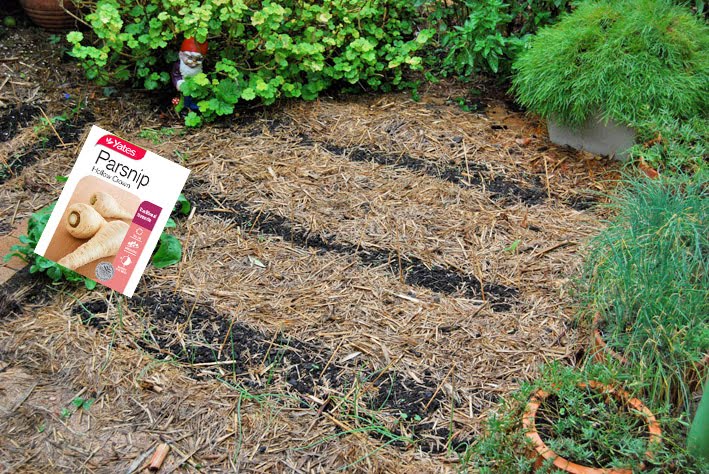
This levitating seed packet of parsnips represents another plant which hates being transplanted and must be grown from seed. I'm having another go at parsnips this year, as my home-growns from two years ago were the sweetest, tastiest, tenderest parsnips I have ever enjoyed. While I know it's the cliche to claim that everything home-grown tastes better than the shop-bought stuff, I really haven't found that to be invariably the case. With tomatoes, definitely yes; parsnips, most assuredly yes; freshly harvested herbs, yes; English spinach, yes; potatoes, yes; citrus yes; garlic, yes.

But for vegies such as carrots, leafy greens, beetroot, shallots, cucumbers, eggplants, silver beet, beans and broccoli the real advantage to me is their tenderness and fresh quality, plus the knowledge that they really, truly have been grown organically. This latter group have never tasted especially superior to the high quality shop-bought, fresh equivalent. I just know mine are healthier. But my home-grown parsnips were a revelation in flavour and tenderness. I want to eat them again!

Besides, parsnips aren't a bad looking plant, either. Very nicely green and leafy, and they are part of the garden for a number of months as they slowly grow through the winter. The only problem with getting parsnips started is that even the seed packets suggest you sow the seed thickly, as germination rates are a bit iffy. I can live with that. And I've done the bamboo skewer trick to keep the doves and pigeons away, too.

Here's an evening meal's worth of parsnips harvested last time round. One interesting little snippet about my parsnips is that here in Australia at least there aren't all that many varieties to choose from. By far the most popular variety is 'Hollow Crown', and it has been around for generations. It's a bona fide Heritage or Heirloom vegie, but all the major seed suppliers have it too, and it's not marketed as such. The best Yates Seeds (the biggest seed company in Australia) can do is call it a 'traditional favourite'.

So I don't really have much to grumble about with my seeds. I just hope all that heavy rain we had over the weekend hasn't washed the teeny weeny little poppyseeds away, but the soil there doesn't look too disturbed. I should be seeing some action there maybe next weekend if I'm lucky. But with the parsnip seeds, I'll have to wait. They're every bit as slow as parsley seeds to get going, taking three to four weeks to come up.

And that's both the best and the worst bit about seeds: the waiting!


Saturday, March 19, 2011

Rain at last!


Goody goody raindrops! Some decent rain at last, the first good fall of the year, in fact, and we're halfway through the third month. Huey, you've been a disgrace to your profession of Aussie Rain Godlihood this year. Floods in Queensland and Victoria, and Sydney, which is piggy in the middle, gets almost no rain at all for the first three months. (Well, when I say "no rain at all", I mean 33mm in January, when the average is 103; 23mm in February, when the average is 117; and until yesterday only 14mm in March, when the average for the month is 131. That's a dry spell by Sydney standards.)

I'm not sure what has been going on up in the weather-making heavens, but here's hoping today's blessed sogginess is the beginning of some kind of return to normal. Let it rain, Huey!

There, I've had my say, on with the slide show. I do love a rainy day!

My curry tree, looking greener than ever thanks to the simple expedient of more food. I didn't realise they were so greedy. Just the organic liquid fish stuff, applied more often, does the trick.

Frangipanis manage to look equally nice in both rain and sunshine. And that perfume...

This year's annual flower discovery is the cheery, tough, long-flowering gomphrena. A little thing no more than 10 inches (22cm) tall, it has been flowering like this for three months now, and isn't about to stop.

This is a good example of bloody-minded determination at work. Late last year I sowed a punnet of 'mixed colour' capsicums and they were all pale lemony colour banana shapes. Boring! And so after I pulled up the last of the glut-making Lebanese cucumbers, I decided there was still time to have another go at growing some classic red and green bell-pepper style capsicums before it turns chilly in late autumn. This is the first green capsicum baby here, and so I think I'll get my colourful crop yet.

Rainy days and young lettuce are perfect photo partners, just like cute kids and fluffy pets.

Margaritas, anyone? The limes are ready to use now. Lots of Asian salad dressings for sure (1 tablespoon lime juice, 1 tablespoon fish sauce, 1 tablespoon tap water, pinch of sugar, pinch of chilli, shake, pour). And lime delicious puddings, and lime wedges for Pam's Corona beers. It's a good thing we like limes, as there's always a glut at this time of year.

The 'Eureka' lemon is flowering its head off, as I just fed the tree two to three weeks ago. For Aussie readers, all citrus trees need a feed now, by the way. A rainy day like today is the perfect day for feeding trees, as the rain waters in the fertiliser for you.

Typical, this. I've never done all that well with dill before, but I never give up on these things. So I wondered if sowing seed a bit more thickly might help, and now I have a forest of the stuff.

If my dill is too abundant, then my rosemary is too tall. It's at fence height now, about two metres. It's flowering profusely now, the most it has ever flowered, and I think that's due to the very dry summer here, which is much more to its Mediterranean-style liking.

Like the rosemary, the grevilleas here have been enjoying the drier summer. This 'Robyn Gordon' grevillea can get a bit sulky in persistently wet and humid conditions, but it's loving the dry run it has been getting lately.

And not all the happy plants here are mine. My neighbour Nick is a keen gardener, and at the end of every summer a stack of his plants become part of my garden, leaning over the fence for a chat to my plants. This is his Chinese lantern plant, the Abutilon, which our local native honeyeater birds just love.

Another of Nick's plants, this is called Nick's Pink Thing because I don't know its correct name. Bet you its real name isn't as good as Nick's Pink Thing, either.

On the right, Pam's indoor plant, her Peperomia, is having a day out in the rain, keeping my goldfish pond plants company. The lush green thing behind is our low-growing Gardenia radicans, which is always happy, provided you liquid feed it every month.

And so that's my rainy day report. I plan to rev up this garden blog again, now that the awful summer seems to be over. Just a quick note of thanks to the good people who got in contact to ask if I had given up garden blogging altogether. No way, but I did need a break from it to freshen up my blogging batteries. I've been sowing seed, I have cunning plans in mind, there is digging to be done and, from time to time some (more frequent) blogging to be done, too.

Sunday, January 9, 2011

Holiday snapz


I'm not sure what the official definition of a holiday is. One possible one is that if you're not sleeping in your usual bed, but you've got your usual partner beside you, then you're on holidays.

However, this time round we holidayed at home. The nights might have been same bed (same girl!) but the days have been very laid-back and irresponsible. I needed a break from blogging and we both needed a rest from work. So we concentrated on really difficult assignments like going to the movies, eating out at restaurants, and catching up with friends – on weekdays, for lunch. So that's my new working definition of a holiday. If you see your friends for a long lunch on weekdays, then you must be on holidays.

And so here are a few holiday snapz of my lovely summer holiday spent here at home, a million miles from care.

Every year Pammy designs her own Christmas cards, gets a local printer to print up a couple of hundred of them, then she hand-writes a message in each of them for family, friends and clients. This is this year's card, a complete departure from anything she has done before, and I love it.

Out in the garden, almost everything that happened was pretty much expected for this time of year, but there has been one exception. This orchid normally flowers in June and July, so what possessed just one plant to come into flower for Christmas, for the first time ever, I don't know. It seems healthy enough, but I've got my eye on this weirdo now.

The freshly harvested red spring onions looked so nice I had to take a photo of them before I started cooking.

Lazy me bought a punnet of 'mixed assorted capsicum' seedlings and all of them, every one, was of the yellowy-green banana capsicum type. Serves me right for not starting them from seed a month earlier.

I'm just starting to harvest the first of the Lebanese eggplants which I blogged about in December, here. What a wonderful colour, and it's a handsome plant.

I've created a monster with my Lebanese cucumber plants. We are cucumbered out! Fortunately both of our Greek neighbours' families eat cucumbers by the score, and so a couple of armfuls have been handed over the fence on both sides so far. And whether they want them or not, friends and family all leave after a visit here with some cucumbers. Where I went wrong is that I noticed there were few bees buzzing around the cucumber plants, and so I hand-pollinated the flowers with a paintbrush – and ended up with a major glut. They're very nice to eat, though, and we've even cooked them as a vegetable, sliced into sticks and sauteed in butter with either chopped chervil or dill tossed in at the last moment. Nice side dish.

As well as having too many cucumbers, I definitely have too much basil. There's only so much pesto you can eat or make, same for tomato and bocconcini salads, tomato pasta sauces, etc. The upside is that it's a nice plant to be around. If you lightly brush past it as you're weeding around the area, the air is scented with basil as you work.

Don't you love it when a sick plant bounces back from death's door and gets well again? That's real job satisfaction. A while back I did a blog posting with the dreadful name of 'The Black Lagoon' about the radical attempt to resuscitate this struggling pot of French tarragon by soaking it in an inky-black lake of Seasol and a wetting agent. Well, it worked! Lovely aniseedy flavour, French tarragon, and I'm sure the revived stuff tastes better than ever.

At the same time as I rescued the tarragon, the chives needed the same rehab treatement, and that soaking trick definitely seems to work on sad, struggling pots of herbs.

Another former hospital patient has bounced back well. This Grevillea 'Robyn Gordon' has looked as though it was headed for the cemetery twice in its career, and both times it has recovered beautifully thanks to repeat sprays with Anti-Rot, followed by a radical prune. The honeyeaters are loving it now, squabbling over the nectar-laden flowers every morning.

Down close to ground level the little Tibouchina 'Groovy Baby' has hardly grown at all. Iit is a dwarf that will only get to 60cm (two feet) but it's going nowhere fast. However, it has been in flower since late September and is still going strong. Some of the lower leaves are yellowing a bit, which is a worry, so I've fed it recently in the hope that it's just tuckered out from flowering so much.

I'm a sucker for quick-growing, dense-blooming summer annuals, and these marigolds are as reliable as they come. Once planted, they need almost no attention.

Ditto these rudbeckias. Easy-peasy and cheerful too.

As I started with Pammy's card for the masses, I might as well finish with Pammy's card made just for me. Her gift choices, gift-wraps and cards are a constant marvel to all who know her, and this year she made a special card for me, a whole year in our garden. Each month, on the first of the month, she took a photo of the garden from the same spot. The card itself is a whopper, A3 size (and of course the other six months are on the other side). She's a special one, my Pammy.

So welcome back to all my readers, and I hope you too enjoyed some good times over the Christmas/New Year period. I know from watching the news how hard that would have been to achieve for many people. I saw how appalling the snow and cold has been in both North America and Europe, and how drenched and heartbroken much of Queensland has been as well. I just hope that 2011 is a better year than 2010 for all of you (and us as well), a much better year.

This year I am planning on conducting a hi-jacking of sorts of my own blog. I'll still keep rabbiting on about my garden as I usually do, but if things work out as I expect they will, I might blog a bit more about food and cooking this year, and a bit less about gardening. We'll see what happens.

Pam and I are in full swing planning our holiday to the US later this year, and 'American cookery' was the theme of the various books and packages of ingredients which formed her Christmas present to me this year. So don't be surprised if I blather on about gumbo instead of grevilleas and jambalaya instead of jasmine, from time to time.

Wednesday, December 15, 2010

Lebanese eggplants


"That's a nice plant to grow in the garden just for its own sake. I think I might do a painting of that one," said my wife Pam this morning. Though it isn't bearing any fruit at the moment, our Lebanese eggplant has begun to flower, and it's a handsome plant, worthy of an artist's attention.

There's a lovely purpley-pink tinge to the flower buds, flowers, the stalks and the central veins of the broad leaves of this Lebanese eggplant.

The plant label promised that it would reach about 1m tall, so it's halfway there now. I planted some little annuals called Gomphrenas at the same time as I planted the eggplant seedling, as I thought a pinky purple scene would look pretty. So far so good!

The flowers themselves point down towards the ground, and hopefully some long, thick, sausage- shaped, purpley-black eggplants will be dangling from this spot sometime in late January.

Turn a flower up for a peek and it has that tell-tale look that other members of the Solanum genus, such as potatoes, have. It's a simple bloom that has a brief heyday of beauty, but with that colour it's a class above a humble white spud flower.

As I mentioned earlier there's a purplish tinge to the dark veins that run along and across each leaf. They're a big part of what makes this plant such a handsome thing. Growing it isn't too hard. It's the usual story of give it fertile, well-drained soil, lots of sunshine and regular water. The plant label says to give it an extra feed when the fruits start to swell, and avoid over-watering as the fruit nears maturity. In a typically wet Sydney summer, that might be where I come unstuck!

Pam and I are not big eggplant eaters, but we do like them occasionally. I just like to grow all sorts of vegies, just to see how the plants grow and look. I'm sure we'll find some new ways to enjoy our home-grown eggplants. I am rather fond of the dip called Baba Ghannouj, so here's the recipe I use (it's based on the one from the Complete Middle Eastern Cookbook, by Tess Mallos, but not so garlicky).

1 medium sized eggplant, about 375g
1/4 cup lemon juice
1/4 cup tahini (a sesame paste product used a lot in Lebanese cooking)
1 clove garlic
salt to taste
1 tablespoon olive oil

Pierce the eggplant all over with a skewer (to stop it bursting), then place it on a rack in a 180°C (350°F) oven for about 35-40 minutes, turning it once or twice to ensure even cooking.
Remove from the oven and let it cool slightly, but do peel off the skin while it's still very warm. Discard the skin, roughly chop the flesh, then put the flesh in a blender, along with all the other ingredients, and whizz till it forms a paste.
Use it as a dip with flatbread or crisps, or serve it as a side dish in a spread with cooked meats, salads, flatbread etc.
Note: if you can be bothered to cook the eggplant over a smoky char-grill, the eggplant will take on a smoky flavour which some people say is the hallmark of a great baba ghannouj. I'm not wild about smoked flavours myself, but there you go.

Finally, if you enjoy Lebanese food too, there's a great food blog by a Sydney-based Lebanese cook that's well worth visiting. It's called The Food Blog and right now, today, he's making pistachio ice-cream.


Wednesday, November 17, 2010

Crunchy munchies


My girl Pam likes her healthy snacks: carrot sticks, celery sticks and cucumber sticks. (I think all this health food puts the cosmic balance of our house out of whack, so I balance things out with Peanut Butter on toast.) Simply because I have never grown cucumbers before, I decided that I would have a go at providing Pam with some home-grown healthy crunchy munchies in the form of some Lebanese cucumbers.

Now, before you start hitting the comment button with "you're doing it wrong, Bozo" comments, yes I know I should be growing them up a trellis of some sort. The problem is that I've run out of space for trellises, and my vegie growing books say you can grow them along the ground, if you plant them into a raised mound. So that's what I'm doing. After a slowish start in October, rainy November has been just what the cucumber plants wanted.

The first of them is almost ready to harvest already. Naturally enough I've sown the cucumbers into soil enriched with a stack of home-made compost and generous handfuls of pelletised chicken manure. Cucumbers love their 'good going' so I hear.

While not spectacular the cucumber flowers are plentiful, cheerful and a pleasing sunny yellow for the brief time they appear.

Behind most of the flowers you can see the baby cucumbers already forming. No doubt we will end up with a glut, and so anyone coming over to our place will probably find some Greek-style Tzatziki dip on the table (for the recipe, see below).

"Where's my trellis, man?" asks the seeking tendril. Sorry bud, hit the low road, you're a groundcover plant this time round. While growing cucumbers on the ground definitely isn't recommended, I think I should be able to keep the fruit looking good by being attentive to keeping fresh straw mulch beneath the developing fruits. We'll just find out whether this works or not over the next few weeks, I guess.

While the wet weather is a blessing at the moment, it also threatens the usual curse of powdery mildew fungal attack which affects all the cucurbits such as cucumbers, zucchinis, marrows, squash, melons and pumpkins. This time round I'm using a new organic product called Eco-Fungicide. As far as I understand it, it's basically glorified bi-carb soda, but I've been told it works. You need to mix up a batch and use it all that day (it doesn't store), and that means adding a spoonful of the powder to water, along with a thimble full of vegetable oil or horticultural oil. So far so good - no powdery mildew on the plants, so it seems to work well. Last year I used the home-made organic solution of watered-down milk sprays, and these worked fairly well but you had to respray constantly, and it was a bit of a hassle to stay on top of the problem.

Finally, a recipe. Tzatziki for cucumber gluts.

1. Peel, deseed and grate 1 cucumber. Leave the grated cucumber to drain in a colander for 15 minutes, then squeeze out any remaining juice in your hands.

2. Mix the drained cucumber into 250g thick Greek plain yoghurt, then add 2 tablespoons extra virgin olive oil, 1 tablespoon white wine vinegar, 1 tablespoon chopped fresh mint, crushed garlic to taste*, salt and pepper to taste.

Tzatziki is nice as a dip with bread or crackers, but it's also great dolloped on the side when serving barbecued meats, seafood, chicken etc.

* As for 'garlic to taste', real Greeks would add at least 4 cloves of crushed garlic to their Tzatziki, while lots of non-Greeks would think 1 clove of crushed garlic is probably a bit too much. So I'll leave the exact amount of crushed garlic up to you. I'm a 1 clove wimpy Anglo boy myself. I find too much garlic ruins the refreshing zing of this dish, with its tangy mint, vinegar and yoghurt flavours. But try to tell a Greek that too much garlic ruins it!