Showing posts with label pebble mulch. Show all posts

Friday, August 27, 2021

Gladiator V Onion Weed

Pictured below is nothing less than a disgrace. A weedy disgrace, a total temporary victory by the evil onion weed.

And so last week I decided I had to do battle with this almost invincible foe, or die in the attempt. More to the point in my current state of health, I didn't so much fear death by onion weed than a relapse in my recovery from the broken foot/wrecked ankle. Neither happened, I'm still here. I won (kind of), and here's what happened in the Coliseum Match of Gladiator V Onion Weed.

Neglect onion weed for a few weeks so it gets a foothold in your garden, then wait for a thoroughly wet week or so of rain and suddenly you have this appalling problem to deal with.

And this is how it looked about three hours later. Every plant removed from the patch, plus half a wheelie bin full of onion weed. And as well as getting the big strappy leafed onion weeds with the bulbs on the bottom, of course there are approximately one million baby bulblets left behind, waiting for their chance to make my life a misery. I managed so sift out a few hundred thousand bulblets, but have no illusions about the task ahead. All the white dots you can see on the soil surface are the remnants of my decorative pebble mulch that has never managed to suppress a single weed in the last decade. Pretty, but useless ... 

Apart from leaving in place one large Crassula shrub and a pretty Kalanchoe 'Copper Spoons', I pulled every other succulent out of the ground. This trug full of haworthias isn't all of them by any stretch. These things multiply almost as well as onion weeds.

Little guys like these sempervivums somehow survived the smothering weeds, but from now on they are going to be growing in their own comfy pots.

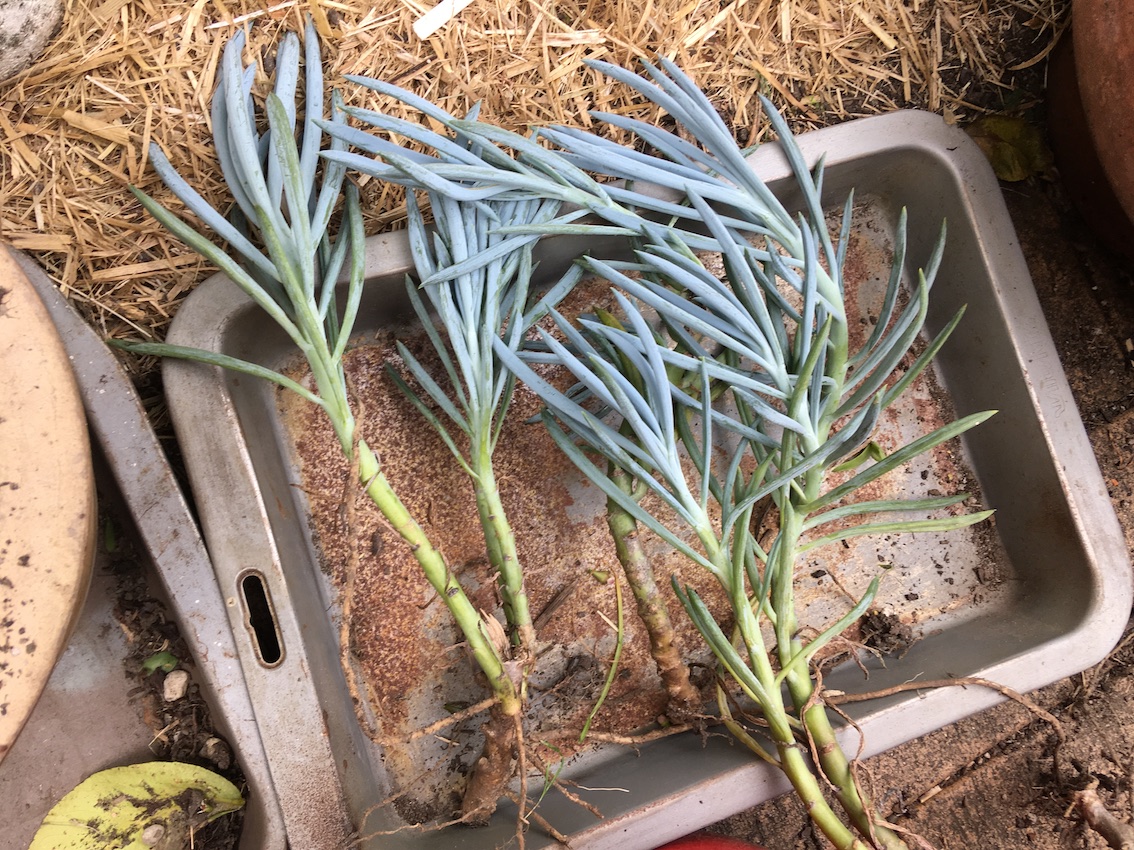
Some of these Senecio 'Chalk Sticks' will be popped into pots, and a few put back in the ground. Lovely grey-blue colour.

I don't look like much of a Gladiator, but it was a torrid battle that lasted most of the day in the end. One of the things I like about digging soil is coming across all the worms and other little critters who call this soil home. I suspect they were all very upset by my presence. 

So the brilliant new plan is to grow many more succulents in pots, and only the very hardiest things (like those multiplying haworthias) in the ground. I've alway grown a small selection of cacti in pots, and the succulents make perfect company for them.

I used up every spare pot I could find in no time. The best ones for growing succulents are the "wide and shallow" ones. And I used up all my special Cacti & Succulent potting mix in no time, and most of these are now growing in good old ordinary potting mix, which will probably suit them just fine anyway (but it was all I had in the shed, so I couldn't be fussy).

As mentioned earlier, I have left the established 'Copper Spoons' shrub where it is, in the ground. Love the coppery colour of the new foliage. Every now and then a few leaves that fall off soon sprout into new plants on the ground, without any help from me.

Years ago when I first started this blog I made it a mission to find out the actual botanical names of my succulents, and it was no easy task. I tried hard but did get several wrong and was then corrected by succulent specialists who got in contact to set me straight. I am almost back where I started, though, as I now have half a dozen succulents, including this handsome one, whose name I don't know. I call him 'Pagoda guy'.

Since I renovated the succulent patch I've only been disappointed that there's still no sign of the first onion weed shoot popping up through the soil. I'm keeping a close watch and heaven help that first sprout! However, the real test will be whether I can keep up the vigilance if warm spring and summer weather gets wet. That's when the onion weed will really get cracking and try to take over again.


Tuesday, August 15, 2017

Mulch, let me count the reasons why ...


Yesterday, compost. Today, mulch. We're getting back to basics here this week, but these two topics are the heart and soul of healthy soils, and that's where happy gardens thrive.

To get started on my mulching post, I trotted out to the backyard, confident as could be with a trusty trowel in one hand, mini camera in my pocket. I peeled back a layer of mulch, dug down a few inches, and this is what I saw ...


One of the reasons I am a keen mulcher is this person, and his/her million brothers and sisters. (Hang on Jamie, I think worms are hermaphrodites, so I'll change that to the much safer and more accurate "siblings".) 

I just knew if I lifted up some mulch and dug down that I'd find worms. They love a cool blanket covering their soil. In fact, I've noticed (completely unscientifically mind you) that in the places in the garden where the mulch has thinned out, there aren't so many worms when I dig there. In the heavily mulched spots, worms are plentiful. I do like the idea that they move around, and they have opinions.

If your soil has lots of worms, you're in a good place. Almost anything and everything you plant into soil thriving with worms should grow there. So that's the first reason I love to mulch my garden. It makes worms happy!

Another reason I love mulching my garden is that it just looks good. Sure, it's bit of a superficial thing to say, but I just love the way mulched beds look, especially when I use my favourite straw-look mulch, which here in Australia is sugar-cane mulch.

Speaking of sugar cane mulch, this is the stuff I bought on Saturday. I think it's a new brand, or different packaging, but I have no brand loyalty whatsoever to any one brand of sugar cane mulch.

However I am fiercely loyal to a price point of no more than about $16 per bale. Any more than that and I won't buy it, any cheaper and I am your man. I love it when I can get a bale for $12 or even less. In our small garden, one compressed bale like this covers pretty much all the beds I mulch with hay. 

I don't spread it too thick, either — just two or three inches — as there's plenty of evidence that a too-thick layer of mulch can prevent the water from lighter showers of rain ever reaching the soil below — and you don't want that to happen.


Our fruit trees, like this Tahitian lime, are mulched year-round, and it definitely helps to suppress weeds and retain soil moisture. This is the reason the advertisers always trot out, and they do over-claim its benefits in the hope of attracting lazy gardeners. Take it from me, weeds will still appear, and you will still have to water your garden regularly. And the mulch will eventually break down, and you will have to top it up regularly. I kid you not, mulching is just another gardening chore. It isn't a magic work preventer.

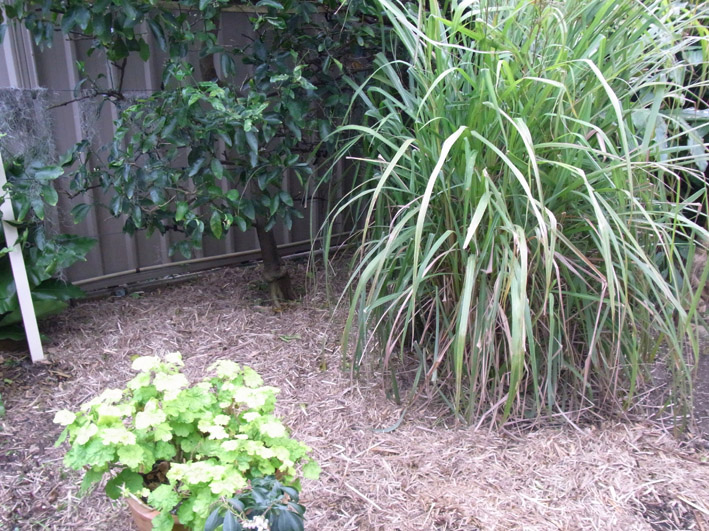
What's that big thing on the right? That's my lemongrass plant, and in about a week from now it will be getting its annual cut-down-to-the-ground trim, and it will be back to its beautiful, fragrant, willowy best by midsummer. It doesn't mind a bit of mulch around its root zone, either.

Finally, this is my other favourite use for mulch: to keep weeds down in all my bigger potted plants. This is my Thai lime tree, and ever since I started mulching it with sugar cane the weed problems have been halved. Oxalis still spreads itself around, but it is fooled into thinking the layer of mulch is "soil", and so I find it's now much, much easier to pick out long strands of oxalis now.

As for the mulch retaining moisture in the potted plants, I guess it does that, but I find potted plants need a power of watering to stay happy in Sydney, so no layer of mulch is ever going to stop my watering program. However, the mulch does provide some peace of mind if I go away for weekends.

Sure, there are other mulches, such as lucerne mulch, which the expert gardeners recommend. But have you seen how much that stuff costs? I am too much of a cheapskate to ever use lucerne mulch. 

And pebble mulches, they look really cool. My whole succulent garden is covered in pebbles, and they are a truly hopeless mulch if you're hoping to suppress weeds. Onion weed just brushes pebbles aside. 

At least the pebbles don't stay wet, like normal mulches do, and so the succulents don't get hopelessly soggy and die during one of Sydney's horrible wet weeks of constant downpours, which happen a few times every year.

And I do use coarse bark mulches in other spots where it's not so visible. It has the advantage of lasting much, much longer than sugar cane so it's a good investment if your budget is tight, but I find it a bit depressing to look at if there is too much of it. 

But everywhere else, give me sugar cane mulch every time. I love the farmyard look when it's freshly spread, and my little mates the worms love it, too, which is good enough for me.


Friday, May 13, 2016

Renovations


Should they ever discover plant life on Mars I would not be a bit surprised if it turned out to be onion weed ... or oxalis. These two weeds are indestructible, and they have well and truly taken over our succulent patch in recent months. It was a disgrace: you could barely see the smaller succulent plants for the weeds, and so I've been waiting for the weather to cool down a bit so I could get stuck into the big job of yanking out all the weeds and renovating the whole patch back to "as-new" condition.

To kick things off, let's start with the finished, renovated succulent patch. Traa daa! 


This, dear readers, is how it now looks, six hours after starting on the project. It took a lot longer than I imagined it would.


The first step was to pull every small succulent out of the ground and toss them into a few trugs and trays. That's one thing I can say about succulents: these things grow and multiply incredibly easily. I was amazed how many there were.

The next step was the ugly bit, and it took a long time to do it: digging out onion weed and both type of oxalis (ie, the one with large leaves which grows from bulbs (Oxalis latifolia) and the "creeping" variety with small leaves that sends out runners in every direction (Oxalis corniculata).)

As I dug the soil I realised that there were probably more decorative "mulch" pebbles in the soil than on top of the soil as mulch, so I went into the kitchen, grabbed a large bamboo-handled wire scoop (bought from a Chinese food store) that we never use, and pressed it into service as a pebble sifter.


What a fantastic pebble sifter! It did a brilliant job, and along the way it also scooped up, oh ... about another thousand oxalis and onion weed bulbs.


Two giant trugs loaded up with sifted pebbles, and I was ready to plant the succulents back into the prepared bed. 

(By the way, pebble mulches are nice to look at and have one other benefit: they don't stay wet and so they are a good environment for growing succulents. As for slowing the growth of weeds? Utterly hopeless. In fact, the creeping type of oxalis loves spreading across pebble mulches, and onion weed powers through it. And over time, the pebbles slowly sink into the soil, so in general they aren't my favourite mulch at all.)


Replanting everything allowed me to re-arrange the plants, with the smallest ones right down the front, mediums in the middle and tall ones at the back. I know this sounds perfectly obvious, but when I originally planted the succulents I wasn't sure of their ultimate sizes, and a few have grown more than I expected.Pictured here are Gasteria (top left), sempervivums (left), faucaria centre right, echeveria (far right), Corpuscularia (top centre), and another type of echeveria (top right).


Some of those names above might be familiar to you, but if you haven't heard of corpuscularia, here it is. It's one of my favourites in the whole patch, and the renovation has allowed me to move it to a better spot.


The spiky guy in the centre is Haworthia attenuata. When I planted it back in 2012 the clump was almost this size. Now, four years later, I was able to divide the clump into two clumps this size. I honestly hadn't realised until I looked at an old photo how much this had grown.


As I mentioned earlier, I had dug out all the smaller succulents, but had left the larger, more established succulent shrubs in place. And they've also grown a fair bit since I first planted it all out in September 2012. Look at the photo below for the comparison.


While the weeds have multiplied, so have the succulents themselves. I am sure the weeds will be back in force in no time, but here's hoping the succulents will also keep on growing and take over the place. That's the plan ...


Sunday, September 28, 2014

Mulching by instalments


Our extremely soggy August provided some of the best conditions for weeds to grow in living memory, and trust my luck that at the same time I have been on what might be called 'light duties' lately – forced to rest up while my arthritic old ribcage tries to mend itself. And as a compulsive gardener, I sometimes forget that I am on light duties, I see something "out there" that I just have to attend to … and I hurt myself again. Back to square one ...

And so it has come to this. When in my prime I could mulch whole acres in a day (OK, slight fib) right now I am doing it one square metre at a time - per day. Talk about slow progress.

When I talk "mulching", that really is gardening code for "lots of weeding for 90% of the time taken (to get rid of the onion weed, oxalis, chickweed and other uninvited greenery) followed by a short, triumphant spreading of the mulch as a grande finale". 

I use three different mulches here in our garden. All the food
plants are mulched with sugar cane mulch. The purists, who must
also be quite rich, insist on lucerne hay, but the poor, ordinary
folk-on-a-budget of this world use sugar cane mulch in Sydney.
The ornamental flowering beds are mulched
with some kind of composted bark, such as
this freshly laid pine bark around this gardenia.
Here it is in close-up around our newest acquisition, a
Grevillea 'Pink Lady' ground cover.
The third type of mulch in use here is the
off-white pebbles in the succulent patch, and
it has proved to be a hopeless mulch. All
weeds love it. Here's some onion weed brushing
the pebbles aside.
The oxalis skips across the top of the pebbles like Ginger Rogers
and Fred Astaire. Oxalis just adores pebble mulches.
My favourite mulch by far, the sugar cane mulch, is full of fresh,
farmyard handsomeness for the first two weeks after it is
spread. Thereafter it goes grey and lifeless, and as it breaks
down quite rapidly it needs regular replenishment. But I do
love the look of a freshly mulched vegie patch!
And so today I weeded and mulched the spot where I planted the perpetual spinach and Serrano chilli (pictured above). Next chance I get, it's the strawberry patch (another square metre owned by Emperor Oxalis). After that, maybe next weekend, another square metre around the clivias and frangipani. I think I am slowly catching up to the August explosion of weeds, but please Huey, no month-long downpours this spring? Please, my ribcage couldn't stand it!