Showing posts with label pebbles. Show all posts

Friday, May 13, 2016

Renovations


Should they ever discover plant life on Mars I would not be a bit surprised if it turned out to be onion weed ... or oxalis. These two weeds are indestructible, and they have well and truly taken over our succulent patch in recent months. It was a disgrace: you could barely see the smaller succulent plants for the weeds, and so I've been waiting for the weather to cool down a bit so I could get stuck into the big job of yanking out all the weeds and renovating the whole patch back to "as-new" condition.

To kick things off, let's start with the finished, renovated succulent patch. Traa daa! 


This, dear readers, is how it now looks, six hours after starting on the project. It took a lot longer than I imagined it would.


The first step was to pull every small succulent out of the ground and toss them into a few trugs and trays. That's one thing I can say about succulents: these things grow and multiply incredibly easily. I was amazed how many there were.

The next step was the ugly bit, and it took a long time to do it: digging out onion weed and both type of oxalis (ie, the one with large leaves which grows from bulbs (Oxalis latifolia) and the "creeping" variety with small leaves that sends out runners in every direction (Oxalis corniculata).)

As I dug the soil I realised that there were probably more decorative "mulch" pebbles in the soil than on top of the soil as mulch, so I went into the kitchen, grabbed a large bamboo-handled wire scoop (bought from a Chinese food store) that we never use, and pressed it into service as a pebble sifter.


What a fantastic pebble sifter! It did a brilliant job, and along the way it also scooped up, oh ... about another thousand oxalis and onion weed bulbs.


Two giant trugs loaded up with sifted pebbles, and I was ready to plant the succulents back into the prepared bed. 

(By the way, pebble mulches are nice to look at and have one other benefit: they don't stay wet and so they are a good environment for growing succulents. As for slowing the growth of weeds? Utterly hopeless. In fact, the creeping type of oxalis loves spreading across pebble mulches, and onion weed powers through it. And over time, the pebbles slowly sink into the soil, so in general they aren't my favourite mulch at all.)


Replanting everything allowed me to re-arrange the plants, with the smallest ones right down the front, mediums in the middle and tall ones at the back. I know this sounds perfectly obvious, but when I originally planted the succulents I wasn't sure of their ultimate sizes, and a few have grown more than I expected.Pictured here are Gasteria (top left), sempervivums (left), faucaria centre right, echeveria (far right), Corpuscularia (top centre), and another type of echeveria (top right).


Some of those names above might be familiar to you, but if you haven't heard of corpuscularia, here it is. It's one of my favourites in the whole patch, and the renovation has allowed me to move it to a better spot.


The spiky guy in the centre is Haworthia attenuata. When I planted it back in 2012 the clump was almost this size. Now, four years later, I was able to divide the clump into two clumps this size. I honestly hadn't realised until I looked at an old photo how much this had grown.


As I mentioned earlier, I had dug out all the smaller succulents, but had left the larger, more established succulent shrubs in place. And they've also grown a fair bit since I first planted it all out in September 2012. Look at the photo below for the comparison.


While the weeds have multiplied, so have the succulents themselves. I am sure the weeds will be back in force in no time, but here's hoping the succulents will also keep on growing and take over the place. That's the plan ...


Sunday, September 16, 2012

Got it covered


Oh what a difference mulch makes! We've all been indoctrinated in recent decades to value mulch for its ability to disappoint weeds and to keep the soil moisture where it's needed around the plant roots, but today I looked back on a couple of hours of mulching (after a lot of planting) and the thing that really hit me was how much better a garden looks with a fresh layer of mulch. It hides all sorts of blemishes. And down at the landscape supply place it's clear that there's a couple of dozen different mulches to choose from. It actually took me a while to decide, too.


In the foreground, a fresh layer of fine
pine bark mulch around the purple patch
of lavenders and tibouchinas. Much better
looking than plain, dark brown earth. In the
background, the succulents' pebbly cover.

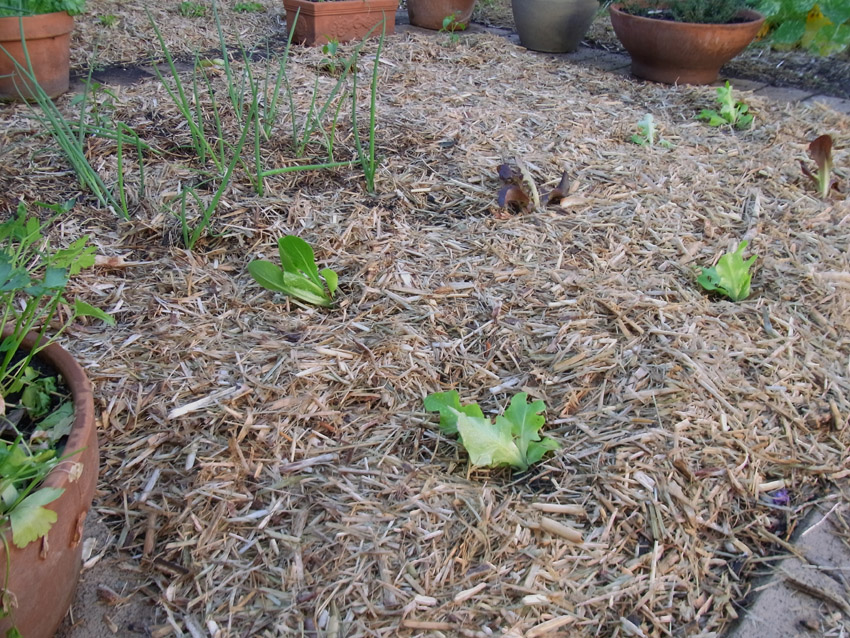
All the vegie/salad/herb beds are mulched with straw.
It's a nice farmyard look on the day it's laid down,
but this stuff breaks down fast, so it'll need topping
up in a month or so. No worries with that, as I keep a
big bag of sugar cane mulch in the shed for this routine
job, but that bag of mulch also comes in handy as a
magic ingredient in making compost. Every few days I
spin the compost tumbler bin, like a good boy should,
but before I do I add a very generous handful of straw
to the bin, which is mostly full of wet vegie/fruit scraps.
The dry straw balances out the wet-dry mixture, and
ever since I started this habit several years ago,
the quality of my compost improved enormously. 

This is just my excuse to run another photo of my pebbly
little succulent patch. All seems well here, in fact I am
sure some of them are showing signs of growth already.

I've used the fine pine bark mulch around
today's plantings of Lomandra 'Tanika'
(the low grass in front) and the Tiger
Grass behind. This 'Tanika' stuff is evergreen
so it doesn't go through a crappy looking
phase each year. It's almost indestructible,
and is often seen in traffic islands and other
very inhospitable spots. I want my garden to be
much lower maintenance, and I'm hoping that
the Tanika, backed by the bamboo-like tiger
grass, will be the least of my worries over
the coming months and years. Time will tell
whether this works or not. It almost feels like
cheating or laziness to plant Tanika – heck, we
keen gardeners are meant to take on impossible
challenges! Well, this keen little gardener with a
dodgy back is simply hoping for a lighter workload. 
I think I've got off track in this post... where was I? Oh that's right, mulch! Without me thinking about this fact too consciously, it has worked out that a key part of the design for this little backyard makeover is that it's the mulch which defines the various beds. Pebbles for succulents, straw for food plants, and the foliage-only and flowering plants are mulched with fine pine bark. Works for me.

Saturday, August 25, 2012

Heavy lifting


It's a glorious, sunny Saturday afternoon and here I am inside blogging on my computer, when I should be outside weeding, digging, planting and, well you know... gardening! Never fear I am just giving my poor old back a long, late lunch break before I saunter outside for a final burst of activity. But I haven't been slacking this morning: I've been doing some heavy lifting, all in a good cause.

I went out to Turtle Nursery at Rouse Hill in north-western
Sydney. It's about an hour's drive from my inner-western
former crime den now trendy village of Marrickville. I
was on a mission to buy some sand, the right sand, for
my succulent beds, and Turtle Nursery is the place to go,
so I've been told. As Turtle also has the pebbles and
manures I also need, I loaded up my poor little Citroen
with about 380kg of bagged garden goodies there, then
slowly drove home, my little car looking like a lowered
hot-rod, when the truth was a lot slower.

Once I got home, the serious heavy lifting began.
Eight 20kg bags of 'P-Coarse' sand, at $6 a pop. It's
the right stuff: nice, clean, washed, coarse-grained
river sand, ideal for adding to potting mixes or to make
soils sandier. Not having a trolley or barrow at hand,
I pressed our wheelie garbage bin into service, popping
two bags at a time on the lid and wheeling each load up
the narrow passage along the side of our house.

Six 20kg bags of 10mm-size Cowra white pebbles,
at $10 a pop: the future mulch around the planted
succulents. An organic mulch (eg, bark chips, leaf litter)
would hold too much water during one of Sydney's week-
long drenchings that happen a few times every year.

Six 25-litre bags of aged cow manure,
at $6 a bag. These are to enrich the soil
where I will be planting the gardenias, and
the leftovers will go into the vegie patch,
along with lots of home-made compost.
Well, that's the heavy lifting done: I'm going to give my back a rest today and begin on the digging in and spreading around chores tomorrow. In the meantime, there is still plenty more to do in the way of removing existing plants, weeding and cutting back. 

I'm making progress on this garden renovation every day now. As I work from home it gives me the chance to do a bit of gardening in the early mornings, just an hour of activity before I start work each day. And yes, it's hard to drag myself back to the desk sometimes. I'm in the mood to be out in the garden all the time, right now. I think I've got my gardening mojo back!

Almost everything in this photo had to go. Pam has
never liked the mother-in-law tongues in the background
here, although I admired their tenacity, if not their looks.

Gone now, the mother-in-laws and the money tree.
The mulched foreground was once occupied by quite
a large sage bush, but it is making way for that
purple-flowered tibouchina on the left. I've dug up
a small piece of the sage bush with a good root system
attached and new baby leaves all over it, so I hope sage
junior keeps up the fine tradition set by its parent plant.

All is not sand, manure and destruction here right
now. The potted herbs are all off to an early spring
start. I already had a packet of chive seeds, so I
combined a cheap new pot of chive seedlings with
a surrounding sprinkle of seed. The seed has come
up nicely, the seedlings are happy and this should
be a nice, dense clump in a month or so.

The common mint and spearmint are both thriving
in their new potting mix and the regular liquid feeds
haven't done any harm, either. Happy plants.

A few weeks ago, I saw a Mr Fothergill's packet of
coriander seed set into little circular pads of seeds
(like seed tapes, only round). I've never used seed tapes
much and so something in me said 'give them a try' and
they seem to be working quite well.

Finally, the rest of the garden is very
definitely of the opinion that spring has
sprung. My potted Turkish Brown fig,
which was Underperformer of the Year
in its first year in the garden last year,
is off to an early promising start in its
second growing season. Good!

Well, lunchtime is over, my back seems (touch wood) to feel fairly normal, and I'm back out into gardener's playland for an afternoon session. I think I'll stick to weeding, though. That's enough heavy lifting for one day.