Showing posts with label kalanchoe 'Copper Spoons'. Show all posts

Friday, August 27, 2021

Gladiator V Onion Weed

Pictured below is nothing less than a disgrace. A weedy disgrace, a total temporary victory by the evil onion weed.

And so last week I decided I had to do battle with this almost invincible foe, or die in the attempt. More to the point in my current state of health, I didn't so much fear death by onion weed than a relapse in my recovery from the broken foot/wrecked ankle. Neither happened, I'm still here. I won (kind of), and here's what happened in the Coliseum Match of Gladiator V Onion Weed.

Neglect onion weed for a few weeks so it gets a foothold in your garden, then wait for a thoroughly wet week or so of rain and suddenly you have this appalling problem to deal with.

And this is how it looked about three hours later. Every plant removed from the patch, plus half a wheelie bin full of onion weed. And as well as getting the big strappy leafed onion weeds with the bulbs on the bottom, of course there are approximately one million baby bulblets left behind, waiting for their chance to make my life a misery. I managed so sift out a few hundred thousand bulblets, but have no illusions about the task ahead. All the white dots you can see on the soil surface are the remnants of my decorative pebble mulch that has never managed to suppress a single weed in the last decade. Pretty, but useless ... 

Apart from leaving in place one large Crassula shrub and a pretty Kalanchoe 'Copper Spoons', I pulled every other succulent out of the ground. This trug full of haworthias isn't all of them by any stretch. These things multiply almost as well as onion weeds.

Little guys like these sempervivums somehow survived the smothering weeds, but from now on they are going to be growing in their own comfy pots.

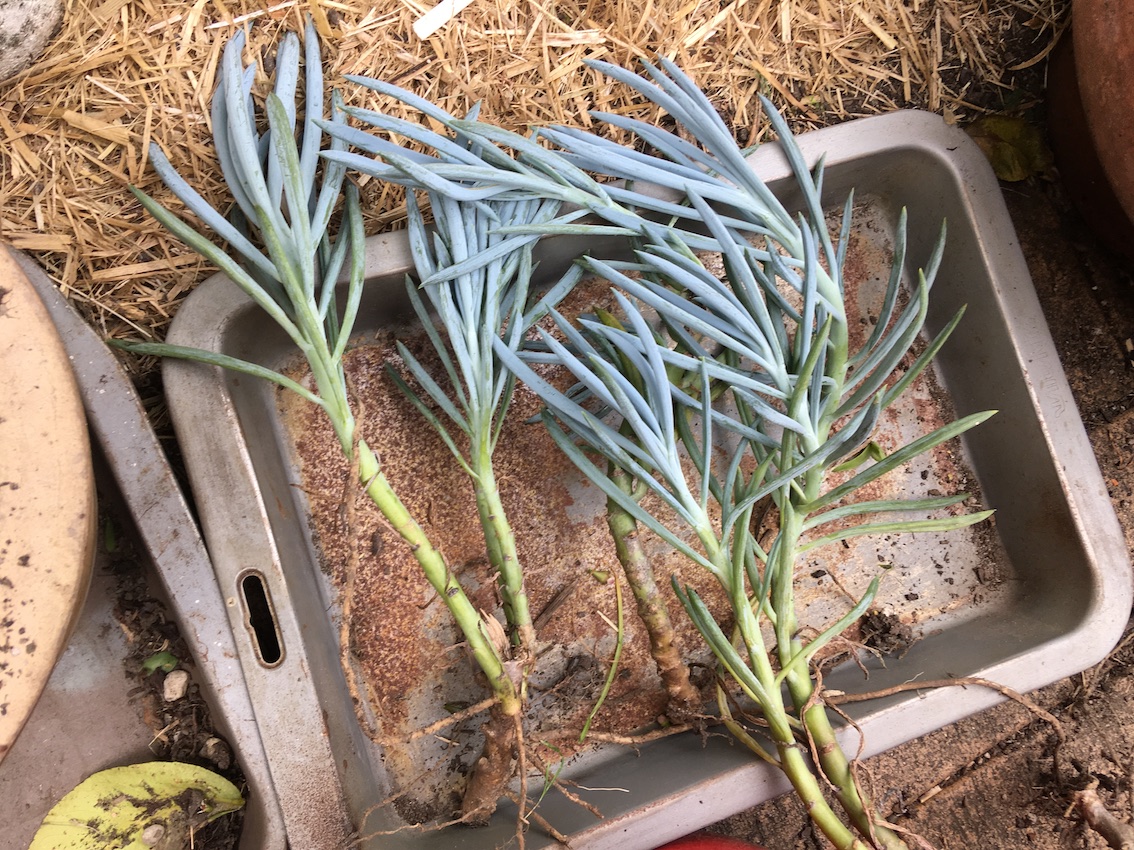
Some of these Senecio 'Chalk Sticks' will be popped into pots, and a few put back in the ground. Lovely grey-blue colour.

I don't look like much of a Gladiator, but it was a torrid battle that lasted most of the day in the end. One of the things I like about digging soil is coming across all the worms and other little critters who call this soil home. I suspect they were all very upset by my presence. 

So the brilliant new plan is to grow many more succulents in pots, and only the very hardiest things (like those multiplying haworthias) in the ground. I've alway grown a small selection of cacti in pots, and the succulents make perfect company for them.

I used up every spare pot I could find in no time. The best ones for growing succulents are the "wide and shallow" ones. And I used up all my special Cacti & Succulent potting mix in no time, and most of these are now growing in good old ordinary potting mix, which will probably suit them just fine anyway (but it was all I had in the shed, so I couldn't be fussy).

As mentioned earlier, I have left the established 'Copper Spoons' shrub where it is, in the ground. Love the coppery colour of the new foliage. Every now and then a few leaves that fall off soon sprout into new plants on the ground, without any help from me.

Years ago when I first started this blog I made it a mission to find out the actual botanical names of my succulents, and it was no easy task. I tried hard but did get several wrong and was then corrected by succulent specialists who got in contact to set me straight. I am almost back where I started, though, as I now have half a dozen succulents, including this handsome one, whose name I don't know. I call him 'Pagoda guy'.

Since I renovated the succulent patch I've only been disappointed that there's still no sign of the first onion weed shoot popping up through the soil. I'm keeping a close watch and heaven help that first sprout! However, the real test will be whether I can keep up the vigilance if warm spring and summer weather gets wet. That's when the onion weed will really get cracking and try to take over again.


Thursday, August 25, 2016

Springing open


It is nice having a full set of senses – you know, smell, sight, touch, taste and hearing – but when it's spring if you were a poor unfortunate down to just one sense or two, you'd definitely know that spring has arrived.

Take smell, for example. It's the worst one to start with because your sense of smell would tell you that this keen gardener has sprinkled far too much chicken poo under his citrus trees, and it is taking days for the farmyard stench to die down. I know this might seem a tad unsympathetic, but bad luck! The limes and lemons need a feed ...

So let's move on that far more delightful sense of sight, and I'll show you some nice photos of spring flowers doing their thing in our garden at the moment.


Now, this one is an official "Pammy plant". It's her potted Pieris japonica, and it seems like the position we have for it in morning sun, with afternoon shade, is just what the Zen master ordered. Though it's Pam's plant it is of course my sacred duty to keep it happy, and so far it hasn't been too onerous a task, even if it remains a heavy responsibility.


A much lighter and cheerier story is the rebirth of our potted New Zealand Christmas bush (Metrosideros), which always flowers months ahead of the baby Jesus' birthday. A year ago this pot plant looked like it was gone for all money, so I cut off the top three-quarters of it, repotted the stump into fresh mix, plied it with Seasol and soothing vibes, and like Lazarus, it's back!


And it's not just a couple of flowers, either. The whole thing is covered in buds, and we're back in the Kiwi flower business.


And yes, my favourite flowering plant in the whole garden is doing its thing again. Last time I did a blog, which was a month ago, it was about this Scadoxus and its little clump of babies, so I thought I'd slip it down here to Page Five of this blog, just so I don't seem too obsessive about them. But the flowers are all about 90% open right now, and the show is on again.


You can always rely on our succulent patch to have something interesting or weird (or both) happening, and right now the yellow blooms of our Kalanchoe 'Copper Spoons' are the star attraction. 


Finally, good old Geranium 'Big Red' is in bloom not quite "again" ... it's more like Big Red never stops blooming, and so it's "still" in bloom. Every now and then it has a pause-ette for a breather but then it's back in action pumping out the red highlights in no time. What a wonderfully healthy, fuss-free, colourful and happy thing it is. 


And so that's an update on the beginning of spring here. I know that I won't be able to resist showing you more of the Scadoxus once the whole tribe has opened up, and the Pieris japonica deserves a posting, too. I'm hoping to lift my current sluggish rate of one post per month back up to a more respectable one per week, but no promises, mind you. I kind of like this "monthly" pace, it suits my semi-retired lifestyle.


Friday, May 13, 2016

Renovations


Should they ever discover plant life on Mars I would not be a bit surprised if it turned out to be onion weed ... or oxalis. These two weeds are indestructible, and they have well and truly taken over our succulent patch in recent months. It was a disgrace: you could barely see the smaller succulent plants for the weeds, and so I've been waiting for the weather to cool down a bit so I could get stuck into the big job of yanking out all the weeds and renovating the whole patch back to "as-new" condition.

To kick things off, let's start with the finished, renovated succulent patch. Traa daa! 


This, dear readers, is how it now looks, six hours after starting on the project. It took a lot longer than I imagined it would.


The first step was to pull every small succulent out of the ground and toss them into a few trugs and trays. That's one thing I can say about succulents: these things grow and multiply incredibly easily. I was amazed how many there were.

The next step was the ugly bit, and it took a long time to do it: digging out onion weed and both type of oxalis (ie, the one with large leaves which grows from bulbs (Oxalis latifolia) and the "creeping" variety with small leaves that sends out runners in every direction (Oxalis corniculata).)

As I dug the soil I realised that there were probably more decorative "mulch" pebbles in the soil than on top of the soil as mulch, so I went into the kitchen, grabbed a large bamboo-handled wire scoop (bought from a Chinese food store) that we never use, and pressed it into service as a pebble sifter.


What a fantastic pebble sifter! It did a brilliant job, and along the way it also scooped up, oh ... about another thousand oxalis and onion weed bulbs.


Two giant trugs loaded up with sifted pebbles, and I was ready to plant the succulents back into the prepared bed. 

(By the way, pebble mulches are nice to look at and have one other benefit: they don't stay wet and so they are a good environment for growing succulents. As for slowing the growth of weeds? Utterly hopeless. In fact, the creeping type of oxalis loves spreading across pebble mulches, and onion weed powers through it. And over time, the pebbles slowly sink into the soil, so in general they aren't my favourite mulch at all.)


Replanting everything allowed me to re-arrange the plants, with the smallest ones right down the front, mediums in the middle and tall ones at the back. I know this sounds perfectly obvious, but when I originally planted the succulents I wasn't sure of their ultimate sizes, and a few have grown more than I expected.Pictured here are Gasteria (top left), sempervivums (left), faucaria centre right, echeveria (far right), Corpuscularia (top centre), and another type of echeveria (top right).


Some of those names above might be familiar to you, but if you haven't heard of corpuscularia, here it is. It's one of my favourites in the whole patch, and the renovation has allowed me to move it to a better spot.


The spiky guy in the centre is Haworthia attenuata. When I planted it back in 2012 the clump was almost this size. Now, four years later, I was able to divide the clump into two clumps this size. I honestly hadn't realised until I looked at an old photo how much this had grown.


As I mentioned earlier, I had dug out all the smaller succulents, but had left the larger, more established succulent shrubs in place. And they've also grown a fair bit since I first planted it all out in September 2012. Look at the photo below for the comparison.


While the weeds have multiplied, so have the succulents themselves. I am sure the weeds will be back in force in no time, but here's hoping the succulents will also keep on growing and take over the place. That's the plan ...


Saturday, September 26, 2015

Garden homemakers


Eagle-eyed Pam did it again this morning – spotted a wasp's nest being started on our succulent Kalanchoe 'Copper Spoons'. I already knew about another wasp nest underway outside our kitchen window, so I thought it'd be nice to share some images of both nests with you in yet another "ain't nature wonderful" posting. But what really amazed me was how my eagle-eyed camera managed to get inside one of the wasp nests to show what's happening there at the moment. They're making babies!


Look closely inside each little perfect "cell" of this paper wasp's nest and you can see one little golden egg in each. In fact, look closely at the bottom-most cell on the right, and you can see the fine, papery fibres with which the wasp constructs the nest. The scientific name of this paper wasp is Polistes, and yes, I think this is the native species (although there are Asian paper wasps and European paper wasps in Australia as well).

EDIT/UPDATE: see the bottom of this posting for a bit more info on this wasp. It IS a native paper wasp, and thanks to the Australian Museum for their help in identifying it for me.


Here's what Pammy spotted earlier on: another little wasp nest being started on the Kalanchoe 'Copper Spoons' in our succulent patch.


This is an ideal spot for a nest, as far as we are concerned, as I never get that close to the Copper Spoons plant and so I am very unlikely indeed to ever disturb the wasps, and they in turn will remain, as they usually are, peaceful yet busy beneficial insects in our garden.

The other wasp nest outside our kitchen window is also in an ideal spot, high up on the window frame, on the side of the house where it's hard for people to blunder into them. Our kitchen window is also a sliding type, which slides from the other side, so the chance of a wasp ever making into the house, past the curtains, is virtually nil.

So this time they've chosen the sites for their new nests quite well. 

Over the years we have accidentally destroyed too many paper wasp nests, because they made them in spots where blundering human gardeners (ie, me) sometimes stick their stupid arms and hands. In 24 years here in our garden, I have been stung twice by our wasps, and both times were on the same day, in the same place. I hadn't realised our wasps had built a nest in our Grevillea, and so while pruning said Grevillea it took not one sting to alert me to the presence of a nest, but two. Talk about a slow learner!

By now regular readers would have guessed we do like a "live and let live" approach to all creatures great and small who we share our garden with. Poor old insects and spiders get a rough time from some otherwise nature-loving folk, who get creeped out by them. Pammy and I like our insects and spiders as much as our worms, lizards and birds.

Sure, the wasps are a higher risk factor but that doesn't mean peace is not possible.

Paper wasps are not aggressive if you don't disturb them. They are very like bees in many ways. Bees can sting if badly annoyed or if they feel threatened. So can paper wasps. 

(Admittedly, disturbing a whole, large nest of paper wasps, as I did once while trimming a murraya hedge with a powered hedge trimmer, does make them rather upset, with a cloud of black and yellow defenders buzzily filling the air, and so a rapid retreat, then staying out of their way for the next hour or so is a really, really good idea. Abandoning the hedge trimming altogether, or at least for a while, is also a good idea...) 

Besides, paper wasps are beneficial garden insects. Ours will be filling up their nests with insects they have caught in the garden, to provide a food supply when their babies hatch out. Many of the insects paper wasps catch are garden pests who eat our crops, such as caterpillars.

So, over 24 years with a policy of tolerating paper wasp nests as far as practicable, I have been stung twice, and both times it was my fault. I'm prepared to live with that kind of track record.

EDIT/UPDATE: a big THANKYOU to the Australian Museum (and Yvette Simpson, the Interpretive Officer there) for their help in making a positive ID of this wasp. I sent the Museum two of my photos, and Yvette says yes, it's a native paper wasp. She also supplied this excellent other link, if you want to read more on paper wasps.


Saturday, August 1, 2015

Waking up in winter


Yawn ... stretch ... no Garden Amateur posts since June 18? Yes, we've been taking a little midwinter break, but this morning, August 1, is such a mild, sweet morning that all Sydney gardeners know spring is not far away. So it's a good time to wake up the sleeping blogger.

Out on our streets the magnolias are bursting out in pinky purples, the wattles are dripping with golden bling, and here in our little backyard there's colour everywhere you look. On with the show ...

Several of our succulents are colouring up, and this
Kalanchoe 'Copper Spoons' is flushed all over with coppery
new growth on a shrub about 70cm tall. So classy.

Bromeliads such as this Vriesia are the ideal plants for non
gardeners to grow in Sydney. Just shove them in semi shade,
pretty well ignore them, and they will then do this in winter.

Our "groundcover" Cootamundra wattle in our
front garden is at its colourful fuzziest right now.

Growing poppies for Pammy in winter has become a tradition
that I hope will last forever.

Our pot of Aeonioum 'Schwartzkopf' offcuts
that we are striking seem to have taken.

Crassula 'Campfire' is a succulent which
really colours up in winter. It's green when
the weather is warmer, but red for just a
month or two in midwinter.

Same deal with the trailing hanging basket
succulent, Senecio jacobensii. It's green in
summer but wears purple robes to ward off
the winter chills.

Finally, even our silvers are shining right now. The Spanish
moss which Pammy looks after, draped from the bare and
otherwise scrappy looking branches of our Grevillea 'Peaches
and Cream', always look superb in the early morning sun.


All the cliches of the seasons, of winter's bareness especially, just don't apply here in Sydney. And that's how I love it.


Tuesday, July 22, 2014

Winter's pleasant depths


Do you find that on today's internet you often read stuff that's of interest, but only a few days later you can't remember exactly where you read it? It's a case of "that was a thousand clicks ago, how can I remember that?".

Well, I'm pleading a case of thousand-click memory loss, but I was reading some Australian gardening content last week – not a well-informed blogger, it was some fool doing it for money – who was banging on about the grey, gloomy depths of winter, as if they were living in Europe or North America. I wandered outside into my admittedly chilly-ish garden and all I could see in the depths of winter here was lush greenery and a beautiful array of colours.

And so for this little posting I would like to celebrate the depths of winter here in Sydney, Australia. When the cold winds blow from the south you certainly need jumpers and jackets, and slow-cooked casseroles still taste fab once the sun has gone down, but out in the garden there's plenty of colour to enjoy.


Squadrons of bees are feasting on the lavender, their little black
legs glowing golden with collected pollen.


The bromeliads enjoyed the World Cup action in Rio, and wish
they were back home in South America, but Sydney is OK.

Even the bromeliads waiting their turn to
flower can at least wear nice variegated fashions.

My 'hedge' of chervil is at its peak. The flopped
over bits in the foreground are merely drunk on
the drink of fresh water I gave them a few
moments before I started snapping pix. They'll
sober up soon enough.

Kalanchoe 'Copper Spoons' is loving the cooler weather.
I'm trying to strike lots of babies of this lovely thing. No luck
yet, but it is a slow process, I believe.

And the Crassula 'Campfire' is well and truly ablaze.

The new mint growing in the 'spot from hell'
under the adjacent grevillea is loving its first
few months here, but it needs lots of water to
keep this backlit beauty happy.

A Christmas gift poinsettia pot which Pammy
is taking a special interest in is doing what it
does naturally in the cooler months: blush red.
And finally, this single tibouchina bloom doesn't
know it's winter. It's meant to flower in autumn,
so either it's early or it's late, but it's on its own, the 

only flower on the bush at the moment.
And so that's the depths of winter here right now. Yes, growth is slow, but everything is still steadily growing, and for some plants it's their most beautiful time of year.