Showing posts with label Turkish Brown figs. Show all posts

Friday, September 8, 2017

Boing!


One of my favourite experiences in our garden is simply to step out into it every morning, to see what's happening. In Spring I'm guaranteed to find something new every day. Just like me, it's alive and breathing (but unlike me it's young and pretty and growing fast). Oh well, I'm happy to settle for "it's great to be alive".

And so here's a photo-driven little posting of just some of the lovely things I found in our garden this morning.


I think we're at "peak native orchid" today. The show has been brewing for a few weeks but this morning all of them are on song. 


Pammy wants me to send her this close-up of a tiny native orchid bloom, taken with the camera about an inch away from the small but perfectly formed bloom. I think she can sense a watercolour painting coming on ...


Speaking of small but perfectly formed blooms, the first of our purple mint bush blooms made an appearance this morning. As I have three bushes and each is covered in flower buds, these are the first wave of what promises to be a few thousand more. Can't wait ...


And to finish off our purple patch, our potted common sage, the kitchen garden herb, has started to do its thing.


Just a few feet from the sage, also growing in a pot, the Thai lime plant is making good use of all the spring fertiliser I fed it with a few weeks ago. The young "double" leaves are the freshest green, every nook and cranny is filled with bum-like blooms and all is good in the fragrant, spicy Thai flavouring department.


A much quieter chap, the Turkish Brown fig looks such a treat as the morning sun shines through its new green leaves every morning. After its winter repotting, I am hoping for good things this summer. No pressure, though ...


Our Westringia 'Elizabeth Bough', covered in light pink blooms, cuddles up close with the astonishingly capable geranium 'Big Red', which flowers pretty much all year round.


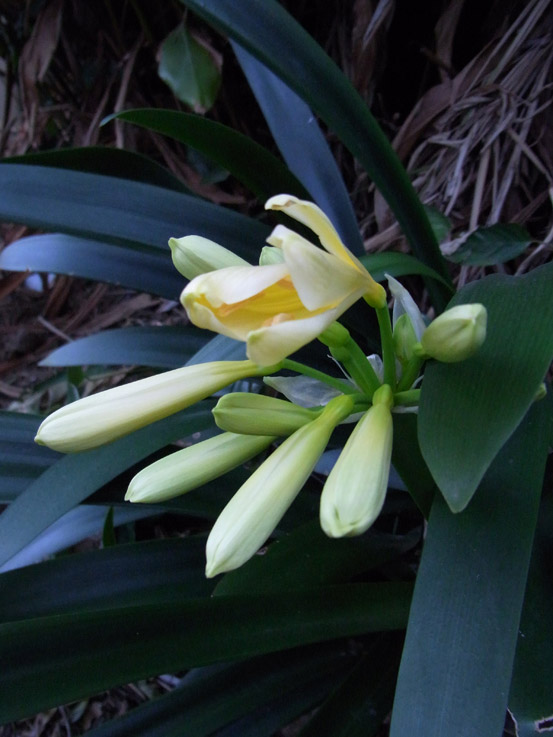
And last of all, in a deep, dark corner of the garden when the sun doesn't get much of a look in, the yellow clivias have decided the time is right. I love how they know this stuff.


Monday, January 11, 2016

Crop Watching


Gardeners often talk about how they notice climate change's subtle effects on plants in the patch under their care. I do, or at least sometimes I do. When flowers appear at weird times of year, crops appear much earlier or later than usual, you can't help but wonder if a change in the Earth's climate might have something to do with it ...

.... And then my whole theory is ruined by other plants operating like clockwork. This morning, the figs are ripening, bang on schedule. Last year I posted about them ripening on January 11, and this morning, January 11, there's several of them ripening up nicely, swelling to double normal size almost overnight, then turning reddy brown once fully ripe. That's almost far too clockworky for me — I think I might be growing climate denialist figs!


My figs, apparently, don't read the papers or listen to the evening news. As far as they are concerned, it's business as usual here in their latest Sydney summer. I love the way they tend to ripen one at a time from each branch cluster. Once we pick this one, another of those other little green ones on each brand will take its turn to ripen. Very orderly.

Pam is the fig aficionado around here, and it's her job to harvest them when she thinks they're at their peak. Of course she might bring the harvest ahead a day or two if our local birds start to show a perfectly healthy interest in a bit of beaky crop-theft.


Elsewhere, our crop watching is in full swing. This lumpy looking cucumber is a bit like a fig in that it suddenly swells up in size in just a few days. Two days ago it was a scrawny little spiky green, unpleasant looking thing half the size of this whopper. I suspect that by tomorrow morning it will be even larger and on our kitchen benchtop, ready to eat. All those yellow flowers around it are cucumber flowers, so I think we're going to have a cucumber glut on our hands by the end of the month.


Progress is more mauve coloured and genteel on the eggplant bush. It's sent out a dozen or so of its simple potato/tomato/eggplant family flowers, and hopefully our local busy bees will pay them a visit. (This is where the "no pesticides" part of organic gardening reaps its rewards — good numbers of bees, who pay their way in the scheme of things by providing a stack of crop-pollinating services.)


Here's a baby eggplant in its creche, starting to grow. These are the common variety 'Bonica', the familiar largish eggplants you see most commonly in the shops around here. 

I've got a whole posting to come about making ratatouille, but I'll save that up for a few weeks from now, when we harvest a few eggplants.


Sunday, January 11, 2015

Ripening, who… little old me?


One of the things I like about growing food plants in my backyard is watching "how" they grow and come to maturity. Our fig tree is a marvel in the way its fruits suddenly swell and ripen, and January is always our "fig glut" time of year here in Sydney, when our fig supply is a time of plenty.

The baby figs appear back in spring, then slowly grow as green little blobs all through spring and the first month of summer. And then just one or two of them decide it's time to ripen. The others stay smallish and green while the ripening ones swell up like a balloon and change colour in just a matter of days. These smaller, green fig-ettes are a bit like people queuing, waiting their turn to have a go.


This is what I mean. The ripening one is on the left, while the
others pretend it's none of their business.
And seen from another angle, the size difference occurs almost
overnight. This one will be picked soon, before the birds get
at it, and once brought inside, our resident fig aficionado,
Pammy, knows what to do next. Over coming days and weeks
they will all ripen, picking up the pace so a small bowl full
will be harvested each time, but the fascinating thing is how
they ripen in turns, rather than all at the same time.
Our fig tree is still only small, as it's in a pot.
It's about three years old and it hasn't been a
stellar performer, but this year it has grown
a bit more and has its best crop so far. It
probably will be put into a bigger pot next winter.
The variety of fig we have here is called 'Turkish Brown' and as the fruits ripen they change from green to a rich brown tinged with some burgundy-red. They might not be the world's favourite fruit but if you develop a taste for them, like we have, summer here in Sydney is a deliciously foggy time of year.


Saturday, October 12, 2013

Patient progress


One of my favourite gardening blog titles is 'Patient Gardener', as that is what I would like to be: a patient gardener. Shame about that, can't have everything I guess. 

However, wandering around my garden this warm and sunny spring morning I felt such a sense of progress here, there and everywhere, despite much effort on my part. It was then I realised that I must have been experiencing an unfamiliar bout of patience. So that's what patience feels like... it's a sense of knowing calm, a preparedness to wait, without interfering.

Pleased with the spring progress all around me, I popped inside, grabbed my little pocket camera and found all these little patient virtues enjoying the spring sunshine every bit as much as I was.


Mr or Ms butterfly posed for many seconds atop a lettuce leaf
while I fumbled excitedly for the right camera settings. Ta.

I could have sworn I harvested a big bunch of
this perpetual spinach plant for our dinner last
Wednesday, but now it looks just as big as ever.

The brown liquid splodge on this collard green leaf is this
morning's organic liquid feed. I have a few collard greens
plants steadily growing from the seed sown in early September.
The seeds came with my order of my friend Awia Markey's
'Soulicious' eBook cookery book, so I might as well give it
another plug while I'm at it. Check it out here.

I had to get out the tall step-ladder to take this shot of the first
passionfruit flower bud finally making an appearance. The
vine itself is a huge, wall-covering thing, but it's all greenery
and no flowers or fruit. Hopefully, if I'm patient and leave it
alone, it will produce many flowers and many fruit and we can
all live happily, deliciously, ever after.

I'm not sure why my Thai makrut lime looked
so ordinary all through winter, as it wasn't a
cold winter at all – quite the opposite in fact.
Regular feeds and cutting off the ugly bits has
suddenly borne flowers and fruit this spring.

Baby Turkish Brown figs have appeared on schedule.  

So too the next crop of strawberries from the
self-sprouted patch which came up out of the
compost. Such a healthy plant, these, easily
the most vigorous strawbs I've ever seen here.

This year I'm limiting tomato production to just a couple of
pots of cherry tomatoes, raised from seed. After a slow start
they're now 50% bigger than they were last weekend, or so
it seems.

Another "sown-from-seed" planting done last autumn, this is
the first love-in-a-mist (Nigella) flower to come out. Many more
should follow next week, so I'll post something about them once
the full range of colours makes an appearance.

As usual, the so-called Christmas bush gets its timing
completely out of whack, colouring up in October. 

The deciduous frangipanis must have been
leafless for just five or six weeks this year,
their shortest 'winter' ever.

Finally, as I was up on top of the step ladder
taking that passionfruit flower bud shot,
I had a view of the garden I rarely get, and
so here's the progress on my new fence
screen of four Gardenia magnifica plants.
What's that smell? Of course it's Dynamic
Lifter, that heady chicken manure perfume
that you detect. Look closely and you can see
the odd yellow leaf, a gardenia trademark
that often happens in winter and spring.
Chicken manure is the cure. Works every time.

Monday, December 3, 2012

Dripping wet


Lovely sound, gentle rain on a tin roof. And the changes a bit of morning rain brings to the garden are so tempting. No matter how much it rains, I just have to go out there and soak it up (the imagery, not the water). One delightful thing that rain does to the garden is that some plants actually look their best when they're wet, such as this weeping Acacia cognata, pictured below.

Though this is a wattle it doesn't flower in a
wattley way. It's a foliage plant that has come
into vogue in recent years, but it's a tricky
thing to keep happy in humid Sydney.
Somehow mine has survived (maybe that's
because it's one of "Pam's plants" of which
there are several here in the garden). When it
rains it becomes sparkly with raindrops held
in place against the laws of gravity.

You'd never notice this tiny spider web on top of the Acacia
when it's dry, but in this morning's rain it's a foam of rain bubbles.
I was almost going to leave my morning's posting on raindrops at simply admiring the lovely little weepy Acacia, but with little pocket camera in hand, everywhere I turned there was something which looked a bit lovelier in the rain. So here's a few more...


Looking almost waterproof, Sedum 'Autumn Joy'.

This other succulent sedum looks as if someone has hit the
'pause' button. Raindrops which should be sliding down the
smooth sides just hang onto the side as if they're blobs of glue.

Still green and young, these will grow up to
become Turkish Brown Figs one day.

I think the PestOil which I sprayed onto my Thai makrut lime
leaves (to deter aphids and citrus leaf miner) has played a hand
in making these leaves so water-repellent.

And lettuce always looks more delicious in the rain.
It hasn't really rained here enough during spring, so the garden needs a good drink. No matter how well I attempt to water all the plants here during the dry periods, they always prefer a drink from the heavens rather from the end of a hose. There's magic in rainwater: if you go outside in the rain, sometimes you can see it.


Saturday, August 25, 2012

Heavy lifting


It's a glorious, sunny Saturday afternoon and here I am inside blogging on my computer, when I should be outside weeding, digging, planting and, well you know... gardening! Never fear I am just giving my poor old back a long, late lunch break before I saunter outside for a final burst of activity. But I haven't been slacking this morning: I've been doing some heavy lifting, all in a good cause.

I went out to Turtle Nursery at Rouse Hill in north-western
Sydney. It's about an hour's drive from my inner-western
former crime den now trendy village of Marrickville. I
was on a mission to buy some sand, the right sand, for
my succulent beds, and Turtle Nursery is the place to go,
so I've been told. As Turtle also has the pebbles and
manures I also need, I loaded up my poor little Citroen
with about 380kg of bagged garden goodies there, then
slowly drove home, my little car looking like a lowered
hot-rod, when the truth was a lot slower.

Once I got home, the serious heavy lifting began.
Eight 20kg bags of 'P-Coarse' sand, at $6 a pop. It's
the right stuff: nice, clean, washed, coarse-grained
river sand, ideal for adding to potting mixes or to make
soils sandier. Not having a trolley or barrow at hand,
I pressed our wheelie garbage bin into service, popping
two bags at a time on the lid and wheeling each load up
the narrow passage along the side of our house.

Six 20kg bags of 10mm-size Cowra white pebbles,
at $10 a pop: the future mulch around the planted
succulents. An organic mulch (eg, bark chips, leaf litter)
would hold too much water during one of Sydney's week-
long drenchings that happen a few times every year.

Six 25-litre bags of aged cow manure,
at $6 a bag. These are to enrich the soil
where I will be planting the gardenias, and
the leftovers will go into the vegie patch,
along with lots of home-made compost.
Well, that's the heavy lifting done: I'm going to give my back a rest today and begin on the digging in and spreading around chores tomorrow. In the meantime, there is still plenty more to do in the way of removing existing plants, weeding and cutting back. 

I'm making progress on this garden renovation every day now. As I work from home it gives me the chance to do a bit of gardening in the early mornings, just an hour of activity before I start work each day. And yes, it's hard to drag myself back to the desk sometimes. I'm in the mood to be out in the garden all the time, right now. I think I've got my gardening mojo back!

Almost everything in this photo had to go. Pam has
never liked the mother-in-law tongues in the background
here, although I admired their tenacity, if not their looks.

Gone now, the mother-in-laws and the money tree.
The mulched foreground was once occupied by quite
a large sage bush, but it is making way for that
purple-flowered tibouchina on the left. I've dug up
a small piece of the sage bush with a good root system
attached and new baby leaves all over it, so I hope sage
junior keeps up the fine tradition set by its parent plant.

All is not sand, manure and destruction here right
now. The potted herbs are all off to an early spring
start. I already had a packet of chive seeds, so I
combined a cheap new pot of chive seedlings with
a surrounding sprinkle of seed. The seed has come
up nicely, the seedlings are happy and this should
be a nice, dense clump in a month or so.

The common mint and spearmint are both thriving
in their new potting mix and the regular liquid feeds
haven't done any harm, either. Happy plants.

A few weeks ago, I saw a Mr Fothergill's packet of
coriander seed set into little circular pads of seeds
(like seed tapes, only round). I've never used seed tapes
much and so something in me said 'give them a try' and
they seem to be working quite well.

Finally, the rest of the garden is very
definitely of the opinion that spring has
sprung. My potted Turkish Brown fig,
which was Underperformer of the Year
in its first year in the garden last year,
is off to an early promising start in its
second growing season. Good!

Well, lunchtime is over, my back seems (touch wood) to feel fairly normal, and I'm back out into gardener's playland for an afternoon session. I think I'll stick to weeding, though. That's enough heavy lifting for one day.


Saturday, April 2, 2011

Thai lime time


Pammy came home yesterday with a lovely present from her old friend Antonio – these amazing looking Thai 'kaffir lime' fruits. Antonio and his wife Louise live just around the corner from us and they've become keen, and very good, gardeners in recent years. Antonio has always been a brilliant cook long before he became a qualified chef in recent years, and so they love to grow their food plants: citrus and herbs in particular. And haven't they done a wonderful job with their Thai limes!

These limes are not so hot for squeezing. Juiciness is not their thing. Instead, it's the fragrant skin which you grate or zest which is what's valued with this wrinkled fruit. It's also really the foliage of the plant which is what most cooks use from this tree most of the time. The leaves are finely shredded and added to salads, soups, stir-fries and dressings, and they really are one of the signature flavours of Thai cuisine, right up there with fish sauce, chillies and smelly old shrimp paste.

I had always intended to buy a Thai lime tree to grow in a pot, as a few years back I nursed back to health my sister-in-law Laura's potted Thai lime tree, which had endured a bad winter on a shady apartment balcony and had been turned into bare (but thorny) sticks. In my sunny backyard, with some TLC it bounced back beautifully and returned to live with Laura once more. Antonio's gift of these fruit spurred us into action, and so this morning Pammy and I went to a big, flash garden centre in northern Sydney and picked one out from the good selection there.

Here it is, just a tiddler now, but that's how I like to start with potted fruit trees: not too big, so they haven't become pot-bound and unhappy at the garden centre. This one was $35, but you could buy advanced Thai lime trees there, with fruit on, for $200, if you were silly enough. Thai limes (Cistrus hystrix) are probably one of the best potted citrus, as the tree is naturally small, only 1-1.5m tall at best. Its only drawback is that it's a thorny thing, but if you harvest either fruit or foliage with both care and respect you should survive unscathed.

And for readers not familiar with Thai limes, here are their wonderfully distinctive leaves. They are called 'waisted' leaves, as they look like two leaves but in fact are one, with a 'waist' in the middle. I always have Thai lime leaves on hand in my kitchen, but that's only because they freeze brilliantly well, and thaw out in less than a minute. So, I buy them fresh at the local Asian stores, and put the unused ones in a Tupperware container and freeze them. Maybe that 'frozen' discovery is what has made me a bit slow to get my own supply of fresh leaves. But when I saw Antonio and Louise's glorious fruit, that was it. No more procrastination, boy. Buy a Thai lime tree this Saturday, you slacker!

Speaking of slackers, this is what I fully intended to buy and plant this time last year: an edible fig tree, destined for a large pot. So, today we also bought a 'Brown Turkey' fig.
Tomorrow is planting day, and then we wait. The figs have finished fruiting in Sydney (or are winding down over autumn) and they'll be bare over the winter. That first shoot of spring will be a thrill, and it's almost odds-on that eagle-eyed Pammy, who doesn't miss a thing out in our backyard, will be the one to come bounding in with that "guess what I spotted" gleam in her eyes.

As for the Thai limes, we fully expect our latest addition to get growing straight away and never look back. However, we'll have to wait till this time next year for the first of those wrinkly wonders to be ready for zesting.