Showing posts with label silver beet. Show all posts

Friday, November 19, 2021

Looking good


While my enthusiasm for garden blogging might be on the wane, the opposite is true for gardening itself. I've never enjoyed it more. Perhaps the blogging has been getting in the way of my enjoyment of gardening? In recent years I suspect so, hence very little activity here on the Garden Amateur blog.

So here's a rare posting on how things are going here in spring. I may post  something during summer, but right now in spring there is almost too much to talk about.

The one thought that hit me the other day as I was admiring all the flowers and crops is how spring makes you feel like you're a better gardener than you probably really are. Everything grows so well, it all seems so easy. Plant something new and whoosh! It races away like happy children in the park.

Summer in Sydney, however, brings you back to earth with a thud. The humidity, the heat, the sheer difficulty of helping everything to merely survive is hardly a joyful pursuit — it's an important part of the gardening year of course — but gardening here in spring is a much more wonderful time to be out there among all the plants. 

Encouraging little garden sprites whisper in your ear "Hey, you can do this!" and "That worked well" as you tour the flower and vegie beds. It's good for your soul to be out there soaking up the success. 

So, here's my usual little 'photos with captions' essay on what's happening here now. It's very pretty, a lot of fun, and I sometimes wish spring would last forever. 


The amazing Geranium Rozanne is getting bigger and better all the time. It started flowering its head off in midwinter when we bought it and has never let up. It's now spreading about three feet wide and rising two feet tall and it's covered in the prettiest purple flowers.

This feels like cheating, but I love it. All you need to do is buy a La Sevillana rose in flower from your garden centre, bring it home, whack it in a bigger pot and let it flower on. This is one of "Pam's plants". She saw it at a friend's house, loved the clear red colour, issued orders on what we needed next and a week later it was brightening up our pergola area. It's so lightly scented that you barely notice it at first, but I have never seen anyone admire a rose without sticking their nose into the centre. However, Pam being an artist with an eye for colour, this is definitely the rose she wanted.

This is our society garlic, or Tulbaghia, in flower. Lots of variegated strappy leaves with these pink trumpet flower clusters on tall stems rising up. I admire its tenacity. All sorts of horrid weeds like to bully it but it never gives up and always shows up.


Our potted New South Wales Christmas Bush is getting better at timing its display of coloured bracts for the festive season

Boy, are we eating a lot of spinach and silver beet right now. Pam loves it Japanese style, chopped and steamed with a sesame dressing, and I love it Indian style, in dishes such as Palak Paneer and Chicken Palak. The golden rule with these prolific spring crops is that if you think you haven't planted enough, you've probably planted too much already.

Lettuce thrives in spring but soon gives up the will to live once summer comes around. Fortunately we're a little pair of salad munching bunnies, and Pammy also loves to make up egg and lettuce bread rolls for lunch.

I'm a sucker for multi-coloured bowls of salad greens, and so I find all seed packets of "mixed lettuce" to be irresistable. Here's another crop approaching harvest time.

My other must-have crop in our garden is shallots, or green onions, or scallions, or whatever you call them in your part of the world. I'm still perfecting my skills at sowing enough — and especially not too many — seeds to raise the next punnet of seedlings while the current crop matures, but this is much more satisfying than buying a punnet of far too many shallot seedlings at the garden centre and only planting half of them.

Who me? Impulse-buy a Grosse Lisse tomato plant at the local Woolies supermarket? Yes, of course. Total sucker for growing tomatoes, with a very ordinary success rate on the big tomatoes, and a perfectly acceptable success rate on the cherry tomato front. So of course I am attempting to keep a big climbing tomato happy in spring. Summer will be the seasoning of reckoning, but I am prepared to take on the challenge.

On the other hand, all the potted succulents are looking forward to summer's heat. Ever since I repotted them they are all loving the new potting mix. And though it's hard to see here, there's a very thick layer of pine bark mulch spread between the pots and all over the formerly weedy succulent patch, and for the meantime at least, the weeds are not enjoying life at all. They're probably biding their time, waiting for the mulch to break down, but right now the succulent patch is a peaceful village of potted contentment.


So there you have it loyal readers, all 10 of you. Pammy and I are both really enjoying this year's spring in our garden. 

Pam's art students love wandering around and finding something to draw or paint, and for me as a gardener that's plenty of job satisfaction right there.

Wednesday, September 15, 2021

What seeds have taught me about patience


One very strange thing I haven't been doing lately is visiting gardening centres. Prior to all this covid disruption, you'd probably find me browsing through a garden centre at least once a week. They were right up there with bookshops for me: regular haunts. But that was back then, and I haven't been to a bookshop for quite some time, either.

So, instead of picking up a punnet of seedlings at the local garden centre, for the last few weeks I've either been sorting through my stash of seed packets, searching the small section devoted to seeds at my local supermarket, or — by far the best fun of all — I've been browsing seed catalogues online, placing orders, then waiting for our poor overworked Postie to deliver me the goodies.

Another small padded envelope of seeds arrived in the mail today, and so I thought it's about time to share with you "What seeds have taught me about patience". It's not all good news, but it isn't a disaster story, either. 

On with the slide show.


I love the way coriander seeds hang around on top of the baby leaves until the very last moment. It looks like the baby plants are telling the seeds to "buzz off, now scram!"
It's a tiny bit late in the season for coriander — I normally start sowing seeds in autumn — but this will be my last batch for 2021. They have just a couple of months to grow into lovely leafy herbs before summer comes on. O
nce things get seriously warm they go berserk, become seedy in no time, and the leafy herb I love is no more.

I only sowed these basil seeds last Monday, and they're up as fast as those other legendary quick sprouters, rocket. I'm looking for a crowded pot of little plants that will look very photogenic for a few weeks and supply lots of leaves for tossing into the mix with tomatoes, especially. What a team!

I'm not fussy about where/who I get my seeds from, and my seed tin stash has all major and minor companies represented.

These English spinach seedlings came up only a day after the basil, and it's a good thing they're making a fast start. They're another crop which does better in the autumn and winter months, but I've got them in a partly shaded spot to avoid the heat, and I plan to fertilise the daylights out of them to make them grow faster. If we get a good crop, there's nothing Pammy likes more than a Japanese style Gomayagochi spinach salad with her grilled Teriyaki salmon. Home-grown spinach flavour here we come.

Once you get addicted to growing plants from seed, as well as actually planting some of the seeds (eg, the spinach, silver beet and spring onions in the top row) you also end up buying packets of seeds in a "seemed like a good idea at the time" kind of way. I fully intend to grow leeks, lettuce and radish some time soon, I hope. No reason why not, really ...

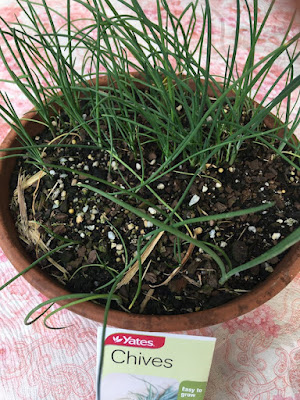
Here's one of those lessons in patience that seeds have taught me. Usually I am dead lazy about growing chives. Every winter my pots of chives turn into dense, unhappy clumps that turn yellow and look crook. Always a glutton for punishment, I have tried de-potting the clump, diving up the plants and replanting them in fresh mix, and the results have never been all that great. So most years I just buy a fresh punnet of little chives, plant them in a pot and they zoom away! This time, I decided to do it with seeds, and what do you know? (See below) ... 

It takes 14-21 days for the seed to sprout, and this pot took all 21 days to sprout (that was all of July). Now, 6 weeks later, we're in business snipping chives to go into Pammy's scrambled eggs on Sunday morning. But the lesson I have to share with slow-sprouting seeds is to know this in advance, plan well ahead, and try to see the year in three-month-long blocks of time. Impatient "days and weeks" thinking is just too hurried. If you grow chives from seed, think "third quarter of the year" as chive time.

Much more fun, quicker and prettier to look at, the wonderful world of lettuce is a great place for beginners to get started with seeds. There's a zillion varieties to choose from, especially when you start shopping online, and usually lettuce will sprout for you quite quickly.

I've been growing spring onions/scallions/shallots (call them what you will) from seed for several years now. My problem is that I hate wastage, and buying just one punnet of seedlings gives me about three times more seedlings than I have space for them, so I raise small batches from seed each time I start a crop. I cook with them all the time, adding them to salads and stir-fries, as well as using them as a mildly oniony substitute when I don't have any onions at hand. And that classic Chinese ginger and shallot dipping sauce for poached chicken is just heaven on a plate. I miss Yum Cha!

This is what arrived in the mail today, from my favourite online seed supplier, Eden Seeds. Like all the good quality specialists they have a wide range to choose from, and their customer service and delivery speed is reliably very good. This time I succumbed to the lure of two very pretty loose leaf lettuce, and a packet of the hard-to-find, tricky-to-grow and finely flavoured herb, chervil. I've been banging on for years about how good chervil is and so far I think I have convinced no-one. But Pammy loves chervil too, and that's all I need to know to enjoy its flavour. Its lightly aniseedy delicacy is superb with mild-tasting vegies such as zucchini and squash. Transforms them from bland to beautiful.

As well as being a sucker for lettuce varieties in seed catalogues, I am also very susceptible to limited edition tins of biscuits or other products on supermarket shelves. My shed has a goodly number of "collectable" supermarket tins filled with glues, nuts & bolts, and seed packets. All the cricket heroes on this Weet-Bix tin have long retired but this tin has aged nicely, with almost all the colours fading to a bluey-grey, as if there has been a printing mistake at the factory. Inside that tin is a cornucopia of seed packets that is constantly being added to ... more Aladdin's tin than Aladdin's cave.

Last but not least in the slide show is confirmation that not everything in that Weet-Bix tin is an edible. I know that cosmos is a bit weedy, so I have planted a row of cosmos seeds at the back of my Big Red geranium patch. So the plan is this summer the cosmos will add cheery yellow and orange flowers towering over the scrambling concourse of red geraniums, and then after the cosmos season has ended, the Battle Royal will ensue as weedy cosmos grapples with ever-spreading geraniums.

So, even though growing everything this year from seed is like gardening in slow motion, time ticks over steadily. It's spooky, like it has something to do with the position of the sun in the sky or something.

If you are impatient, don't even think about growing chives, chervil or parsley from seed. They're seeds of patience, for the long-term planners.

If you are impatient, get out there and start sprinkling around the basil seeds, the spinach, the lettuce, the rocket. There'll be something happening before one week has passed. 

I'm somewhere in between when it comes to patience. I do have some patience, but not a lot. So I do love it when seeds come up fast.

But I have learned that there's a deep satisfaction when real patience, the long-waiting, not-much-happening-yet kind of patience is rewarded. It's as if time has become an old friend with whom I am strolling through the year, hand-in-hand. 


Friday, February 9, 2018

Summer holiday


Time does bounce along, doesn't it? It's been more than two months since I last posted anything here, and that's because I've been on a summer holiday of sorts.

No, we haven't been travelling much, apart from a short holiday break down on the NSW far South Coast. Instead, I just haven't felt like adding anything to my little gardening blog for these last 10 weeks. The garden is in summer mode, that is to say it's as thirsty as can be, every known pest and bug is doing its best work right now, and this little gardener is merely helping where he can, watching it all unfold.

So here's a little update on just a few things happening here, more for the record that any earth-shattering insights.


In its first full summer here, the baby frangipani which I've dubbed 'Serendipity' isn't breaking any records for speed of growth, but as you can see, it's a beautiful bambino.


Sometimes you have to measure success in terms of sheer survival, and this Pieris japonica is looking remarkably chipper despite having to spend summer in hot and humid Sydney. There's new growth everywhere, and last spring's dead bits, which I simply cut off, are well hidden by greenery. One secret to keeping this alive on scorching hot days when the temperatures reach into the high 30s and beyond, is that I have made a little shade cloth cover for it and pop it on whenever the weather forecast is unfriendly to delicate petals which would rather be under a cool forest canopy, if given the choice.


I'm not sure what the minimum allowable size is for a meadow, but I am hoping that four feet by four feet makes the cut. Even if not, I am also considering this a minor success, at least as a lesson in persistence, which I do believe is a close cousin of pig-headedness.
These simple little daisies are Zinnia linearis, grown from seed. I couldn't find the seed I wanted from any seed growers online, or in garden centres, so I bought a packet on eBay and they were complete duds. Hopeless. Nothing came up. So I tried online again, and second time round a grower in California came to the rescue, and her/his seeds sprouted well. I was hoping for yellow flowers as well, but I am OK with white and orange only.


I do love the way bromeliads quietly go about their business of producing outrageous flowers. This one is tucked behind the Thai lime tree and I like the way that it's in a "backstage" position in the garden and so very amazing when you finally discover it.


Meanwhile, in the vegie patch, all is quietly ticking over, and my only problem is the usual one of the backyard vegie gardener: Gluts.


This is far too much silver beet for two little people to eat. We've been harvesting lots, but that only makes it grow more, and quite frankly we're a bit silver beeted out. 


We also do not suffer from any shortages of purple/white striped/speckled eggplants.


I am currently fooling myself into believing that I've finally got on top of radish production, sowing just half a dozen seeds at a time, at spaced intervals of time.


However, I have saved the best for last. Well, it's not the "best" for everyone, but it is the one summertime gardening project which I've been most interested in. It's the little fern garden out in front of the house, sheltering under the dappled light of our wide-spreading Cootamundra wattle "ground cover" tree.


Last time I posted about this the begonia cuttings were just bare stalks stuck in the ground. Now they've sprouted their spotty leaves (which are a lovely deep red on the underside). The native violets are winding their flowery way here and there. All the ferns are well and truly alive and growing, and so too are the spidery trails of Spanish moss.

It's still quite hot and humid here in Sydney. In fact February is generally a rotten month to be a gardener here, so I don't expect to be very busy.

However, I was getting a minor sense of guilt over my slothful ways, and so by posting at least something, anything, I hereby announce that the 2018 garden blogging year has started, and all is well.


Saturday, November 25, 2017

The sweet spot


Stepping out into the garden this fine late November morning, I was struck by what a sweet spot the garden is in at the moment. Everything is growing well, all the vegie crops are already being picked and producing more every day, and all the woes of a Sydney summer seem like they're an eternity away. Late spring is just about the perfect time of year to be a gardener in this part of the world.

As is my custom, here's an iPhone "Panorama" shot taken 10 minutes ago of all the happy campers in their park.

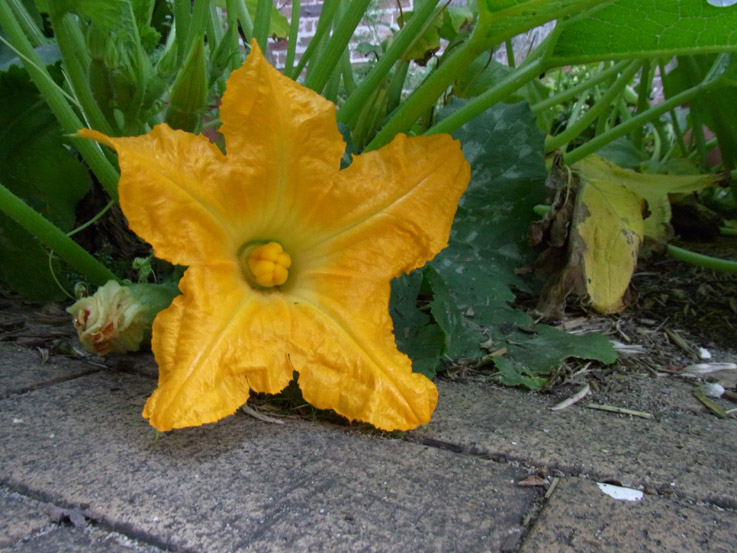
I'm often struck by how different the human eye is from a camera. From inside our house, looking out, this big yellow star of a zucchini flower is what catches your eye. It said to me "if you don't come out with your camera and take a photo of me, you're missing out". And yet in the panorama above you can barely notice it.

This is the first year I have grown Lebanese zucchini, and they're different from the more conventional 'Blackjack' zucchinis which I tend to grow most years. For one thing, as you can see here, the plants are very susceptible to powdery mildew, but this doesn't affect the crops. In fact, this light dusting of mildew almost looks nice. I'm sure it'll end up being much worse, and I'll pull the plants out prematurely in midsummer, but right now, in this late spring "sweet spot" I can live with spotty leaves.

Zucchini flowers don't last long, but they are fun, and besides, you can always fill them up with ricotta cheese and herbs, coat them in tempura batter and do some fancy dining with them.

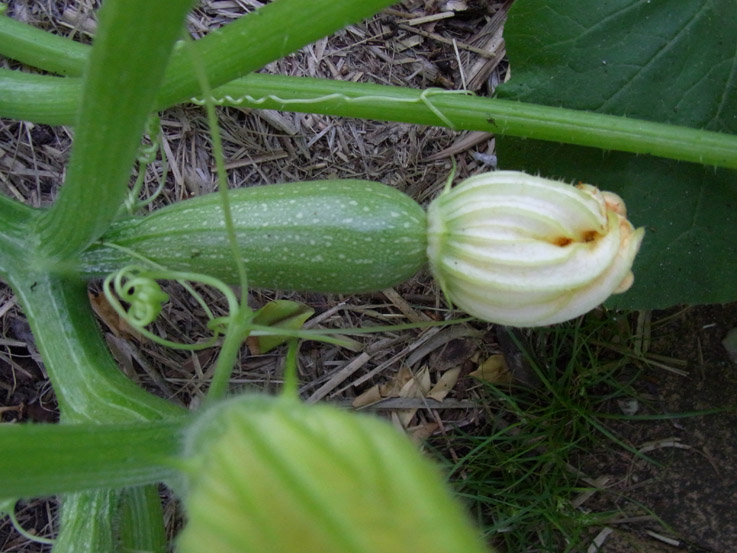
The reason I'm growing these pale green Lebanese zucchini is mostly just to try something different, but also because I think these smaller zucchinis have a better flavour than the bigger, dark green ones.

"Lebanese" this, "Lebanese" that: it's an accidental theme this year, and here's my Lebanese eggplant looking young and healthy. Lots of flowers but no fruit yet. They'll appear in summer.

But wait, there's more! Lebanese cucumbers, too, climbing up my frail, spindly teepee of skinny bamboo. These things don't merely "crop", they "glut". We've already harvested several and have given a few away, but fortunately Pammy loves snacking on little bits of chopped up cucumber, so she's my main customer. 

It's taken a while to turn a dozen or so tiny little mixed lettuce seeds into this delicious salad starter pack, but the idea of having a nice mixture of salad greens in a pot that's within a few steps of the kitchen is working out nicely.

I haven't grown silver beet in years, but by chance I ended up with half a punnet of seedlings and in just a few weeks here they are, very big ready to go. I love cooking Indian food, and so a lot of these leaves will go into things such as a lamb or chicken saag, or a vego palak paneer.

I suspect this whole crop won't be here in two weeks' time, but right now they are looking splendid.

Call it a portent of summer pests to come, but here's the only problem popping up during this gardening sweet spot. I suspect it's slugs, because I can't find any snails nearby, but someone is munching on my pot of basil and they're having a delicious old time of it, too.

I've moved the pot to another spot and I'm on the lookout for culprits. So far no luck, and more leaves eaten last night. 

Maybe it's caterpillars? In that case, in my current sweet mood of spring gardening contentment, I am adopting the benign policy of feeding our garden's future butterflies some tender young Genovese basil, and I hope they appreciate its flavour.


Friday, November 20, 2015

Good crops, bad crops


Of course everyone who has ever watched a detective show on TV knows about "good cop bad cop", where one detective is nasty to the suspect (ie, the bad cop) while the other one (the good cop) offers the "perp" a drink and a kind word, in the hope that the suspect spills the beans to the nice detective before the bad one gets seriously upset and starts turning off the tape recorder and throwing chairs around the interview room.

What's this got to do with growing vegetables, you ask? Well, I suspect my vegetables are trying to work me over. My potatoes are my bad cop, my spinach is the nice guy. I think they want me to grow fewer potatoes and more spinach, but my mind doesn't work that way. I like eating both of them, so I am going to continue growing both of them, despite my dud crop of spuds trying to play the bad crop.


What do I mean by "dud crop of spuds?" Well, this is all of them. Not even one colander full. I was rather hoping for a few kilograms, and all I ended up with is far too many one-inch tiddler mini spuds and only a dozen or so "proper-sized" Kind Edward potatoes. Here's what happened ...


Back in mid-October, the potato plants started to do their usual thing of looking ugly. That's OK, potato crops do that. The foliage is meant to slowly die off while, underground, countless dozens of little spudettes turn into enormous great big spuds.


A month later, by mid-November, the plants looked like they'd done their dash, and so I harvested the lot ...


... and couldn't even fill one lousy colander. It's not as if this is my first go at growing spuds. I've done it a few times before, sometimes growing them in the ground and other times in bags. And I grew them this time using the same methods as before. Of course I could turn around and blame my seed potato supplier, but that would be churlish (however, I have resolved not to order from that same supplier next year, just as a precaution). Never fear though, this potato-loving boy will be back next season, hoping for a better result.


Meanwhile, in the very same patch of ground, and right next door to the dud spuds, my long-lasting crop of perpetual spinach had reached peak abundance, so I harvested the lot before our forecast scorching hot 41°C Friday hits us.


Ever the experimenter, several months ago I spotted a red-stemmed variety of perpetual spinach in amongst the more regular green types at the local nursery, so I have given that a try. Perpetual spinach isn't English spinach, and it isn't silver beet, and it isn't ruby chard. It's a close relative of all these, but it has the lovely quality of simply lasting a long time in the ground.

When the leaves are young and small we pick them as colourful little extras in a leafy green salad. Later on, once the number of leaves gets ahead of us and they mature into bigger leaves, we've been picking several at a time for cooking as a spinach side dish. (My favourite is to simply stir-fry it, along with currants (or sultanas) and pine nuts.)

The flavour is closer to English spinach than the more pungent silver beet/chard, but the main benefit of this is the way it lasts and lasts through all the winter months and spring. Once summer's heat comes along it's a goner, bolting to seed, but I've given up growing short-lived English spinach and rely instead on this. I'm not sure of its botanical name, but it's sold in nurseries around here as perpetual spinach, so give it a try once the worst of summer has passed.

And so, even if my vegie patch wants me to grow more spinach, I'm not taking the bait. Next year I will spud-up again, and there'll be trouble if there ain't a bumper crop!


Monday, October 5, 2009

Not quite a farmer's market


Over at Charlotte's food blog, How to Shuck an Oyster, she had an interesting post yesterday morning on the farmers' markets phenomenon. While I'll let you read for yourself what Charlotte has to say on that topic, I dropped in with a comment that I've never actually been to a farmer's market. And that's true. I haven't. At Charlotte's blog I flippantly said it's because feeling morally inferior is a comfort zone for me, but my real reasons for not bothering were more personal. Though I grow my own organic food, it's nowhere near enough to feed us every day. So that's not it. And while I could go on about elitism (which is rife amongst foodies) and proletarianism (which is rife at supermarkets) they're not it, either.

The simple truth is that I hate being in crowds, of any sort. Can't stand being in a crush of people, amid a busy throng. The various farmers' markets I've seen don't look very inviting at all, even if the produce is lovely and the shopping good. I guess it's some kind of panic attack thing, but whenever I'm in a crowd all I want to do is get out of there, especially the noisy crowds. I've left so many music concerts and other 'events' over the years that Pam and I have a happy agreement that some of the gigs she goes to are 'not suitable for Jamie' but others are.

And when did this simple truth occur to me? It was while peacefully harvesting a bit more home-grown organic produce from my own backyard, all on my own. I do a lot of thinking while I do various bits of basic domestic drudgery, such as weeding or pottering in the garden, or washing up or chopping vegies in the kitchen. Greatly under-estimated thing is a spot of contemplative drudgery. However, back to the harvest itself...

Mini farmer's market harvest number one: ruby chard. It's so pretty I have been putting off harvesting this stuff as I just like the look of it in the garden. It actually does look better than it tastes (ie, 'Sensational' v 'OK'), but it does taste OK, if you mix it with fetta cheese and shallots and nutmeg and turn it into spanakopita.

Mini farmer's market harvest number two: beetroot. Two plants were growing close together and I thought I'd pull out just one, but they came out together, clinging to each other by the roots. They immediately reminded me of two cats a girlfriend and I once bought, many years ago. We went to a house to buy one all-black kitten, and when we picked up the all-black kitten, another one (all-black, but with white feet and white half-moustache) came up attached to the all-black guy. Both were clinging onto each other for dear life. We couldn't bring ourselves to separate them, and so they both came home. But I digress...

Mini farmer's market harvest number three was a successful thinning of slightly overcrowded carrots. Grown from seed they're all doing fine, but most of them need another week or so of growth to get up to a good size.

So here's one of the 'thinnings', a small but perfectly formed short carrot. One thing I like about carrots is not cooking them. Wash, peel, eat straight away. That's my carrot-eating philosophy. I just love the taste of crisp, tender, oh-so-carrotty, freshly-harvested carrot.

Cheaper than a farmer's market, definitely organic and home-grown and, best of all, quieter and much less crowded – my backyard farmer's mini market!