Showing posts with label mesclun. Show all posts

Saturday, September 26, 2020

Sowing seeds to ease the covid boredom


First up, a big, warm THANK YOU everyone for all your lovely messages saying things like “welcome back” “wondered where you got to” “was thinking of you only the other day” etc etc. (Not one saying "oh no, he's back"). You’re such nice people! 

On with the show.

Last posting I mentioned that I was going to do something about growing things from seed, because that’s been my main activity ever since the COVID-19 pandemic turned the whole world upside down early this year.

Like all other sensible people, I’ve been avoiding crowded spaces wherever possible. I do my supermarket shopping (mask on!) in the early morning hours, when it's fairly empty, and I haven’t been to a major gardening centre for more than six months — and yet I’ve been very busy growing crops of herbs, vegies and flowers during all this time.

The reason for that is simple: seeds. I’ve bought some of the seeds I need at the supermarket, and others that I can’t find there I have bought online.

So what have I been raising from seed?

Mesclun: this is just a mix of different salad greens, including several varieties of lettuce, plus rocket, lamb’s lettuce, a small Asian green like tatsoi, plus sharper tasting mizuna and red radicchio. Each seed supplier has its own mesclun mix. I'm growing mesclun in long, deep planter troughs that edge our outdoor entertaining area.

Coriander: one big pot is all I need. I sowed a batch in April, then when it started to tire in July, I sowed another batch.

Chives: this is the first time I've sown chives from seed, and it's worked so well I might do it this way every year. My chives pot always loses the will to live in midwinter, when it becomes a solid clump of pot-bound roots in its pot. In previous years I've either divided up the clump and replanted the best ones, or I've taken the lazy route and just bought another punnet of seedlings. From now on, it's seeds, ho!

Parsley: this is a pain to do, as parsley can take 3-4 weeks for the seeds to sprout, but it's a good reliable way to rejuvenate the parsley patch if you get started in late winter.

Poppies: usually I buy seedlings of Iceland poppies to grow for Pammy, but this year I started them off from seed a few months ago, and they're blooming nicely now. Nowhere near as easy and convenient as buying seedlings in late April, but not difficult to grow from seed, either.

Sweet peas: after last year's success with my first sowing of seed, I've expanded the size of the sweet pea patch and moved it to a sunnier spot. So far, so good.

Shallots (green onions): the thing I hate about buying punnets of shallot seedlings from garden centres is that even one punnet has too many seedlings, so I've got into the routine of sowing a small number of seeds every few weeks to keep production going. During the pandemic lockdown my culinary adventures have included lots of stir-fries, and learning all sorts of noodle dishes, and you end up getting through a lot of shallots when you start cooking a lot of Asian food.


Sowing seeds in pots

Sowing seed is easy in pots using my ‘scatter and cover’ method. Here's how I do it (I'm sowing coriander seeds, simply because they are pale and big, so you can actually see them in the photos). The basic principles apply to all sorts of other seeds (ie, chives, shallots, basil, parsley, chillies, tomatoes, lettuce, mesclun).

First up I smooth out a bed of fresh potting mix so it is flat and even, and reaches almost near the top of the trough, but not quite. 

Then I scatter the seed from the packet as evenly as I can, making sure to err on the side of scattering too many seeds, rather than too few (I can thin out the crop a few weeks later on). 

Here's a cool trick ... read the instructions! Seed packets will tell you how "deep" to sow the seeds. In this case, with coriander, it's 5mm deep.

So, I scatter seed-raising mix* fairly thinly over the seeds, about 5mm deep in this case (without getting too anxious about how accurate you are). But do make sure it's enough to cover the seeds so you can’t see them anymore. 
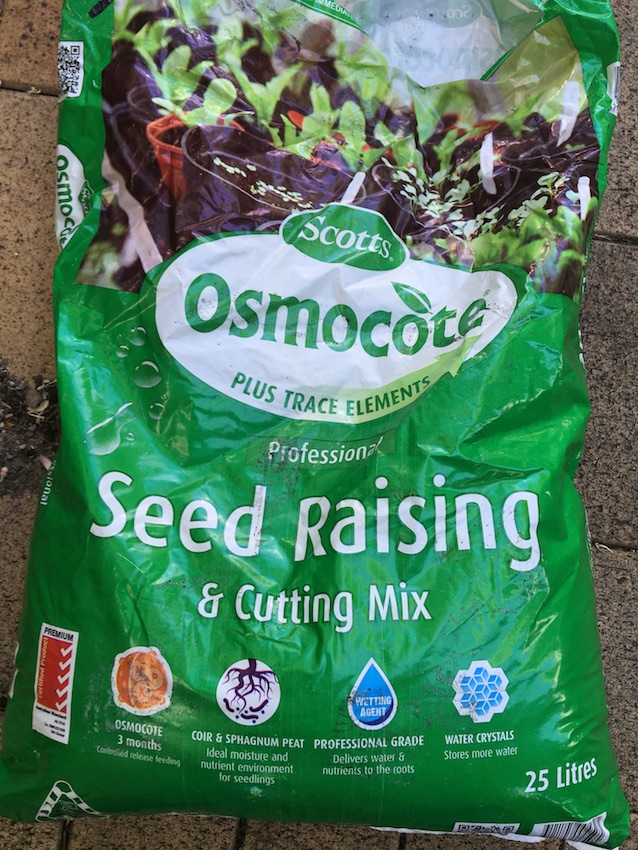
* (By the way, for people outside Australia, seed-raising mix is a very fine-grained potting mix. Maybe a cuttings or propagation mix is the closest thing if you can’t find seed-raising mix.) 

Finally I use a mist spray setting on my fancy multi-setting hose nozzle (that I bought in an Asian Bargain Shop for $8, and which has worked well for years) to dampen the soil well but not drench it messily.


I mist the pot every morning until the seeds sprout. And if I can manage it, I like to keep pots out of the hot sun in a shaded area until they sprout, then expose the pots to more sun as the plants grow. Sometimes, with big heavy troughs, that isn't possible, so I just make sure to keep seedlings exposed to full sun well watered at all times.


Here's how the mesclun trough looked like after about two weeks, with lots of babies coming up. With a mesclun mix the fast-sprouting seeds like rocket and mizuna are up within four days. Some of the other seeds can take several days more to appear, sometimes up to two weeks. 

Coriander grows at a more leisurely rate, taking about 10-12 days to appear, but it looks lovely when fully underway, like this pot full of babies that are probably about a month old.

With my first trough of mesclun I learned that I needed to keep a close eye on which plants are bullying the others and grabbing all the space, and that meant I had to occasionally pull out an over-eager bully plant so the tiddlers lower down could get going.

After a few weeks of sorting out the squabbles between competing plant egos, they all settled down to make the most picturesque and delicious mixed leaf salads. A mature pot of mesclun is so photogenic, and if you just use a pair of scissors to give the pot a light haircut you’ll have a nice mixed greens salad ready to go, with replacement leaves growing back rapidly in the next few days. Regular (fortnightly) liquid feeds keep the production humming along.


The alternative to mesclun, and also worth growing, is simply to grow several different lettuce varieties in the one pot. Though nice to look at and easier to manage, what a mixed lettuce salad lacks is a bit of that tasty pepper and spice in the leafy mix that you get with mesclun.

Managing the competition

The one trick to remember with my ‘scatter and cover’ method is that it's likely that you will have sown too many seeds, so you will at some stage (say, in the third or fourth week after sowing) have to play at being Charles Darwin and pull out several weaker plants so there is enough room for the healthy ones to grow on. Don't be squeamish, just imagine you are the David Attenborough of salad greens, observing that only the strong survive while you watch on, fascinated.

Breaking news ...

I am also growing basil from seed, just because I don’t want to visit garden centres to buy seedlings, not because basil doesn’t grow well from seedlings. 

All the seeds came up beautifully, they looked as cute as fat babies, but a few nights back the slugs ate everything. It was my fault — I had sat the basil seedling pot up on top of the soil under a potted lime tree, so it got nice dappled shade on a warm day, and I forgot to move it back to a safer space that evening. I found a bunch of slugs living under the rim of the lime tree pot, sneaky slimy seedling munchers ...

There was nothing left, just pathetic little white stumps where leaflets used to be. Such is life, and gardening, so start again …


Saturday, September 12, 2015

Salad season


Tonight's mixed home-grown garden salad, but before we
get to that bit ...

I can't begin to tell you how much I enjoy Saturday mornings, especially ones as lovely as today's, where Sydney is working its way into a perfect, sunny spring day.

The shopping is great, for one thing. It's a 15-minute walk along bustling Illawarra Road to Banana Joes, the fruit, vegie and grocery hub to thousands of locals. Today I lashed out and paid 10 bucks for a kilo of fresh broad beans.

I love cooking something special for Saturday nights, for me it's the perfect way to finish off a day pottering in the garden. Pam sometimes laughs and says I'm a glutton for punishment, with the trouble I go to for some meals just for two, but it's my favourite dish – dinner for two, with Pammy.

And those broad beans will take some preparation, too. One friendly young Vietnamese girl manning the checkouts in Banana Joes sometimes asks me how do I cook certain vegies which aren't part of her mum's repertoire at home. In the past we've had some lovely chats about quinces and celeriac, for example, and this morning she wanted to know about broad beans.

So I explained how I open the big, long pods to extract the beans (gave her a demo on one pod!). Then how I blanch the beans in boiling water and peel them again, to expose the gleaming, shiny inner broad beans (didn't do a demo on that ...). It seemed to her like so much work that she couldn't help laughing a bit, but the old Greek mumma behind me in the queue, who was patiently enjoying the conversation, backed me up and said that's the way she prepares them, too.

That's one of the things I like about Banana Joes and Saturday mornings ... the conversations with the people you meet.

My bought broad beans (didn't grow any this year) will be going into the pot at the last moment, where lamb pieces will have been cooking for a few hours in a Moroccan spice mix, along with some zucchinis, tomatoes, eggplant and potatoes.

On the side I thought I'd offer up a light little salad of home-grown fresh mixed salad greens. With the tomatoey, spicy sauce surrounding the main dish, the salad doesn't need much dressing at all. 

And so that's my home-grown content in tonight's dinner: the salad. What follows is just a few photos of how I am going about making my salads a bit more interesting. 


The pot of 'mesclun' mixed salad leaves is coming along nicely. I just bought a packet of Yates Mesclun French Salad Mix seeds, sowed some, covered them lightly with seed-raising mix and watered the pot with a fine spray (for non-Australian readers, seed-raising mix is a light, fine potting mix that's very like a propagating mix). 

The trick is to keep it steadily moist for the first few weeks. The seeds take about 7-10 days to sprout, then a few more weeks to get to this size. If you're slack about watering pots, your potted salad will probably cark it, but if you can remember to water it most days, it's easy to grow. A liquid feed or two helps a lot. There's all sorts of different leaves in the mesclun seed mix (Yates says it has endive, corn salad, rocket, chicory and lettuce) so if you only have one salad pot growing, make it mesclun and you're in business. 


But we're watching a glutton for punishment in action here folks. Here's a pot of cultivated rocket. This stuff is fabulous as a salad on its own, provided you harvest it very young, like it is now. Later on the leaves will be too peppery when they get bigger. 


Our wild rocket, which is a perennial plant, has awoken from its midwinter slumber. I ended up cutting it almost to the ground in mid July, but with feeding and watering once the weather warmed, it's becoming prolific again. Just a few leaves of this peppery zinger in a salad adds real flavour and character to your bowl of rabbit food.


Adding colour to a salad always helps, and so this red-stemmed baby spinach does the trick. This is a type of spinach called 'perpetual spinach' and it truly lasts for months. In its early days the baby leaves are fine in salads, but once they get bigger treat them like normal spinach and cook with them. 


The old standby of mixed lettuce leaves helps when you're making bigger salads for bigger groups, and I've been a loyal buyer of the 'Combo' lettuce punnets from garden centres for many years. Every now and then I grow more interesting lettuce from seed, but when feeling a bit slack and lazy I just grab another Combo punnet and whack them in the ground. Never fails. 


A few herby leaves never go astray in a mixed salad, adding a lot of flavour – but of course the trick with herbs is not to be heavy-handed. Just a little. My potted chives usually look disgustingly sad in midwinter, so in late July I routinely take them out of their pots, divide the crowded clump into individual chive plants, then I repot them into new, fresh potting mix. Six weeks later, with plenty of water and some liquid organic food applied, they're back in business. We roadtested our chives in last Sunday morning's scrambled eggs for breakfast, and Pammy gave them the tick of approval. 


A little bit of chervil adds an aniseedy tang. Our little chervil border, grown from chervil sprouts bought from the supermarket, is looking truly luscious at the moment.


Slower to get going but now making steady, promising progress, our flat-leaf parsley border (also grown from supermarket sprouts) will also eventually make a contribution to some of our salads.

And it being early spring, there's no better time to grow some salad greens. Summer is a tougher task as it gets too hot, but right now we're truly enjoying our salad days.