Showing posts with label collard greens. Show all posts

Saturday, March 8, 2014

The changeover season


Every move you make here in Sydney at the moment, you sweat. It's sticky. On these uncomfortably humid, end-of-summer days, the weather forecasters endlessly repeat their "chance of a shower" chant each morning, and that means it's very warm and humid, mostly sunny all day, then in the late afternoon there's rain or, if we're lucky, a storm as well.

While it's not my favourite time I year (the humidity knocks me around more and more as I get older), I do enjoy this season because it's time for the changeover from the spring/summer crops, to the autumn/winter plantings in the vegie patch. Rip out the old crops, plant new ones. That's what I call fun.

So the garden looks like a mulch farm at the moment, with not much to show for all the effort, but I do like digging soil. That's one of the best bits about gardening. Digging over soil. I also enjoy adding a bit of dolomite lime to sweeten the soil's pH, then working in some cow manure and compost to give the worms and all the other soil-borne critters a treat. At the end of it all, smooth over and level the rich dark soil, stand back and admire your work... 

The digging takes some time, the planting seems to be over in minutes. I've been a bit lazy this time round. Instead of conscientiously raising everything from seed I went down to the garden centre and bought some punnets of seedlings. I've sown seeds, too, but only here and there. Here's how things are going, in the Changeover Season of autumn 2014.

Wild rocket in front, lettuce (raised from seed)
behind. The wild rocket is the serrated-leaf kind
seen most commonly in shops. It's a perennial
plant that should last some time here. It's a much
better bet as a garden plant than the ultra-fast
growing annual type of rocket. Mind you, baby
annual rocket (with the rounded leaves) is still
my favourite rocket to eat, but it's so much work
to sow, re-sow, re-sow, re-sow. Eventually I
tire of the effort, and give it a rest. At least
with this wild rocket you get an easier supply.
Here's the mulch farm. There are spinach seedlings in the
centre, spring onions as well, perpetual spinach on the left.
The perpetual spinach will crop well until spring and is one
of my favourite leafy greens. The English spinach is much
shorter-lived, but it is so nice in Japanese cuisine. The big
leafy greens on the left are more chicory plants, and they are
another excellent leafy green that we turn into Greek-style
horta, boiled greens dressed with olive oil and lemon juice.
There is such a thing as too many Thai limes. They're falling
off the tree now. It's a wonderful choice if you're wondering
which citrus to grow in a pot. It reaches a bit over 1m tall
and wide and seems quite hardy, too. Just brushing past the
leaves or the fruit is such a fragrant thing to do.
Huge, green and unproductive. I've tried watering in some
sulphate of potash to stimulate flower production on our
18-month-old passionfruit vine. No luck. Plan B is do nothing
at all. Pretend it's not there. It's a bit hard to do when it
is so huge, so it's now my 'elephant in the room' plant.
  
At least the lemon tree is flowering its head
off. It smells lovely in the still morning air,
and hopefully the recent rains and the big
dose of chicken poo I gave it will restore it to
health and happiness.
Have you ever anxiously watched a plant, hoping
it would flower in time for the big Sunday lunch
that you've invited some friends to? Well, our
Tibouchina 'Jules' is letting us down. It has
18 hours left to burst into purple glory by midday
tomorrow. Otherwise it's just another green blob
in our very green blob of a garden. Healthy, yes.
In flower, not yet. 
As for the things I can't show you, I have sown more seeds of collard greens, as these big cabbage-family leafy greens were such a success over spring and early summer. They're meant to be even better in the cooler months, so here's hoping that's true. And I have also sown a few rows of seeds of the love-in-a-mist (Nigella) seeds I collected in midsummer, following the end of its spring flowering. 

The first of the collard green seeds are already up, after only five days in the soil. The Nigella seeds are on a more leisurely schedule. They'll appear in a couple of weeks, and the flowers won't do their thing for at least another six or seven months. I can wait. It's one of the very nice things about growing plants from seed. They offer the chance to share in a full life-cycle, especially if you harvest the seeds at the end of it all. I like that idea.


Monday, November 18, 2013

Collard Greens, y'all


I am sure lots of gardeners will agree with me that we never really get over the amazement that something as tiny as a little round black seed no more than 1mm across can turn into a beautiful big vegetable like this. If you're not sure what it is exactly, but can see the cabbage family resemblance, your hunch is a good one. 

Its botanical name is the same as ordinary cabbage, Brassica oleracea, and its origins as a vegetable aren't known for sure, which is a story common to the many and amazingly varied types of Brassica oleracea out there, including cabbage, wombok, kale, cauliflower, Brussels sprouts, broccoli… and this lovely thing, collard greens.

Collard greens are a staple green vegie not only of the Southern USA, but also of countries such as Brazil and Portugal. It's the Southern USA connection which got me interested in them, as I ate and enjoyed some while driving across the USA in 2011. When I bought a copy of the Soulicious eBook by Awia Markey, she included a packet of collard greens seed with the CD she mailed out. So around late August I planted them, they came up in around 10 days, and they've been growing well ever since.


I wasn't sure how big the plants grew and so under-estimated
their impressive final size. I had thinned the seed out to allow
just two plants to grow, but about four weeks ago I realised
the faster-growing plant was going to monster the smaller one.
So I transplanted the smaller one (on the left in this pic) and
it didn't like that and struggled for a couple of weeks, but is
now showing signs of growth. The big one just powered on.
This 'helicopter' shot from above shows that, unlike cabbages,
the collard greens plant doesn't form a central head. It's just
 a big, beautiful bunch of thick, wide, ornamental leaves. I have
been feeding it monthly with an organic-based liquid food,
and watering it regularly. It wilts very readily on hot days but
bounces back very well after it's been given a drink. It's easy
enough to grow but needs space and sunshine to be happy.
One irresistibly charming thing about the plant is the way that
raindrops sit up on it like big jewels, in much the same way
raindrops do on nasturtiums and the leaves of broccoli.
As they're easy to grow and very nice to look at, I'll be growing more collard greens with the unsown leftover seed given to me by Awia. 

As for cooking it, I gave it a try last Saturday night and was very pleasantly surprised. I was expecting it to be a bit like spinach and silver beet, in that a whole lot of uncooked leaves shrink and wilt their way into a tiny puddle of shapeless green veg. 

Not so with collard greens. In terms of texture and form (but not flavour), they remind me mostly closely of broad-leafed seaweed that I encounter in Japanese restaurants sometimes. In terms of flavour it's mild and pleasant, but given a boost with the traditional additives of onions, garlic, a touch of chilli and smoked meat. So, what follows is my Saturday night collard greens experiment, which worked out well.

Step one, harvest all the outer large leaves from the larger of
the two plants. This bowl full weighed about 1lb, or 500g.
It was easy to trim out the thick, white central
stalk, then I tore up the leaves by hand into
big pieces and washed them in a couple of
changes of water in the sink. The leaves are
noticeably thicker than silver beet or spinach,
and almost feel like fabric in your hands
as you tear each one into pieces.
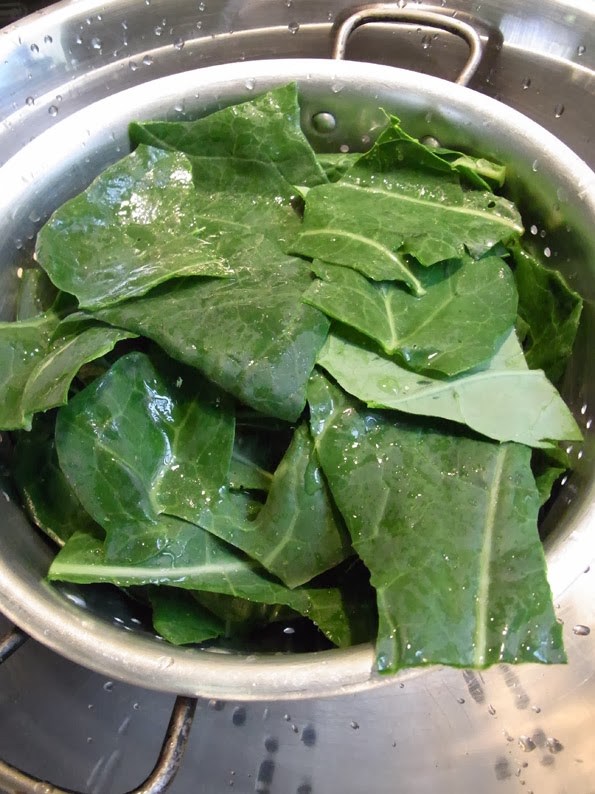
Drain in colander, set aside. 
Now, this is where the recipe taught me something. The method for cooking the greens is to create a broth, let the broth cook for 20 minutes, then add the greens, pop on a lid and let it cook a further 30 minutes. They came out very green, tender yet holding their original form nicely, and they had hardly shrunk down at all.

Awia's recipe (at the end of the posting) uses smoked turkey
meat, along with the onion, salt, chilli, garlic, sugar and a
pinch of bicarb soda. I varied that, as I knew that the Cajuns
use Andouille sausage (not smoked turkey), and so I investigated
that. Andouille sausage isn't available in Australia, and the closest
thing to it doesn't come close, as it lacks chilli. This "closest"
sausage is kielbasa (smoked Polish garlic pork sausage). The really
important thing is the "smoked" flavour, which is why Awia
used smoked turkey, then added garlic and chilli to her recipe
(clever move). You could also use smoked ham hocks instead.

Anyway, for 500g of collard greens I chopped up 200g of
kielbasa and added the onion, chilli, salt, sugar and a pinch
of bicarb soda into about a two-inch depth of water, let
it come to the boil and then simmer away for 20 minutes.
The bicarb soda and sugar are essential. The bi-carb soda
tenderises the leaves and preserves their green colour, but
it does make the already slightly bitter leaves more bitter
still, so the sugar restores the flavour balance nicely.

After 20 minutes of cooking the broth, I added all the leaves
to the pot, and popped a lid on to let the simmering continue
for another 30 minutes.
 
Here's a thrilling action shot of the greens cooking in the broth.
One little detail to note is that you don't serve the greens with
all that smoked meat (just dot it here and there with a few
pieces). The meat is there to flavour the broth and the greens,
but this is still essentially a vegetable dish.

It'd take a much better photographer/stylist than me to make
a plate of collard greens look exciting, but they did taste very
nice indeed, much milder in flavour than silver beet. As I mentioned
earlier, the leaves hold their original texture very well.

And, it being a birthday weekend for this new
member of the 60-year-old gardeners club, we
washed down our new culinary discovery with a
glass or two of very non-traditional but eminently
agreeable bubbles. 
Finally, the recipe


The thing I really like about Awia's Soulicious eCookbook is that
you can print out the page you want, instead of having a whole
book cluttering up your bench space. You can spill spices,
liquid, garlic etc on it then toss it into the compost at the end.
You can order the eBook from Awia's Facebook page, and that's
the best way to get the recipe, but the basic proportions I used
were: 500g leaves (enough to serve 4-6 as a side dish); 250g
smoked meat (Awia uses turkey legs or thighs – red meat, not white
breast meat; I used Polish kielbasa garlic sausage); 2 minced
garlic cloves (if you're using smoked turkey, but omit if you are
going for garlic sausage); 1 onion, chopped; chilli flakes to
taste (about 1 teaspoon is a fair bit); pinch of salt; pinch of
sugar; pinch of bicarb soda (baking soda). The method is
explained in the photos above.
It's all very easy once you've cooked it the first time, but the first step, of course, is to grow your own collard greens.


Saturday, October 12, 2013

Patient progress


One of my favourite gardening blog titles is 'Patient Gardener', as that is what I would like to be: a patient gardener. Shame about that, can't have everything I guess. 

However, wandering around my garden this warm and sunny spring morning I felt such a sense of progress here, there and everywhere, despite much effort on my part. It was then I realised that I must have been experiencing an unfamiliar bout of patience. So that's what patience feels like... it's a sense of knowing calm, a preparedness to wait, without interfering.

Pleased with the spring progress all around me, I popped inside, grabbed my little pocket camera and found all these little patient virtues enjoying the spring sunshine every bit as much as I was.


Mr or Ms butterfly posed for many seconds atop a lettuce leaf
while I fumbled excitedly for the right camera settings. Ta.

I could have sworn I harvested a big bunch of
this perpetual spinach plant for our dinner last
Wednesday, but now it looks just as big as ever.

The brown liquid splodge on this collard green leaf is this
morning's organic liquid feed. I have a few collard greens
plants steadily growing from the seed sown in early September.
The seeds came with my order of my friend Awia Markey's
'Soulicious' eBook cookery book, so I might as well give it
another plug while I'm at it. Check it out here.

I had to get out the tall step-ladder to take this shot of the first
passionfruit flower bud finally making an appearance. The
vine itself is a huge, wall-covering thing, but it's all greenery
and no flowers or fruit. Hopefully, if I'm patient and leave it
alone, it will produce many flowers and many fruit and we can
all live happily, deliciously, ever after.

I'm not sure why my Thai makrut lime looked
so ordinary all through winter, as it wasn't a
cold winter at all – quite the opposite in fact.
Regular feeds and cutting off the ugly bits has
suddenly borne flowers and fruit this spring.

Baby Turkish Brown figs have appeared on schedule.  

So too the next crop of strawberries from the
self-sprouted patch which came up out of the
compost. Such a healthy plant, these, easily
the most vigorous strawbs I've ever seen here.

This year I'm limiting tomato production to just a couple of
pots of cherry tomatoes, raised from seed. After a slow start
they're now 50% bigger than they were last weekend, or so
it seems.

Another "sown-from-seed" planting done last autumn, this is
the first love-in-a-mist (Nigella) flower to come out. Many more
should follow next week, so I'll post something about them once
the full range of colours makes an appearance.

As usual, the so-called Christmas bush gets its timing
completely out of whack, colouring up in October. 

The deciduous frangipanis must have been
leafless for just five or six weeks this year,
their shortest 'winter' ever.

Finally, as I was up on top of the step ladder
taking that passionfruit flower bud shot,
I had a view of the garden I rarely get, and
so here's the progress on my new fence
screen of four Gardenia magnifica plants.
What's that smell? Of course it's Dynamic
Lifter, that heady chicken manure perfume
that you detect. Look closely and you can see
the odd yellow leaf, a gardenia trademark
that often happens in winter and spring.
Chicken manure is the cure. Works every time.