Showing posts with label Australian native orchids. Show all posts
Sunday, September 2, 2018
Easy orchids
Labels:
Australian native orchids,
beginner's orchids,
Dendrobium kingianum,
dendrobium orchids,
Dendrobium speciosum,
native orchids,
orchids
Orchids are difficult to grow ... right? Wrong! Some orchids are so easy to grow they barely need any help from me to do their thing. Just a bit of water, an occasional feed of liquid orchid food, and a sheltered spot that gets a bit of sun, but not too much. Mine are nestled up against a side fence, so they get no afternoon sun at all.
And they're flowering now. In preparing to write this little blog posting about my native orchids, I discovered a couple of things I didn't know previously. The first is that they are both closely related, even though one is a tiny little guy with flowers less than one inch wide and the other one is big, bold with "can't miss it" sprays of many yellow blooms. They're both dendrobiums.
This one pictured above is the little person, formal name of Dendrobium kingianum, common name of native rock orchid. Small but perfectly formed ...
And this big yellow personality is Dendrobium speciosum, with a few common names, including rock lily and Sydney rock orchid. But I think of it as the Sydney Mardi Gras orchid.
This is the first time the big yellow orchid has flowered, even though it's been in our garden for the last three years. Now, if I had done my research more thoroughly back then, I would have learned that if you buy a young plant then you are going to have to wait a few years for it to flower. For a while I wondered if I was doing anything wrong, as each year the little rock orchids flowered their heads off and the much bigger plant did nothing. It looked healthy enough, but it just didn't produce flowers. This year was its big debut, and what a spectacular entrance it has made.
I have several pots of the smaller rock orchids, including this white one, and they flower very reliably every year. Two years ago I repotted them all, as they were multiplying quite prolifically and getting overcrowded, and all the transplants have survived the experience.
So, what's the second thing I discovered about these orchids? Well, it seems that these are regarded as two of the easiest native orchids you can grow. Perfect beginner's orchids. And that explains a lot!
I think both forms look wonderful, and the fact they are hardy and do well even in the care of an absolute beginner makes them even more marvellous in my eyes.
Now, I should give credit where credit is due, and mention two Australian websites which are a good source of information on native orchids. One is this page on Angus Stewart's website, and this page at the Australian Orchid Nursery website, which is all about Dendrobium speciosum.
If you are looking for something to grow in a line along a fairly boring fenceline on the western side of your garden, then give orchids a try. Contrary to popular belief, many orchids are not difficult to grow at all. In fact they are remarkably tough, easy-care potted plants. As well as these native dendrobiums, look out for the cymbidium orchids, another excellent choice for beginners.
Buy your orchids already potted up and they should do well in that original pot for the first few years at least. Your local garden centre or major hardware chain will stock special orchid foods. I use a liquid feed that I mix up with water and apply from a can, but there are dry granules which you mix up with water, and slow-release pellets which you scatter around every few months. I find the liquid feed easiest, and I feed my plants whenever I remember to do it. I guess that's about once a month.
All the other stuff about them special potting mixes, etc is true, but it mostly has the effect of making people think orchid growing is difficult. It's not. Just buy a plant already potted up, plonk it in a good spot and you're nine-tenths on your way to success.
Good luck!
Posted by
Jamie
at
12:06 PM
Friday, September 8, 2017
Boing!
Labels:
Australian native orchids,
clivia,
Clivia miniata,
coast rosemary,
common sage,
mint bush,
sage,
sage flowers,
spring,
spring flowers,
thai lime,
Turkish Brown figs,
Westringia,
Westringia Elizabeth Bough
One of my favourite experiences in our garden is simply to step out into it every morning, to see what's happening. In Spring I'm guaranteed to find something new every day. Just like me, it's alive and breathing (but unlike me it's young and pretty and growing fast). Oh well, I'm happy to settle for "it's great to be alive".
And so here's a photo-driven little posting of just some of the lovely things I found in our garden this morning.
I think we're at "peak native orchid" today. The show has been brewing for a few weeks but this morning all of them are on song.
Pammy wants me to send her this close-up of a tiny native orchid bloom, taken with the camera about an inch away from the small but perfectly formed bloom. I think she can sense a watercolour painting coming on ...
Speaking of small but perfectly formed blooms, the first of our purple mint bush blooms made an appearance this morning. As I have three bushes and each is covered in flower buds, these are the first wave of what promises to be a few thousand more. Can't wait ...
And to finish off our purple patch, our potted common sage, the kitchen garden herb, has started to do its thing.
Just a few feet from the sage, also growing in a pot, the Thai lime plant is making good use of all the spring fertiliser I fed it with a few weeks ago. The young "double" leaves are the freshest green, every nook and cranny is filled with bum-like blooms and all is good in the fragrant, spicy Thai flavouring department.
A much quieter chap, the Turkish Brown fig looks such a treat as the morning sun shines through its new green leaves every morning. After its winter repotting, I am hoping for good things this summer. No pressure, though ...
Our Westringia 'Elizabeth Bough', covered in light pink blooms, cuddles up close with the astonishingly capable geranium 'Big Red', which flowers pretty much all year round.
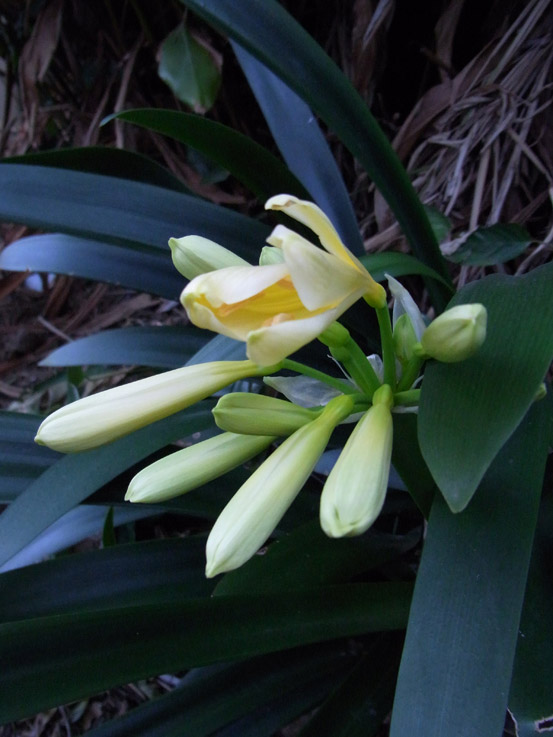
And last of all, in a deep, dark corner of the garden when the sun doesn't get much of a look in, the yellow clivias have decided the time is right. I love how they know this stuff.
Posted by
Jamie
at
8:28 AM
Saturday, September 5, 2015
Native beauty
As a gardener I do find it mildly hilarious that our florist shops, when they send out a bunch of "native" flowers, often don't include a single Australian native bloom in their beautifully arranged displays. Poor things, their lovely bunches of proteas, leptospermums and other South African belles do resemble their Australian native cousins, but their idea of what constitutes a "native" flower isn't one of floristry's strong points. You do occasionally see the odd Aussie kangaroo paw in there, maybe a banksia or two, but usually the "native" flower bunches created by our florists are not especially Australian.
If you think that's bad, imagine if someone asked for "natives" and they sent orchids! Well, ironically enough there's a chance, if the orchids were tiny little things, that they might be Aussie native flowers. But our florists just aren't going to go there anytime soon, nor are their customers.
All this, of course, is just my way of introducing you to the fact that our Australian native orchids are blooming right on schedule once more, in early spring. These little gems are as native to Australia as kangaroos, grevilleas, emus and waratahs, although they're not what people think of when you talk about "native flowers", of course.
![]() |
| Same deal with this person. Seven years of excellence! To give you an idea of their size, this one is about an inch wide. |
![]() |
| Meanwhile, there's more than just flowers to admire. There's flower bud towers, too. |
![]() |
| And each cultivar has its own flower bud colourings, and some toss spotty patterns into the mix as well. |
As for growing them, they're just like our cymbidium orchids: tough and easy-care. They get a bit of sunshine each day, but spend most of their day enjoying either some dappled light or bouts of full shade. I feed them with liquid orchid food once a month (or when I remember to...), and give them a drink of water if it has been dry for a week or so. Mostly, Sydney's natural rainfall waters them well for me, as these are all outdoor plants.
If you are an admirer of Australian plants in general but don't have enough sunshine to grow the bigger sun-loving natives, a few pots of these beautiful little native orchids will fit into that semi-shaded spot very nicely indeed and give you something little yet lovely to admire every spring.
Posted by
Jamie
at
11:50 AM
Sunday, September 7, 2014
Small but perfectly formed
There was an interesting chat on the radio yesterday morning about the number of seasons there are in Sydney's gardening year, and the consensus was that having just four definitely is not enough. Spring, summer, autumn and winter might be fine for the US, Canada and most of Europe, but it just doesn't tell the story of other parts of the world.
A 'four-season' divvying-up of the year is hopelessly wrong for tropical and subtropical zones, and even a place like Sydney, a few hundred miles south of the true subtropics, needs at least six to tell the whole story. (I believe the traditional Aboriginal system for Sydney includes six seasons, so we're on the right track – you can read more about the Aboriginal seasons for Sydney here.)
Right now, according to our radio chatterboxes, we're in 'Sprinter', that time of year in August and September when it's still cool but the new flowers are leaping about in colourful profusion. ('Spring' is late September through to early November, a traditional springtime; it's followed by 'Sprummer', that warm, rainy time of spring when the flowers are fading already, the weather is warming but cold days are still about, all through November especially and even into December;. Then follows a full four months of real summer, from late December through to the end of March.)
Oh, where were we? Sprinter. Every Sprinter, our native orchids appear on schedule, and they're here again, small but perfectly formed tiny orchids about 1.5cm across (that's a bit over half an inch). And some of them are lightly scented, too.
![]() |
| Sorry, can't help with the botanical names here. This is the deep pink one. |
| And yes, you guessed it, this is the pale pink one. To give you an idea of its size, that's a pod of a 'normal' cymbidium orchid behind it. |
| These two cymbidiums look like swimmers emerging from the water with their hair wet but they're just two big, beautiful flowers trying to open their wings on yet another soggy morning here in Sydney. |
The native orchids are as easy to care for as the normal cymbidiums, which means they are as tough as nails. Normal orchid potting mix for them. They do like a feed, though. I use an organic liquid food formulated for orchids on both the cymbidiums and the natives, giving everything a feed once a month. Every three, four (or maybe it's five?) years, this happy band of potted orchids needs repotting, simply because they grow so readily that they outgrow their pots. While it's said that orchids like to have their roots crowded together, in the long run overcrowding will cut down on the flower shows.
After repotting, the terrible, shocking problem is that I end up with too many beautiful orchids and not enough pots (or space). On a scale of one to 10 of terrible problems gardeners have to face, this is surely a 0.0005. I have much more weighty matters to bother me, like convincing people that 'Sprinter' isn't a stupid name for this season…
Posted by
Jamie
at
7:37 AM
Subscribe to:
Posts (Atom)