Showing posts with label Plumeria. Show all posts

Monday, September 20, 2021

The bare and the beautiful


There is no time of day to compare to the mornings in our garden. As you stand at the back door and look out, the low morning sun appears in the far right corner of the north-facing property and steadily lights up every plant as it rises.

However, as an early riser who's often out there before the sunbeams appear, the truly best time to view it all is that gentle brief time between dawn and the moment the sun starts casting shadows. 

That soft, low morning light allows the many different greens and the subtle greys to do their version of glowing, before old shiny guts appears over the fence and starts bleaching the light for the rest of the day.

So, early this morning was the ideal time to attempt my next video of the garden, and my focus this time was on the bare beauty of our two frangipani trees. They're all just branches right now. It'll be another couple of weeks, early October, before the leaves appear, followed by the fragrant flowers in November.

So for this next attempt at a low budget, iPhone video production, I've learned my lesson and will only post a link to the YouTube video, all 1 minute 19 seconds of it.

Here's where you click and watch the show: https://youtu.be/L0MDdvFZGAE

Meanwhile, here's a few photos of what to expect later this spring, plus as a special bonus for language lovers, one of my favourite pieces of wordy trivia.

The 'big' tree grown from a cutting is the classic Sydney frangipani, the white one with the yellow centre. I love it.


The smaller tree, also grown from a cutting supplied by a local art studio where Pam teaches, is a much more tropical looking, colourful piece of confectionery. I've called it Frangipani 'Serendipity' because it has been such a happy discovery.


And now for my favourite piece of English language trivia. 'Serendipity' is an invented word, and we can almost trace it back to a specific day and date: January 28, 1754, in a letter written by Horace Walpole to a friend. Pictured above is the page from The Oxford English Dictionary's definition of Serendipity.

The word Serendip is the ancient Persian word for the beautiful island we know of today as Sri Lanka, and as Walpole explains in his letter, in the fairy tale 'The Three Princes of Serendip' the heroes were always making discoveries by accident, of things they were not in quest of. Happy accidental discoveries, if you will. And to describe that fortunate phenomenon, he invented the word 'serendipity'. 

What all this has to do with gardening is precisely nothing, other than for the fact that whenever I go out into the garden I don't always think about gardening.

Take yesterday morning as an example. There I was pulling out all the weeds growing around the base of my little tropical frangipani, and instead of contemplating the exacting business of pulling out weeds, I was thinking of dictionaries, writers, Sri Lanka and invented words. 

And before I knew it the drudgery of weeding was over and it was time for a cup of tea.


Monday, August 7, 2017

Choice cuts


I love the way recycling operates in our streets. Our local council does a great job. There are yellow-lidded bins (paper/glass), green-lid bins (garden clippings) and red-lid bins (everything else) for every household. 

But our street has been developing its own system: if you have something you no longer need, but you think other locals might like, just leave it out on your nature strip, preferably on a Saturday, and by Sunday night it'll probably be gone. Works most of the time, too.
So that's what I did with about a dozen big frangipani cuttings. I stuck them in a plastic bucket, created the beautiful sign you see here and stuck it to our street tree, and let recycling take its course. Which it did. All of them were taken by Sunday evening ...


Now, as for the frangipani cuttings themselves, they came about because our frangipani tree is growing too well. Last summer it invaded our pathway to Pammy's shed, and a few branches reached far enough that washing on the clothesline occasionally snagged on a branch. So, once the tree had lost all its leaves for winter, we cut it back here and there. And there, and over there, and up there. We ended up with quite a few cuttings ...


Standing back a few feet to take this shot, you can easily see how the pathway is now clear. The job itself is a bit messy, as frangipani immediately ooze out lots of sticky white sap, so wearing gloves saves on cleaning up. 

I collected up the cuttings then put them in a dry spot and then let them dry for a few weeks, with the aim of drying off the base of each cutting (the bit you stick in the potting mix). If you don't let the cuttings dry off, you run the risk of rot developing around the oozy cut after you plant the cutting into potting mix. And that's basically all I know about striking frangipani cuttings. Our tree is grown from a cutting taken 11 years ago, so it's a good way to get started.

Quick peek down memory lane. Here's the oldest photo I have of our frangipani, taken soon after I started blogging in 2008, and in that photo caption I said the cutting-grown plant was two years old then. My how it's grown!

Finally, one little footnote to our street's informal recycling system ... 

This Monday morning I went outside to collect the plastic bucket in which I had placed all the cuttings, and even the bucket had gone! Fortunately, it wasn't my best bucket ...


Tuesday, February 21, 2017

Frangipani dreaming


Well, it only took two months to get our latest frangipani planted. I thought it would take longer, being a pessimist about my workrate during summer, but the last two cooler mornings have seen the whole job done.

Regular readers might remember this blog posting from December, when Pammy came across this very nice little baby frangipani tree at a local ceramics gallery, where she conducts painting classes. Home it came to our place, I blogged about how wonderful it was, then followed the hottest, most humid and nasty summer for many years. In the last two days the weather looked a lot better, so I got to work.


First of all I had to remove the sprawling and very dead Grevillea which occupied this spot. That looked like a really daunting challenge in this weather, but I was wrong: it was so rotten and dodgy that it took about half an hour to cut off all its limbs and dig out the stump. And so this morning the task of planting the frangipani was all done by 7.30am. 
(I like to do my summer gardening very early each day ...)


As the frangipani isn't in full flower at the moment, here's a reminder of its many-coloured, pinky-yellow themed blooms. It's going to be a lovely complement to the white and yellow frangipani that shares our backyard.


If you haven't planted out a baby tree from its pot, the basics are simple. 

Water the pot first and let it soak for a while, to loosen the root ball, while you dig the hole. The hole itself should be no deeper than the pot itself, but twice as wide. Don't add any fertiliser to the hole. 

Take the plant from its pot, very gently! Sit it in the hole and do a few checks. 

Make sure it is facing the way you want it to face. 

Next, make sure the soil surface of the pot's soil is at least level with the surrounding soil. (Lay down a straight stick/rod to check your levels are OK.) Lower than the surrounding soil is bad, slightly higher is OK, level is fine too. Then fill in around the hole with the surrounding soil. Lightly tamp it down, but don't pack it down. And never cover the pot's soil with garden soil.

Did I say don't add fertiliser? Well, don't. Then water it generously from a watering can, to which you have added some seaweed solution (here is Australia it'd most likely be either eco-seaweed, or Seasol). That's it.

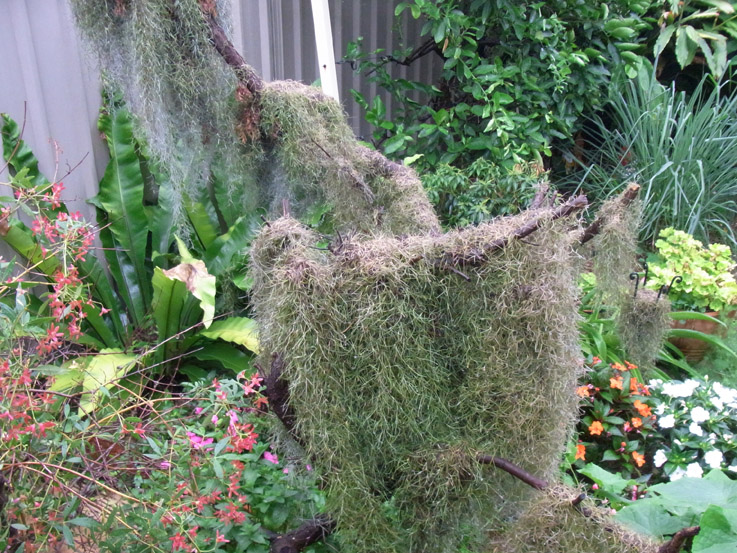
Now, finally, a photo to finish of the dead grevillea, and its empire of Spanish moss, because we've come up with a wonderful idea for where to put the Spanish moss (if it works). AND, I've also started up a bonsai growing project that has been on the back burner for quite a while. So expect a few more February postings from this little amateur gardener.


Farewell old Grevillea 'Peaches & Cream'. Sad ending, but you were a wonderful native garden shrub, stunningly colourful, a mecca for squabbling honeyeaters, and in your demise, a hauntingly memorable display stand for our beloved Spanish moss. You will be missed!


Monday, December 19, 2016

Frangipani 'Serendipity'


Replacing a major plant in our garden always leads to a small series of what Pammy and I jokingly refer to as "committee meetings". In this case the vacancy was created by the demise of our Grevillea 'Peaches & Cream' which was split into two floppy, despondent, sodden halves during a fierce storm a few months ago.

Since then the committee has met a few times, and eventually we decided a second frangipani would be the perfect choice for the spot, which is very close to our covered pergola, where we do all our summer entertaining. Cool shade and tropical fragrance in summer, lots of leafless light getting through in winter, the perfect size of small tree too, and an easy-care beauty that loves being in Sydney. Win, win, win, win, win!

But what kind of frangipani? What colour? Well, it turned out that Pammy found the perfect replacement by a process of serendipity, and here it is.


This isn't its official name, but I am thinking of this as Frangipani 'Serendipity'. 

Here's how Pammy found it: she opened a gate leading to a local art studio run by a ceramicist, Lisa (where Pam teaches painting), and there it was, in a pot, with a modest price tag on it. It was easily the nicest of a gaggle of about a dozen frangipanis Lisa's daughter had for sale, part of a fund-raising effort for her school. The plant itself was a cutting taken from the same coloured frangipani growing in the garden behind Lisa's art studio. Pammy texted me to say "I've found our frangipani" and later that day it was home at our place.


Here it is in all its shapely glory. With this start, our serendipitous find should grow into a beautifully shaped small tree over the next decade or so. 

Now, 'Serendipity' is one of my favourite words because of the story behind its meaning. The word itself was invented by Horace Walpole in 1754 (says my Oxford Dictionary), in his story "The Three Princes of Serendip". Now, Serendip was the old name of Sri Lanka (in between it was Columbo) and the meaning of serendipity is the "faculty of making happy and unexpected discoveries by accident." Walpole was thinking that coming across Serendip was a delightful discovery, and all of my friends who have visited Sri Lanka assure me he was right — it truly is a delightful place, when it's at peace with itself.


A much less happy tale is the demise of our poor old grevillea. The storm split it in two at the base, and it slowly died off over the next few months. It had been the frame for wearing our ever-growing tresses of Spanish moss, and eventually, a few years from now, we hope our new frangipani will do the same job. Pictured here is the sad sight today, with the bare branches held up by props. 

So, in the meantime, my first task is to redistribute all the Spanish moss evenly amongst our other backyard trees: a lime, a lemon, an olive and our other frangipani. Then it'll be a chore to dig out the grevillea, and finally a pleasure to plant out Frangipani 'Serendipity'.


Pammy loves our existing frangipani tree, which also has a similar history to our new one, in that the cutting comes from a friend, Krissy's, garden. Krissy is a former workmate of mine, and is the sister of another workmate and Pam's music-loving pal, Zora, so it's a tree with a close, personal connection that is important to us both. Our new frangipani comes from Lisa's studio where Pam has spent many many hours teaching art courses. So both our frangipanis have a special, personal history (which is why growing and sharing plants from cuttings is a beautiful way to enjoy a garden full of living memories). 


Of course Zora & Krissy's frangipani is an el-classico yellow and white one, while Lisa's frangipani has a blush of pink, as well as yellow and white ... 


... and both of them will look lovely on a rainy morning ...


... and both will smell tropically divine on a sunny day.


Saturday, December 20, 2014

Frangipani dreaming


Some excellent news for frangipani growers here in Sydney: don't lift a finger! That's right, don't do anything. Don't water them, don't feed them, just get up close every now and then to inhale the flowers' oh-so-sweet perfume (just to show you care) but that's about it for frangipani-growing tips in Sydney.

I'm a classicist. White frangipani with a yellow centre for me.
Others go for the red 'Rubra' variety but there are many others
to choose from. I just like the yellow one.

No, it's not a cake decoration, it's just perfection doing its thing.

Grown from a cutting (thanks Krissy!) taken earlier this
century, our frangipani tree was a slow grower for the first
few years, but it's now settled in to its new home, and
is growing better than ever, thanks to a judicious lack of
'helpful' interference from me.

The same growing tips of "do nothing at all" apply equally to the
other champion plant of Sydney gardens: Murraya paniculata.
However, the murraya's scent is nothing like the sweet
frangipani's, so getting up close isn't something a lot of people
like to do. In fact the murraya's scent comes over to you, it
seeks you out whether you want its company or not.
And right now, here in Garden Amateur land, the murrayas are flowering and so too the frangipanis, and I didn't lift a finger to make it happen. They did it on their own.


Sunday, April 21, 2013

A good year for frangipani


Our problem child has blossomed into a talented teenager this year. Though it has been a part of our garden for several years now, our frangipani tree has never been entirely happy here. But this year everything has changed. It has grown like mad, it's still covered in leaves and those wonderfully fragrant, pretty yellow and white tropical blooms. And most importantly from my gardener's point of view, it's very healthy.

I guess you could say it has been a good year for frangipanis. But these plants love Sydney, and Sydney loves them. They're in gardens everywhere, and the secret to growing them is benign neglect (plus sunshine). Just let them get on with it and they'll be fine, the experts told me. All that advice did was give me gardener's guilt, because mine wasn't healthy and happy. How could I be doing something wrong when I wasn't doing anything?


Still covered in foliage and new flowers still coming on,
it was a fragrant delight to take a few photos of it this morning.

We've grown it from a cutting taken from a workmate, Krissy's,
Sydney garden, in 2007. Krissy's renovations to her house
meant their old frangipani tree had to go. Lots of people
received cuttings, so that one tree is now the parent of many.
This is how it looked when we planted it
out as a big cutting in September 2008.
It had been in our hands for about a year
by this stage, and had grown well.

Since then it has of course grown, but ever so slowly. A few
branches had to be cut off, due to a dieback running up the trunk.
As well as the dieback, in the wet summers of 2010-11 and
2011-12, the leaves were covered in 'rust', a fungal disease.
Spraying it with a product called eco-fungicide, which is
potassium bicarbonate, helped to ease the rust, but the
growth rate was very slow. This year, a hot one, everything
has changed. Pictured above is the bright green, smooth
new growth, which must be at least 30cm on every branch.
Frangipanis are known as slow-growers, but this hot summer
of 2012-13 has made our frangi feel like it's in tropical
Darwin, not middling temperate old Sydney Town.
No-one's complaining, of course. The tree is happy and so are
we. We're halfway through autumn and this deciduous tree is
not going to let go of its leaves any time soon.
The basics of caring for a frangipani, as told to me by several expert gardeners I've been so very lucky to work with, is not to give them extra water, and not to feed them, either. All that was suggested was that I give it some Seasol (for our overseas readers, that's a seaweed-based organic liquid plant tonic) in the first few years, to encourage the roots to grow. And that was it.

I have stuck to the policy of no extra food or water, but when you see a plant suffering with fungal diseases, its foliage covered in the tiny pustules of rust, it's hard to practise benign neglect. That's the thing we so many gardeners like me. We're busy-bodies. We like interfering. We can't help ourselves. And it's all the more chronic when you just love a plant so much, and frangipani is definitely one of the garden plants Pammy and I love the most. So it's very pleasing to see a whole season of continued neglect paying off at last!