Showing posts with label parsnips. Show all posts

Saturday, January 26, 2013

Seedy habits


The therapists say that the first thing to do with any addiction is to admit you have one. Good advice, but I'm not sure if they know what they're doing after that point is reached. Anyway, here goes: I am tragically addicted to growing plants from seed, and my success rate is OK, not brilliant, but getting better. There, I've said it. I'm feeling better already.

And so at the latter end of this hot, windy and rather unpleasant Sydney Saturday afternoon in January, I've brought out my seed tins, taking stock of the lovely little packets of tragic temptation lurking demurely inside, and I'm planning my autumn seed-raising campaign now. Oh what fun, must put on the kettle to make a calming slug of green tea while I plan out my gardening future.


Here's the hot candidates, all vying for attention. With some,
I'm just waiting for this rolling series of heatwaves to be over
before I get any plants growing again (rocket, lettuce and chervil
all hate the heat and wouldn't be worth bothering with right now).

But there's another category of seeds which is demanding
my attention now: those plants which really only are happy
when sown as seed in the spot where they are going to spend
the rest of their little lives. These are the fuss-pots which don't
like being transplanted as seedlings. Here, there's Florence
fennel, Shirley poppies, carrots, parsley, rocket, beetroot, chervil
and parsnips. I'm already starting to play favourites, though.

While I do of course like to eat parsnips, there
is something extra about them that I like. Being
slow and a bit haphazard in the way they come
up from seed has its 'challenge and reward' buzz
when you see them finally come up, but I just like
watching them grow, and of course harvest
time is lucky dip at the carnival time: you never
know what shapes you'll get (but my second
crop was much better than the first, and my
secret of success is deep, maniacal soil prep).

Call me sick, but I just like parsnip foliage.

If you think having a crush on parsnips is worthy
of referral to a therapist, wait till you hear my
Shirley poppy problem! Total failure last time,
complete duds. I rescued the situation by buying
and planting some Iceland poppies in their place
(and Icelands are easy-peasy, lovely from seedlings).
But here I am planning to have another go. Of
course I don't have a clue where I went wrong.
Tragic fools rarely do. But I'm going to try again.

Florence fennel also needs to be sown direct
into the soil. No transplanting seedlings, please.
As I mentioned a couple of postings ago, I
currently have a little 'test batch' sown and
growing well. Pam and I love to blend sliced 

fennel and potatoes together (more spud than
fennel of course), sprinkle with olive oil, grinds
of salt and pepper then toss, into a covered dish
then bake slowly for as long as you like. The
fennel caramelises and becomes a bit sweet
and the result is utterly delicious.

Oops! A seed spill in the bottom of the tin.
Whose are they? Not the fennel! Yep, the
fennel, recognise those seeds anywhere.
Thank goodness for stocktakes and stickytape
fennel seed packet back in good order now.

Two last little asides. Seed packets give old tins a meaning and
purpose in life. Most of my seeds are in the cricket-crazy-kids'
Weet-Bix tin, but the retro-themed Yates commemorative
125th anniversary tin is doing fine service, too.

Last but never least, I amazed myself by actually checking the
'sow by' dates on the back of all the seed packets before I did
anything else. It is a bit depressing to carefully till the soil,
prepare the seed beds, sow the seeds and water them for days,
then weeks, on end, only to have nothing happen. At that point
 you wonder where could you have possibly gone wrong.
Then you finally, belatedly glance at the seed packet only to
discover it says: "You should have sown them three years ago,
you fool". So take it from a tragic fool, read the packet first!


Sunday, August 21, 2011

The lost spring


"We're going to miss out on spring this year," Pam said this morning, and she's mostly right, as we'll be travelling while many things will be bursting into leaf and bloom, and we won't be back until after they have finished. And so this afternoon I did a quick lap of our small garden to look for signs of spring, and I found plenty. On with the show.

Only one-third of the way to full bloom, and already the Scadoxus are stealing the show again. The wonderful thing about this year's blooming is that it's earlier than in the two previous years. I was sure we were going to miss out on seeing anything from them, and what do you know! They must be mind-readers and took pity on us.

This is the first time all three bulbs have bloomed, and the good news is that the oldest bulb is sending out a little 'pup' of a new bulb forming at its feet. Who knows, in 10 years we'll have a clump!

Very pleasing to see the first leaf burst out from the Turkish Brown fig which we planted in late autumn, when it was just a bare stick.

I've seen our pinky-white orchids bloom in late September every year for the last 20 years here, and so I can imagine how lovely they will be very easily.

Our rosemary bush is just starting to flower now, and it was a beautifully fragrant place to be when I brushed against its leaves to take this snap.

These buds belong to our NSW Christmas Bush, and it will be touch and go whether it will still be in flower when we return in early November.

The angel wing begonias always get a bit sad and tatty looking over winter, but they've turned the corner of the season now. I fed them a week or two ago and every pair of leafy 'angel wings' is opening to to make space for a rose-pink tipped baby new leaf to emerge.

Every year the flowering weeds like this heartsease (viola) reappear without any encouragement from me.

Another flowering weed, the primulas have been in this garden ever since we moved here two decades ago. In our first year we foolishly asked the garden centre for something that flowered in shade, and so we brought home primulas and impatiens. I have eradicated the impatiens, but the primulas always come back.

At least these darker coloured primulas offer a bit of a variation on that pastel pink.

I shouldn't complain about the primulas, it's not as if they're giving the parsnips a hard time. By the time we get back the parsnips should be OK to harvest.

And speaking of harvesting, I really should harvest all the cumquats and turn them into marmalade, but I have so many other things to do right now before we leave, and marmalade-making doesn't make it into the top 100!


Sunday, July 17, 2011

Good morning, everything!


It's a little habit of mine that started so long ago that I can't remember when, but each day when I open the back door that leads straight out to the garden, I always say "good morning everything". And I mean everything. Even the earthworms, the aphids, the flowers and weeds, birds and the bees. Everything. No use in discriminating, is there? We're all equals.

And on this only moderately chilly July morning, the middle of our winter, with the temperature at 10°C and likely to soar up to just 17°C by early afternoon, we had a touch of overnight rain and the garden was just lovely to behold and be in. No jobs to be done at all, just a wander around our pretty little patch here on Earth.

The first of the cinerarias decided this was the day to come out. These things will now flower for a few months, in colours so bright that lurid is the most honest way to describe them. These are here to do a job, not so much to be looked at directly, but to be looked at in a mirror, attached to the shed wall, by someone standing at the back of the house. That's the plan.

Now, the nasturtiums are Pam's plants, but this is the reason why I so readily gave in and planted something which I consider to be an invasive weed. Ahhhhhh, raindrops on nasturtium leaves in the morning...

Speaking of raindrops, for some reason they always look like a watery gel, rather than mere water, when they accumulate on these succulents.

If plants were a doggie which could wag its tail with happiness, this pelargonium would also like to press its cold wet nose up against my face while it wagged its furry tail.

Of all the vegies I grow, I like the look of parsnip foliage the best. I know there are some glam contenders out ehre (thinking cauliflowers, kales, cabbages and curly parsley for starters) but the light and cheerful green of the parsnips just seals the deal for me.

On a Sunday morning, where there isn't much gardening to be done because Huey the Rain God has sent down a shower overnight, there's only one thing to do, says Mitchell, our Librarian Gnome, and that's read a good book.

Good idea, Mitchell.

(Looking for something new and totally different to read? I'm loving the book I am reading right now, 'Leo the African', by one of my favourite authors, Amin Maalouf, a wonderful Lebanese writer. I cannot recommend Maalouf highly enough. Beautifully poetic and dazzlingly exotic in the way he brings another, completely different culture and time to life, a good one to look for and start with is 'Samarkand' but 'Leo the African' is winning me over as being every bit as good as my favourite so far, Samarkand.)

Tuesday, March 22, 2011

Suddenly, nothing much happened


I know that on many occasions I have sung the praises of growing plants from seed, because it's very satisfying fun to do so, but in the interests of fairness and balance, let me kick off this little posting about seeds from the other, grumblier end of the paddock.

Seeds can be frustrating things to work with at times, for various reasons, and out here in Amateur Land I am coming face-to-face with some of those frustrations. Let me explain...

First the good news. The coriander seeds have sprouted. (What's that organic looking brown packet of coriander seeds doing floating in mid-air? Have I discovered levitating seeds? No, it's worse than that. I have discovered Photoshop, and how to make all sorts of dastardly changes to simple, innocent garden photos.) Anyway, back to the seeds...
These are seeds I saved from my coriander plants last year, and they're sprouting at the rate of about 60% good 'uns, 40% duds. Not a bad germination rate for an amateur seed-saver. In fact I'm quite proud of the little dears. I have plenty of seeds left over, and I'll be sowing another batch a month or two from now, as coriander is a much better winter crop here in Sydney than it is a summer crop. Lasts for months in winter, does coriander.

However, that's the first frustration I have with seeds: germination rates. I won't bother showing you the boring little paper pots I have filled with brown potting mix, and no parsley seedlings where there should be parsley seedlings. How about a germination rate of 0%? I know parsley seeds are super-slow to germinate - around three to four weeks is average – but I'm up to five weeks now and not a sausage. Not one! So, all I can do is start again (with a completely different packet of seeds, of course). Next slide please, projectionist!

In the top right corner of this pic you can see the packet of the Shirley poppy seeds which I scattered here about five days ago. My Pammy loves poppies, and in previous years I have grown Iceland poppies for her. This year I'm trying Shirleys, which several keen gardeners have strongly recommended for their better colours. The trick with Shirley poppies is that you really do have to grow them from seed, as they hate being transplanted as seedlings. No worries, I can do that. But that's where I have encountered a few more seed-raising issues. See those bamboo skewers poking up out of the ground? They're to stop the pigeons and doves enjoying a dust bath. Any spare patch of bare, dry earth and they're down there spreading their wings (probably trying to get rid of lice, if the truth be known) and making a mess of my neat seed-sowings. They terminated an earlier sowing of parsley seeds with precisely that habit, and so for my Shirleys and other seeds I'm onto them this time.

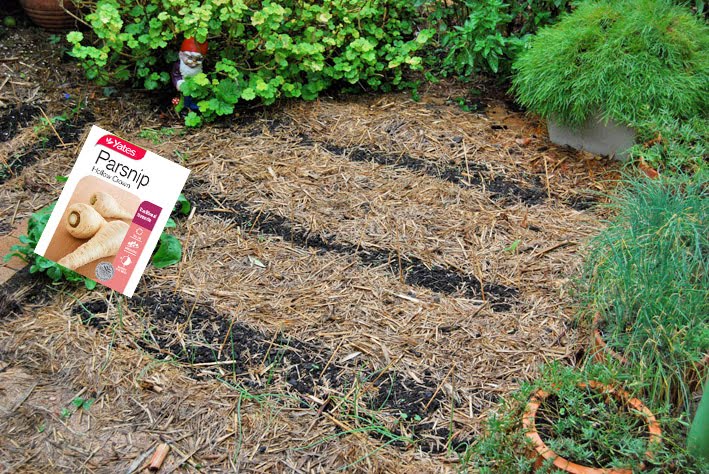
This levitating seed packet of parsnips represents another plant which hates being transplanted and must be grown from seed. I'm having another go at parsnips this year, as my home-growns from two years ago were the sweetest, tastiest, tenderest parsnips I have ever enjoyed. While I know it's the cliche to claim that everything home-grown tastes better than the shop-bought stuff, I really haven't found that to be invariably the case. With tomatoes, definitely yes; parsnips, most assuredly yes; freshly harvested herbs, yes; English spinach, yes; potatoes, yes; citrus yes; garlic, yes.

But for vegies such as carrots, leafy greens, beetroot, shallots, cucumbers, eggplants, silver beet, beans and broccoli the real advantage to me is their tenderness and fresh quality, plus the knowledge that they really, truly have been grown organically. This latter group have never tasted especially superior to the high quality shop-bought, fresh equivalent. I just know mine are healthier. But my home-grown parsnips were a revelation in flavour and tenderness. I want to eat them again!

Besides, parsnips aren't a bad looking plant, either. Very nicely green and leafy, and they are part of the garden for a number of months as they slowly grow through the winter. The only problem with getting parsnips started is that even the seed packets suggest you sow the seed thickly, as germination rates are a bit iffy. I can live with that. And I've done the bamboo skewer trick to keep the doves and pigeons away, too.

Here's an evening meal's worth of parsnips harvested last time round. One interesting little snippet about my parsnips is that here in Australia at least there aren't all that many varieties to choose from. By far the most popular variety is 'Hollow Crown', and it has been around for generations. It's a bona fide Heritage or Heirloom vegie, but all the major seed suppliers have it too, and it's not marketed as such. The best Yates Seeds (the biggest seed company in Australia) can do is call it a 'traditional favourite'.

So I don't really have much to grumble about with my seeds. I just hope all that heavy rain we had over the weekend hasn't washed the teeny weeny little poppyseeds away, but the soil there doesn't look too disturbed. I should be seeing some action there maybe next weekend if I'm lucky. But with the parsnip seeds, I'll have to wait. They're every bit as slow as parsley seeds to get going, taking three to four weeks to come up.

And that's both the best and the worst bit about seeds: the waiting!


Monday, October 13, 2008

Parsnips I have known

Some call it 'harvest', others call it 'day of reckoning', and when it came to my first attempt at growing parsnips, today worked out 50:50 on the harvest/day of reckoning gradient. With all 'above-ground' vegie crops you can check on progress, maybe even fix a problem if you find out about it early enough, so there isn't a lot of mystery when harvest time rolls around. But with 'below-ground' root vegies like parsnips, potatoes and carrots you don't know what you'll get until you yank the plant out of the ground. So today, with parsnips, I enjoyed three good results: some lovely looking successes, some amusing little duds, and a good lesson for the next time round.

This parsnip patch looked too leafy, handsome and happy to inspire confidence. All along I was thinking "all leaf, no parsnip – too much nitrogen". I didn't fertilise the soil prior to planting, and before the parsnips went in it was a sprawling patch of lamb's ears (Stachys), which I also never fertilised, so I couldn't figure out where all the nitrogen might be coming from.

Traaa daaa! Nervous Nellie need not worry. Some lovely parsnips came out of the ground.

And so did some not so lovely parsnips. The problem? Over-crowding. I didn't thin out the plants enough. All these stumpy guys were crowded together neighbours. All the longer, nicer ones didn't have anyone nearby. So that's my big lesson: don't crowd your parsnips, Bozo.

I did a sample harvest of just one parsnip last week, and cooked it that evening by my favourite method – roasting. It was beautifully tender and sweet, one of the nicest little parsnips I've ever eaten.

I've given some of my parsnips to a mate, Brent, who is a parsnip roaster from way back. His big tip – balsamic vinegar – and it is definitely a nice addition. Anyway, this is my share of the harvest, and that will make a couple of meals' worth of parsnips on the side. Aussies love their roast lamb, and roasted parsnips are the classic accompaniment to roast lamb (along with roasted potatoes, of course). So that's how I'll cook the first batch.

All in all a happy little harvest! Even the supposed 'failures' will still taste nice and sweet, and I've learned my lesson about over-crowding root vegies.
And finally, a couple of parsnip recipes to share.

Root vegie roast
While parsnips are yummy roasted with lamb, they're at their best when also roasted with other root vegies. Try roasting parsnip pieces with peeled and chopped potatoes, carrots, pumpkin, eschallots, garlic and thyme, along with anything else you have (eg, turnips, swedes). I put all the vegies into one big bowl, grind over some sea salt and black pepper, then drizzle over extra-virgin olive oil and toss all the vegies in this mix. (And you could add some balsamic vinegar at this stage, too – it is worth trying.) Roast them at 200°C for about 45 minutes, shaking the pan occasionally, or even turning them over with a broad spatula, to stop them sticking. For this cooking time to work, the trick is to cut the vegies into chunks which will all cook at roughly the same rate. Usually this translates into "don't make the potato chunks too big".

Parsnip chips
After peeling parsnips cut them into thin slices (2mm thick). I use a vegie peeler to do this. Then heat a 1cm deep puddle of olive oil in a small frypan until hot. Then throw in one single 'test' piece of parsnip, to make sure the oil is at the right temperature and the oil bubbles around the parsnip slice as soon as you drop one in. Once you're happy that the oil is hot enough, cook the chips in small batches, quickly, for about 2 minutes or until they start to brown. Scoop out with a slotted spoon, drain on paper towels. When they're done sprinkle with salt and serve either as an entree snack, or as a side dish.

Sunday, August 10, 2008

First borns


'Imprinting' is the word bird-keepers use for it – you know, that bond for life that one living thing has for another, no matter how irrational it can sometimes seem. Usually the 'imprint-ee' is the hatching baby, and the 'imprint-er' is the person on the spot. But what do you know, with plants it works in reverse. See your first strawberry develop, notice the first broad bean finally make an appearance, and you remember it well. Hardened strawberry and broad bean farmers might not feel the same anymore, having produced millions of identical babies to be shipped off to the markets, but for this amateur gardener there's a genuine thrill each and every season when the first borns start arriving. Especially the winter babies, who have to do it tough.


Don't ask me why one strawberry streaked ahead of its siblings and turned into bright red bird food like this. I do rotate the pot weekly, so the ones on the other side had the same chance as this guy. But become a beacon it did. The verdict from my taste tester? Yes, definitely a strawberry but nothing exceptional. Just another strawberry in fact. Not even the pleasure of knowing that she got to eat it before the birds did worked any magic. To her, it's an unexceptional child, just one kid in a basketfull of little red children.


Pretty flowers just like this one was all that my broad bean trellis has been producing for the last few months. Very nice, especially close up, but eventually they changed from being pretty to frustrating. Enough with the flowers, guys!

And then, after four cold, wet wintry days with hardly a glimmer of real sunshine, suddenly all the flowers turned into broad bean babies. In fact, so many, that there really wasn't a 'first born' as such. More like a 'first batch'. Having not ventured down into broad bean land for a few days, I'm not sure when they started appearing. It was a case of Sunday no beans, Monday to Thursday rainy gloom keeping even keen gardeners inside, then Friday, broad bean-erama.

Now, this of course is not my first tomato baby, but it is my first midwinter tomato baby. Raised from seed sown in a hanging basket in May, this is 'Garten Perle' a vigorous grower if ever there was one. It's in a sheltered spot on the very edge of a north-facing covered pergola, so it gets lots of winter sun, and not much of the nasty, sold southerlies or south-westerly winds, and a fair bit of attention from me.

These parsnips are of course expected to look like this right now, but I've never grown them before and so they qualify for the 'first born' gallery. Handsome, broad leaves and steady progress all-round. The only problem was the seed packet. It said "sow seed fairly thickly due to (I forget the word, but something like 'haphazard') germination". So, with a germination rate in the high 90% range, I ended up with seedlings everywhere. Thinning done, they're powering along.

And this, too is an unexceptional sight. Rosemary flowers. But for me it marks the completion of a transplanting job on a favourite plant. For some reason this plant is a super-fragrant, super-oily rosemary. Just walking past it sends up clouds of lovely rosemary scent. But it was in the wrong spot in the garden, and I really did have to move it. However, I did the move slowly, very slowly – took about a year. Rosemary strikes very easily here in Sydney, so I just cut off a dozen stems and stuck them in the ground in the 'new' spot. None of this fancy 'taking cuttings' operation beforehand. Just stuck them in the ground. Of the dozen stems planted about 10 thrived, and I've left two to grow on into handsome bushes, with these pleasing results. The old parent plant has been removed, finally, and its progeny, the first generation, if not the first born, carries on the family tradition and continues to be the most fragrant rosemary I've ever encountered.

I am still waiting, quite impatiently, for the potatoes to do something interesting. And when I say 'impatient' that means I actually exhumed one of them the other day to see what was happening and indeed there is progress aplenty, but no shoots above-ground yet.

I really ought to be more patient, as it is midwinter after all. I really am trying to let nature take its course but it's hard not to play God here and there. I'm hardly practising the loving disinterest of a Christian God who never gets involved or interferes directly in earthly affairs. Rather, I tend to feel like, when it comes to my earthly garden, I'm a bit more like a badly behaved chorus of Ancient Greek or Roman style Gods – interfering with this person here, smiting that pest there, getting involved wherever I please, occasionally wreaking havoc, and sometimes doing some good. Not bad fun at all, really.