Showing posts with label radish. Show all posts

Wednesday, May 18, 2016

Sweet shade


Success has its rewards, but like most drugs it also has its undesirable side-effects. Here in sunny Garden Amateurland, our modest success in growing things in all our lovely Australian sunshine is, ironically enough, lots more shade, and less sunshine.


Avert your eyes from our captivating tresses of Spanish moss for a moment if you can, because in the background you can see our two major shade-makers. In the centre is a lemongrass patch that has grown that big in one season, and on the right is our beautiful frangipani tree, which once was a cutting but is now approaching youthful adulthood. The little patch of straw mulch in front of both was once our garden's sunniest spot, a thriving little vegie patch, but right now it barely gets an hour of direct sunshine each day. It's overshadowed by success and I'm not sure what to grow there.


What to do with the lemongrass is a simple matter of cutting it back a month or two from now, in what was once known as "midwinter". I suspect we won't get much of a winter this year, if our warmest-ever autumn is any guide. However, the lemongrass will benefit from a very savage cutback, but will be this size again, same time next year. It's one of my favourite plants in the garden. It's very pleasantly lemony-scented to be near while I'm weeding, and its many graceful arches look like a green fireworks explosion frozen in time.


As a result of all this shade, I have swapped around the roles of a few garden beds. This is eastern side of the garden, now our sunniest spot.


One little bed is now our salad patch. In the foreground, another row of radish seeds have just sprouted this morning (hello!), next to them some lettuce seedlings are doing their thing, and barely visible, slender baby shallots/scallions are making their usual hesitant start.


Next door to salad-land, in our other sunny spot, that's parsley in the foreground, grown from supermarket salad parsley 'micro-sprouts' (see this older post for more on that), and behind the parsley is Pammy's 2016 crop of Iceland poppies, something I grow for her every year.


As for what to grow in the shadier spots, several different herbs do remarkably well in less than full sunshine. Here's some chervil supermarket mico-sprouts planted just yesterday. Chervil is a herb more people should grow and use in both cooking and salads, and it has the bonus that it is not only good in semi-shade (or semi-sunshine if you like), it actually seems to prefer the gloom. Parsley also copes fairly well with semi-shade, and as I've also planted a whole punnet of coriander micro-sprouts from the supermarket into the semi-shaded spot overshadowed by the lemongrass, I'll soon find out how it goes there. 


As for what to do about our garden's major shade-maker, the frangipani tree, it's a conundrum. It's beautiful, and as you can see here it's not just beautiful on the outside, with its fragrant yellow-centred white blooms. Even on the "inside", the space under the frangipani is a deep-shade mini forest that has a touch of the fairytales about it. It does need to be trimmed a bit, but not too much.

In years gone by the deciduous frangipani would drop all its leaves in June and would only fire up again in greenery in late August. In our ever-warming climate I suspect it will be leafless for just a few weeks every year.

The frangipani is also spreading so wide it's actually growing over the path leading out to Pammy's art studio at the bottom of the garden, so a few branches will be removed in winter so she can get out there without being fragrantly whacked in the face next summer. 

We haven't really made up our mind what to do about the frangipani. In the long run it will grow bigger and it will change how our garden grows. My instinct is to go with the flow and not to be too much "in charge" of everything that happens here. I'm just the gardener. While the odd bit of wayward frangipani might be lopped off, I suspect gardening here over coming years will take its own sweet-scented course.


Sunday, April 26, 2015

Successes and failures


This blog posting has taken a few weeks to happen, but at last I can report on a magnificent failure, plus two very satisfactory little successes.

Projectionist! The failure slide first, please...


A failure? Yep, nothing like what I was hoping for. This, folks is a pot of failed radishes, grown from a little punnet of "Micro Radish" sprouts which I spotted at my local giant market-dominating supermarket. The gardener in me said "go on, have a go at growing them into radishes". And when I also spotted some "Micro Chervil" sprouts and "Micro Coriander" sprouts, the grand experiment began...


Here's the punnet of micro radishes, cute and fresh little
zingers which are nice tossed into a garden salad.
Plucked from their punnet they sit in their own
little pot of growing medium, which is kind of
like compacted cotton wool, sort of.
And here's the failure in action: no little round
radishes at all. It's a nice pot of leafy greenery
with red stems, and the leaves taste peppery, like
mustard greens, so I can still use them in stir-fries,
but the experiment was to grow radishes, and
in that attempt I didn't do all that well.

However, I didn't collapse into a funk of despondence, because at the same time I was tasting bitter (or, more accurately, peppery) defeat with the radishes, I was also savouring some, well ... savoury success. The coriander and chervil experiments have turned out quite nicely.

At $1.49, my chervil sprouts are cheaper than nursery
seedlings. More usually they're $2.98 a pop, which is still OK.

The potted chervil is belting along, loving the deluge of rain
which has soaked all of Sydney to its sandstone bones.

Ditto, the coriander sprouts, they're doing well too.

The chervil sprouts look great in the punnet. You can see some
long, thin black chervil seeds still attached here and there.
The trick with planting them up is to divide the punnet into
clumps. Don't bother with trying to separate out individual
sprouts, that's too much like hard work, and it's also too
much handling of the tender sprouts. Instead, just break this
kind of clump into four or five mini clumps, and plant these.

Here's how that single clump looked after being divided up
and planted out. The next trick is simply to keep the sprouts
watered. Some Seasol or Eco-Seaweed once a week is also
a good idea, as these solutions encourage roots to grow.

It's the same story with the coriander. 

It's the same story with the coriander. Just
divide the punnet into several clumps, not
individual seedlings, then plant them out.
Water often, seaweed solution weekly.
Both the coriander and the chervil should last for months, if planted now. As I've said many times before in this blog, coriander loves winters in Sydney and lasts for months in the cooler weather. In summer it grows too fast and turns to whispy-leafed seedy stuff in a matter of weeks. So now is the best time to plant some coriander.

And chervil loves winters here, too. It's also one of the better herbs for growing in part shade or at least gardens that don't get a full day of sunshine (which is the case in many inner-city gardens).

At the prices the supermarket is asking for these mini sprouts, this way of growing them is easier than seed and cheaper than nursery-bought seedlings. Good luck!

Friday, November 14, 2014

A snob's progress


Being called a 'snob' is something we don't like to hear, but recently I called myself a snob, so that's OK. Because it was true. There I was at the garden centre, in the seed section, looking for radish seeds. They didn't have the packet of 'round' radish seeds I was after, but they did have round radish as seed tapes. Seed tapes? I'm a nut-case keen gardener who grows all sorts of stuff from seed… seed tapes are too easy… they're for beginners

That's when I called myself a snob: I took it on the chin (because it was true) and so I bought the packet of radish seed tapes, planted them, and harvested some of the proceeds this morning. Now I love them! Nice crops and so easy to sow, too. 

Small but perfectly formed, what a sensational combination of
red and green. Now, I don't eat a lot of radishes in salads, but
I do like to chop them finely and use them as a flavour zinger,
much in the same way as you use salad dressings. Besides,
I just love the way they look in bunches. I'd grow them just to
look at them, come to think of it.
Yes, the seed tapes are easy. Just lay them on prepared soil,
cover with a bit more soil, water in and wait. They worked
well and all the seeds came up nicely and grew well. But the
cool thing is that a few weeks after the first sowing, I thought
to myself "I need another 20cm of radishes" so I snipped off
a length of tape, laid it on the soil, covered with soil, watered
in and in about 1 minute the job was done. 

And so this little gardening snob has learned his lesson. Gardening doesn't have to be a test of skill, all it has to do is grow things. Doesn't matter how. I am now a seed tape convert (well, as far as radish growing goes, I am). Not sure what else is available in seed tapes, but next time I see them I'll think "oh goody, seed tapes".


Saturday, January 11, 2014

Salads in pots


Everyone I greeted on my usual Saturday morning walk up to Marrickville Road and back seemed to be of the opinion that today's weather is just about perfect. A beautiful day, a Goldilocks summer's day. Just right. Not too hot, such a gentle breeze you hardly notice it, and the shade of buildings and trees feels as cool and refreshing as a drink of lemonade. Shame it isn't like this every day of summer, so all you can do on a day like this is enjoy it while you can.

The problem with summer here in Sydney is that these lovely days are outnumbered by the hotter days, the searing days when the moment you step outside you can feel your bare skin slowly burning. 

Sadly, this hot season isn't a great time to grow salad greens. That's ironic, as it's the ideal time to enjoy light meals of a grill with a salad on the side. My usual sunny vegie beds are just too hot for salad greens to last long in summer. Forget to water them just one day, or believe the morning weather forecasts of 'showers' and not bother to water the garden on a day that turned out to be dry and sunny yet again, and salad greens soon wilt and die. If they survive, they get through their life-cycle in what seems like a fortnight, shooting to seed in no time.

And so, the solution I use is to grow small crops of salad greens in pots, and put the pots in spots which get nice morning sun, then little or no sizzling afternoon sun. It works, but the trick with salads in pots is to water them every day, and don't trust the weather people. 

This is the basic set-up for two, a pot of rocket in
front, and some mixed greens at the back.
Apart from watering daily, the other trick is light
liquid feeds, especially after you've harvested
a big swathe of leaves.
This is a pot of radish seedlings, a new addition to the mix.
I love the way radish seed sprout in 4 or 5 days.
These are red and brown mignonette lettuce seedlings, which
also came up from seed in just four days. They need mollycoddling
in this heat, so I'm keeping them in a cooler spot to let them
grow up to about 7-10cm tall, then I'll cram the healthiest
healthiest half-dozen seedlings into a wide, shallow pot,
mixing up the two leaf colours for a nice looking effect.

Finally, a little experiment. Hopefully you can see the little
ruby coloured seedlings in the photo. These are a new idea
from Yates seeds, sent to us by the lovely Judy Horton of
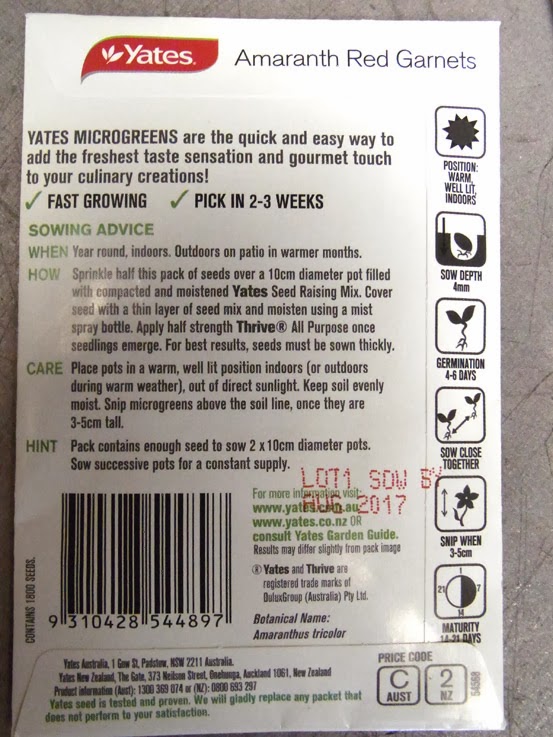
Yates to try out. It's a new range called Microgreens, quick-
growing salad greens which you harvest when they're baby sized.
So far so good, they've come up quickly, in five days.
Judy sent us four packets to try. Our little red
babies are the 'Cabbage Rubies'. The idea is
that you sow about half a whole packet of the
seeds in a small (10cm) pot. You can grow
them indoors, on a windowsill, but I'm
growing ours outside. As the seed packet
says "pick in 2-3 weeks". That's what we'll do.
Some seed packets give you too little growing
info, but Yates can't be accused of that. There
are enough instructions here to give even the
most basic beginner some confidence.
 So, if your salad greens in the garden bed are having a tough time of it here in Australia right now, you're not alone with that problem. My tip is to go potty until autumn. I prefer a mixture of leaves, so those 'mesclun' mixes are perfect for pots. The one great thing about pots is that you can move them to the 'perfect' spot that gets the right mix of sun and shade in summer. The problem with pots is that they're a bit more work, but all that really means is daily watering, before you head off for work.


Wednesday, March 20, 2013

Learning to love radishes


And the winner, ladies and gentlemen, of the seed-sowing race, planted on Sunday morn and announced this Wednesday morning, is... the radish seeds of course!

Hardly a shock winner, but three days is good going. That's why
they say radish are great for kids to sow, because they come up
so fast. It's a shame when it gets to the time for the kids to taste
their first radish, though! In fact I've been a bit that way about
radishes for many years, but this summer I've learned to love them.

Now I can't believe that I haven't taken a photo
of the radishes we've been pulling up, but I just
did a search of my iPhoto files and all I came
up with was this. Mine don't look quite as uniform
as these, but seed packets are like that.

Now, the thing I've learned to love about radishes is how a bit of moderation can go a long way. I've always made the mistake of cutting radishes into too-big slices then finding that I dislike their pepperiness. This year I've been chopping them up much smaller then tossing them into salads, and they've lost that peppery flavour and have now taken on just a warm glow. On the weekend I added some, finely chopped, to a lentil salad and I think they were the magic ingredient that made it go 'zing'.

This shot of the Baker's Creek seed catalogue page on radishes
shows that these rather neglected, almost maligned, little salad
zingers can actually be quite pretty, too.
I don't think I'm going to turn into a radish enthusiast any time soon, but it is good to get to know a vegie you haven't especially liked all that much and find a use for it in the kitchen that's actually valuable.

In the garden these really are a pleasing little thing to grow. So fast and so easy. From now on there's always going to be a little place set aside for just a small row of radishes to add their mouth-warming magic where it's needed.


Monday, March 18, 2013

Getting my act together


Sowing seeds is so much more fun than just banging in a seedling (but I do admit to being a seedling planter fairly regularly, when I commit one of the three "F"s: forget, fail or fudge). However, this autumn I haven't forgotten or fudged, and only time will tell whether I have failed or not. It pays to be an optimist with seed-sowing, so I'm hoping most of them will do their duty and turn into delicious little herbs and vegies.

The other bonus with sowing seeds is that warm sensation of feeling that you're getting your act together. Oooh gosh, I'm all organised for once!

I do actually know which pot is which, despite the lack of tags.
In with the fresh potting mix, scatter on a layer of seed-raising
mix, then the seeds, then a bit more seed-raising mix to get the
correct sowing depth. Pat down, gentle spray of water. Wait.

One pot is filled with coriander, another with flat-leaf parsley,
another with chervil and the last with a 'micro salad mix' that
worked so nicely last spring that's it's worth another go this
autumn. Both chervil and coriander don't like summer here,
going from leafy to flowery then seedy in no time. Winter's slower
pace suits them both fine, and they'll last for months once they
get going. The old parsley plants had gone to seed, and so
I'm sowing seed again (this time soaking the seed in hot water
for a few hours, to speed up its super-slow germination).

Out in the vegie beds it's the same story. The mulch is mostly
there to slow down the onrush of weeds, which are relentless,
but the dark brown bits are where the seeds went in.

In this vegie bed and the one next door I've sown seed of English
spinach, radish, spring onions, lettuce and Florence fennel. The
Florence fennel in particular detests being transplanted so must
be grown from seed, but the same is basically true of the spinach
and radishes, too. Seeds are best. Both the lettuce and spring onions
aren't fussy about being transplanted, but as everything else is
starting from seed, they have to do it that way, too.
The interesting thing now will be 'seed racing': seeing which seeds will come up first. I can tell you who'll run last – it'll probably be the parsley. 

In this cooling weather the lettuce can come up within a week, often less, so too some of the salad greens in the potted micro-salad mix (which includes corn salad, beet, spinach and amaranthus), the spinach and of course the irrepressible radishes. 

The rest present a packed field that are all likely to come up anywhere between 7 and 20 days. The excitement is bearable, but I'm still interested in keeping track of how they all go, and of course once they do start to come up and thrive in the autumn sunshine, it will all be worth it, because if they all come up, then I've well and truly got my act together this time round!


Saturday, January 26, 2013

Seedy habits


The therapists say that the first thing to do with any addiction is to admit you have one. Good advice, but I'm not sure if they know what they're doing after that point is reached. Anyway, here goes: I am tragically addicted to growing plants from seed, and my success rate is OK, not brilliant, but getting better. There, I've said it. I'm feeling better already.

And so at the latter end of this hot, windy and rather unpleasant Sydney Saturday afternoon in January, I've brought out my seed tins, taking stock of the lovely little packets of tragic temptation lurking demurely inside, and I'm planning my autumn seed-raising campaign now. Oh what fun, must put on the kettle to make a calming slug of green tea while I plan out my gardening future.


Here's the hot candidates, all vying for attention. With some,
I'm just waiting for this rolling series of heatwaves to be over
before I get any plants growing again (rocket, lettuce and chervil
all hate the heat and wouldn't be worth bothering with right now).

But there's another category of seeds which is demanding
my attention now: those plants which really only are happy
when sown as seed in the spot where they are going to spend
the rest of their little lives. These are the fuss-pots which don't
like being transplanted as seedlings. Here, there's Florence
fennel, Shirley poppies, carrots, parsley, rocket, beetroot, chervil
and parsnips. I'm already starting to play favourites, though.

While I do of course like to eat parsnips, there
is something extra about them that I like. Being
slow and a bit haphazard in the way they come
up from seed has its 'challenge and reward' buzz
when you see them finally come up, but I just like
watching them grow, and of course harvest
time is lucky dip at the carnival time: you never
know what shapes you'll get (but my second
crop was much better than the first, and my
secret of success is deep, maniacal soil prep).

Call me sick, but I just like parsnip foliage.

If you think having a crush on parsnips is worthy
of referral to a therapist, wait till you hear my
Shirley poppy problem! Total failure last time,
complete duds. I rescued the situation by buying
and planting some Iceland poppies in their place
(and Icelands are easy-peasy, lovely from seedlings).
But here I am planning to have another go. Of
course I don't have a clue where I went wrong.
Tragic fools rarely do. But I'm going to try again.

Florence fennel also needs to be sown direct
into the soil. No transplanting seedlings, please.
As I mentioned a couple of postings ago, I
currently have a little 'test batch' sown and
growing well. Pam and I love to blend sliced 

fennel and potatoes together (more spud than
fennel of course), sprinkle with olive oil, grinds
of salt and pepper then toss, into a covered dish
then bake slowly for as long as you like. The
fennel caramelises and becomes a bit sweet
and the result is utterly delicious.

Oops! A seed spill in the bottom of the tin.
Whose are they? Not the fennel! Yep, the
fennel, recognise those seeds anywhere.
Thank goodness for stocktakes and stickytape
fennel seed packet back in good order now.

Two last little asides. Seed packets give old tins a meaning and
purpose in life. Most of my seeds are in the cricket-crazy-kids'
Weet-Bix tin, but the retro-themed Yates commemorative
125th anniversary tin is doing fine service, too.

Last but never least, I amazed myself by actually checking the
'sow by' dates on the back of all the seed packets before I did
anything else. It is a bit depressing to carefully till the soil,
prepare the seed beds, sow the seeds and water them for days,
then weeks, on end, only to have nothing happen. At that point
 you wonder where could you have possibly gone wrong.
Then you finally, belatedly glance at the seed packet only to
discover it says: "You should have sown them three years ago,
you fool". So take it from a tragic fool, read the packet first!


Monday, January 14, 2013

Good cheer


Of all the silly things a usually sensible person could do, I updated our accounts on Saturday, and delving into inconvenient financial facts always has a slightly depressing effect, doesn't it? And so yesterday, Sunday, was a low point for me, a cheerless day in the garden where all I did was pull out weeds and cut back a rampant ground cover in the front garden that likes to accost pedestrians in the street.

Not the greatest weekend, but it did end well with the first good downpour of rain in ages, and then this morning, Monday, wandering out into the garden had an amazingly uplifting effect on me. Everywhere I looked I saw positive signs, pretty colours, sweet scents – it was full of good cheer. 

And so, dear readers, I present a simple posting designed partly to cheer myself up but also to celebrate the benefits of slowing down and taking stock not only of the pennies in the jar but also the beautiful, natural riches around you.

This is what started it all off this morning. While gathering yet
another colander full of cherry tomatoes, the air was wafting along
on sweet tropical frangipani scents. I stood up, looked at their
lovely simplicity, inhaled another breath and my mood changed.
 
For the record, this is my favourite typo, cheery tomatoes.

Just as I stepped away from cheery frangipani
land I smiled at a conversation I had with an
expert gardener about how impossible it is to
grow Acacia cognata in Sydney. 

The rain brings out the scents and the colours;
this pot of mint was spicy with its tangy scent.

The mint is in flower now, a happy plant in semi-shade provided
it's given outrageous amounts of water and fertiliser.

Next door to the mint, the French tarragon is a contented low
forest of foliage. Medium water, slow-release fertiliser is all
it needs, plus one hell of a cutback in early spring.

My first go at growing Florence fennel is doing
OK. I have a whole packet of seeds here, but
only planted a few in late spring, as I had
missed the boat for the earlier spring sowing
it prefers. This autumn, I'm sowing lots more.

The strawberries just keep on coming. We started
harvesting breakfast bowls full of these back in
early October and they aren't close to finishing
yet. And to think I didn't even plant anything
there! They came up out of the compost, just
like monsters come up out of black lagoons.

And while I'm counting my blessings and
spreading the good cheer, let me recommend
radishes to you. These are French Breakfast
long cylindrical radishes, and I sowed the
seeds for these on Thursday. I'll probably
be eating some of these by early February.
And I've learned to like their flavour, too.
Super-finely sliced, not too much either, added
to a green garden salad, they are pure zing.

The Thai makrut lime fruit is ready for grating
into dressings, salads and sauces, but the only
hard thing is removing them from the tree,
simply because they look so good there, all
knobbly, deep green and just a bit weird.

There's a party going on in the succulent patch.

The Tiger Grass which is meant to become a
tropical look screen to hide the boring metal
fence is finally growing fast, now that the
heat of summer is here. That's what it loves,
apparently, heat and water, just as if it was
growing in the jungles of Thailand. One of
these days a tiger will jump out of that foliage!

If you're still with me after this marathon 'cheer up' to myself, thanks. There really is nothing quite like a spin around the garden on a cool morning after overnight rain. Quite magical, its effect.