Showing posts with label pelargoniums. Show all posts

Saturday, August 25, 2018

Lots of flowers? Must be spring!


"Hey, come and have a look at this," said Pammy, ever the eagle-eyed spotter of all things newsworthy in our garden. We had to get down on our hands and knees, and be up very close, but there it was — the complex, gorgeous mini bloom of our potted succulent. I think it's a graptoveria, but as a succulent amateur I am at all times willing to be corrected on these things. Doesn't matter really, it's the wonderful mini other-worldliness of tiny blooms that had us both captivated.

It's a bit orchidy, this succulent flower, with its red-wine flecks on pearlescent petals.


Even I could spot the next of our spring awakenings — a huge spray of not-quite-yet-open yellow dendrobium orchids.


This spring show has been a few years in the making, as this plant has never flowered before. Over the last few years I have tried my hardest to be nice to it, but without any success. It has always lived with all the other orchids, which manage to flower their heads off like clockwork. But the dendrobium? Nah, sorry. Once all the flowers open fully, I will no doubt do another posting.


This next pink one, a climbing pelargonium, is one of the success stories of my "recovery ward". I bought three plants, put them in a hanging basket in a sunny spot, where they then proceeded to do very little, then started to die off. While I can accept that the fault is all mine, what bugs me is that I didn't have a clue what I was doing wrong.

So I rescued the final, barely surviving plant, repotted it into a smaller, normal pot and it has been keeping my orchids company in a more sheltered spot for the last year or so. And now it's looking happy again. Should I attempt to move it back to the hanging basket? Well, that is why I bought it ... but I am beginning to see that as the "hanging basket of doom" and I can't quite work up the bravery to try it yet.


Next in the spring slideshow is good old, never-fail, grow-them-every-year poppies. Pam loves them. Pam cuts them for vases in our house. And this year we have yellow, white and orange poppies. Lovely.


It's nice to be appreciated. The deal is, if I am nice to my lemon tree and scatter lots of chicken poo under the tree and water it well, the lemon tree produces lots of flowers, and a few months later, lots of fruit. So far it's all going according to plan. 


Even though evergreen Sydney springs aren't quite as spectacular as they are in colder climates, they're still a delightful time to be a gardener. As well as the flowers I have posted here, yellow clivias and vivid orange scadoxus aren't far off blooming, and the native orchid flower buds are all jostling for a good spot ... but I'll call a temporary halt at this stage. Lots to look forward to!


Friday, June 8, 2018

The 10-Year Rewind – Part 7 – Backyard CSI


Every day this month I am looking back on the 10 years since I started this blog in June, 2008. Part 7 is this one — Backyard CSI — from August 2009, in which I played detective to find out why my hanging basket of pelargoniums wasn't happy.


I love the chance to be the amateur detective and do a bit of backyard CSI when a perfectly good plant suddenly gets crook. It happened recently with these cheery people, pink pelargoniums in a hanging basket. The problem is that this is how they looked last spring. They were a happy family back then. This spring they were on the slab. Something was doing them in, and it wasn't pretty. 

Let's start with the victim, back in the days when it was a healthy hanging basket of pelargoniums. The problem was, where it hung out, it was a sitting duck. 

It was a mugging, a gang mugging. 17 culprits – count them – 17 curl grubs munching on the roots of my pelargoniums. These plant muggers can be found everywhere – under lawns, in pots or in garden beds – they're not fussy. They're the larvae of the common black garden beetle and they're very widespread here in Australia.

This is the classic curl grub mugging scenario. Hanging basket with an outside light nearby. You'd think a light would provide some safety, but not from curl grub muggings. In fact, the beetle mum is attracted to the light at night, finds a patch of soil conveniently nearby, and she lays a clutch of eggs. The eggs hatch in the soil and immediately start eating the roots of any plants they find. They're not fussy; they'll eat just about anything. They love lawn grasses, but pelargonium roots will do just fine if that's all that's on offer.

After I removed all the poor little emaciated pelargoniums from the basket they were all virtually bereft of feeder roots. Just the more stout tap roots and nothing much else.

Here's a close-up of the curl grubs. They're usually white and curled up like this. They look like sleeping babies but that's just a front when they feel threatened by bright sunlight. It's OK to handle them with your bare hands, as the hairs aren't nasty, as they can be with some caterpillars.

I dispose of the grubs by tossing them onto the roof of my shed, where the local magpies quickly swoop down for the free feed. In fact, if Aussie readers/gardeners ever see our native magpies standing on a lawn looking a bit odd as they turn their head sideways as if listening to something under the soil, that's exactly what they are doing. They're listening for grubs such as curl grubs munching and moving just beneath the soil.

My pelargoniums were so sad that I bought a punnet of three identical seedlings and planted them into new potting mix, but I trimmed up the best of last-year's plants and planted them in between the seedlings. Hopefully they'll recover and belt along like they did last year.

And so a more optimistic photo seems the right one to finish with!

As a general tip for gardeners here in Oz, if you have a potted plant which used to be doing fine but is now struggling, despite all your best efforts at watering and feeding, think 'curl grubs' first and foremost. There's only one way to check for them: unpot the plant completely. Go through the soil with your hands very thoroughly, as the grubs will probably be numerous and everywhere, from the top of the soil down to the bottom, along the sides and in the middle.

If your 'problem' pot is somewhere near an outside light of any sort, that's the curl grub's classic MO (love the detective talk). Book em, Danno!

Thursday, December 1, 2016

A splash of red


Every bunch of enthusiasts in every field includes quite a few snobs, and gardening is no exception. Snobs, God bless their misguided souls, want to feel that they're a bit better than other people, and so they select something from their favourite pastime to be snobby about. There are wine snobs, music snobs, coffee snobs ... the list is truly endless, but somewhere in that mix you'll find plant snobs, too. 

And the wonderful plant pictured below is one that the gardening snobs will turn up their already upturned noses at, it's a good old geranium (botanically, a Pelargonium), and this very special one goes by the cultivar name of 'Big Red'. It's a miracle worker in my garden.


This is a photo from a few weeks ago. It's almost always like this, but every now and then it takes a breather (and I get in there and cut off all the faded flowers), the red blooms disappear for a couple of weeks, then it's back to full bloom again in no time. It's in flower for most of the year.


Not all geraniums are this wonderful. I have had plenty of them die off in Sydney's humidity over the years, but this Big Red champion just spreads and spreads and flowers and flowers. And it does all this in the one bed in my garden that has never been truly trouble-free or productive. No wonder I am in love with this plant.

Striking cuttings from it is an simple as whipping out the secateurs and whacking the trimmed cuttings into the soil, a pot or a hanging basket. Friends and relatives visiting our place invariably comment on Big Red and tootle home with a handful of cuttings at the end of their visit. Sure enough, six months later they're telling me how incredibly well their Big Red cuttings are going.

And that's what the snobs hate about this gloriously healthy, vigorous plant: it is far too easy to grow. They seem to feel that gardening should be difficult, that it's no achievement to cultivate an easy grower like this. (And I have garden snob friends who feel the same way about murrayas in Sydney ... they're also far too easy to grow, but that's another topic altogether).

So, all I can say to Sydney gardeners in particular, but I suspect many Australian gardeners in general is this: if you have a spot in your garden where nothing has really gone well, try this Big Red person and I sincerely do hope that it might make you happier. Failing that, at least it might make your garden look a whole lot more colourful, for very little effort.


Thursday, February 12, 2015

Geraniums to the rescue


Gardeners are not alone when it comes to carefully-thought-out plans not quite following the script, but at least when things go wrong for we growers of plants, we can at least plant something else and things can still work out OK. That's what is starting to happen here, and it's good old geraniums to the rescue!

In our case, my brilliant plan was to see our row of four Gardenia magnifica plants rising up 1.5 to 2m (5-6 feet) tall, almost covering our boring off-white steel fence with their glossy green foliage and fragrant white flowers. Nice plan! The trouble is that they are struggling rather badly. The tallest is just 1m tall, and the others are lagging behind. Don't worry, I'm working on it...

Here's the problem, and the solution (well,
the solution under way). Those gardenias'
assignment was to fill the space that is
now occupied by bare white steel fencing.
Hopefully a bit of soil pH measuring and
adjusting, then whammo with the chicken poo
and the Seasol and water should get those
gardenias growing in autumn, but in the meantime....

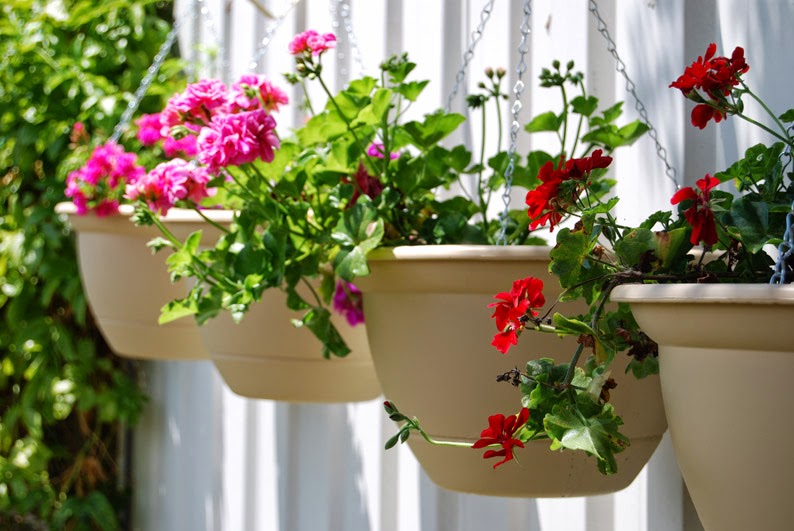
... Pammy and I agreed that hanging baskets spilling
over with foliage and flowers seemed a nice idea. As we are
a little bit old-fashioned in some ways, ivy geraniums
were our pick to do the job of filling the void colourfully.
These are the sort that like to climb, spill or trail.

Part B of our gap-filling job happened down at ground level, with geraniums to the rescue again. Instead of looking at the scrawny gardenias, visitors say "my, your old-fashioned red geraniums are doing well!" (and of course they say nothing about our boring, scrawny gardenias). And these classic old-style red geraniums are doing well.

These red geraniums are sold as 'Big Red' and they cost too much
for me (almost $20 a pop) to buy the five plants we needed, so I
bought  just two and have taken cuttings from them. Geraniums
strike from cuttings so incredibly easily, and so their babies are
 growing along very well now, some sending up their first little
 flower spikes already. And that, folks, is a saving of 60 bucks
for this penny-pinching semi-retired gardener!

There's something about rich red geraniums which make them
my favourite old-fashioned geranium colour combo. I think it's
that tone of red in combination with that tone of green. Love it!


And if you're wondering about those hanging baskets (for Australian readers) they are 'Tuscan' hanging basket planters by Yates, bought from (you guessed it) Bunnings. For the last two decades I have used wire-framed hanging baskets lined with coir, and while they look nice they do deteriorate fast and their soils do dry out fast and they are rather a lot of hard work. I'm trying plastic for the first time and I suspect they will work fine, will soon disappear from view behind a veil of green ivy geranium leaves and quietly go about their business rather well. They also have a "water well" in the base of the pots for the roots to drink from (once they grow that deep).

As for growing geraniums here in Sydney, the first year is always the best one. They really do prefer a less humid climate (they love Adelaide, with its Mediterranean-style climate), and in Sydney you will often strike problems during prolonged wet or wet and humid periods. That's when air circulation around the plants and good soil drainage are the critical factors in keeping geraniums healthy and happy, apart of course from receiving plenty of sunshine all day long.

PS: and if you want to tell me that these geraniums are actually pelargoniums, and not geraniums, go on, I know somebody reading this posting is dying to!

Sunday, July 17, 2011

Good morning, everything!


It's a little habit of mine that started so long ago that I can't remember when, but each day when I open the back door that leads straight out to the garden, I always say "good morning everything". And I mean everything. Even the earthworms, the aphids, the flowers and weeds, birds and the bees. Everything. No use in discriminating, is there? We're all equals.

And on this only moderately chilly July morning, the middle of our winter, with the temperature at 10°C and likely to soar up to just 17°C by early afternoon, we had a touch of overnight rain and the garden was just lovely to behold and be in. No jobs to be done at all, just a wander around our pretty little patch here on Earth.

The first of the cinerarias decided this was the day to come out. These things will now flower for a few months, in colours so bright that lurid is the most honest way to describe them. These are here to do a job, not so much to be looked at directly, but to be looked at in a mirror, attached to the shed wall, by someone standing at the back of the house. That's the plan.

Now, the nasturtiums are Pam's plants, but this is the reason why I so readily gave in and planted something which I consider to be an invasive weed. Ahhhhhh, raindrops on nasturtium leaves in the morning...

Speaking of raindrops, for some reason they always look like a watery gel, rather than mere water, when they accumulate on these succulents.

If plants were a doggie which could wag its tail with happiness, this pelargonium would also like to press its cold wet nose up against my face while it wagged its furry tail.

Of all the vegies I grow, I like the look of parsnip foliage the best. I know there are some glam contenders out ehre (thinking cauliflowers, kales, cabbages and curly parsley for starters) but the light and cheerful green of the parsnips just seals the deal for me.

On a Sunday morning, where there isn't much gardening to be done because Huey the Rain God has sent down a shower overnight, there's only one thing to do, says Mitchell, our Librarian Gnome, and that's read a good book.

Good idea, Mitchell.

(Looking for something new and totally different to read? I'm loving the book I am reading right now, 'Leo the African', by one of my favourite authors, Amin Maalouf, a wonderful Lebanese writer. I cannot recommend Maalouf highly enough. Beautifully poetic and dazzlingly exotic in the way he brings another, completely different culture and time to life, a good one to look for and start with is 'Samarkand' but 'Leo the African' is winning me over as being every bit as good as my favourite so far, Samarkand.)