Showing posts with label spring onions. Show all posts

Friday, November 19, 2021

Looking good


While my enthusiasm for garden blogging might be on the wane, the opposite is true for gardening itself. I've never enjoyed it more. Perhaps the blogging has been getting in the way of my enjoyment of gardening? In recent years I suspect so, hence very little activity here on the Garden Amateur blog.

So here's a rare posting on how things are going here in spring. I may post  something during summer, but right now in spring there is almost too much to talk about.

The one thought that hit me the other day as I was admiring all the flowers and crops is how spring makes you feel like you're a better gardener than you probably really are. Everything grows so well, it all seems so easy. Plant something new and whoosh! It races away like happy children in the park.

Summer in Sydney, however, brings you back to earth with a thud. The humidity, the heat, the sheer difficulty of helping everything to merely survive is hardly a joyful pursuit — it's an important part of the gardening year of course — but gardening here in spring is a much more wonderful time to be out there among all the plants. 

Encouraging little garden sprites whisper in your ear "Hey, you can do this!" and "That worked well" as you tour the flower and vegie beds. It's good for your soul to be out there soaking up the success. 

So, here's my usual little 'photos with captions' essay on what's happening here now. It's very pretty, a lot of fun, and I sometimes wish spring would last forever. 


The amazing Geranium Rozanne is getting bigger and better all the time. It started flowering its head off in midwinter when we bought it and has never let up. It's now spreading about three feet wide and rising two feet tall and it's covered in the prettiest purple flowers.

This feels like cheating, but I love it. All you need to do is buy a La Sevillana rose in flower from your garden centre, bring it home, whack it in a bigger pot and let it flower on. This is one of "Pam's plants". She saw it at a friend's house, loved the clear red colour, issued orders on what we needed next and a week later it was brightening up our pergola area. It's so lightly scented that you barely notice it at first, but I have never seen anyone admire a rose without sticking their nose into the centre. However, Pam being an artist with an eye for colour, this is definitely the rose she wanted.

This is our society garlic, or Tulbaghia, in flower. Lots of variegated strappy leaves with these pink trumpet flower clusters on tall stems rising up. I admire its tenacity. All sorts of horrid weeds like to bully it but it never gives up and always shows up.


Our potted New South Wales Christmas Bush is getting better at timing its display of coloured bracts for the festive season

Boy, are we eating a lot of spinach and silver beet right now. Pam loves it Japanese style, chopped and steamed with a sesame dressing, and I love it Indian style, in dishes such as Palak Paneer and Chicken Palak. The golden rule with these prolific spring crops is that if you think you haven't planted enough, you've probably planted too much already.

Lettuce thrives in spring but soon gives up the will to live once summer comes around. Fortunately we're a little pair of salad munching bunnies, and Pammy also loves to make up egg and lettuce bread rolls for lunch.

I'm a sucker for multi-coloured bowls of salad greens, and so I find all seed packets of "mixed lettuce" to be irresistable. Here's another crop approaching harvest time.

My other must-have crop in our garden is shallots, or green onions, or scallions, or whatever you call them in your part of the world. I'm still perfecting my skills at sowing enough — and especially not too many — seeds to raise the next punnet of seedlings while the current crop matures, but this is much more satisfying than buying a punnet of far too many shallot seedlings at the garden centre and only planting half of them.

Who me? Impulse-buy a Grosse Lisse tomato plant at the local Woolies supermarket? Yes, of course. Total sucker for growing tomatoes, with a very ordinary success rate on the big tomatoes, and a perfectly acceptable success rate on the cherry tomato front. So of course I am attempting to keep a big climbing tomato happy in spring. Summer will be the seasoning of reckoning, but I am prepared to take on the challenge.

On the other hand, all the potted succulents are looking forward to summer's heat. Ever since I repotted them they are all loving the new potting mix. And though it's hard to see here, there's a very thick layer of pine bark mulch spread between the pots and all over the formerly weedy succulent patch, and for the meantime at least, the weeds are not enjoying life at all. They're probably biding their time, waiting for the mulch to break down, but right now the succulent patch is a peaceful village of potted contentment.


So there you have it loyal readers, all 10 of you. Pammy and I are both really enjoying this year's spring in our garden. 

Pam's art students love wandering around and finding something to draw or paint, and for me as a gardener that's plenty of job satisfaction right there.

Saturday, June 29, 2013

Playing chicken


We're into the 700th consecutive day of rain (or so it feels, it might just be the second week) but it's wet in Sydney, folks, and this little gardener ain't doing any gardening right now. The seeds I've sown of the next crops of parsley, coriander and radish are all frolicking in the rain, the lavender inexplicably has decided to start flowering, and none of that is coaxing me outdoors. 

Instead, on this soggy Saturday afternoon I'm playing chicken with one of my favourite recipes, and it's one that I have now cooked several times and each time it has worked out perfectly. The method itself sounds a bit dodgy to Western cooks, but the Chinese have been cooking chicken this way since Confucius was a schoolboy.

Here's some of the ingredients: ginger, garlic,
spring onions and salt. The bottle is of Chinese
cooking wine (Shaoxing), and in our local
Asian grocery it's $1.20 for the whole bottle,
and you use the whole bottle in the stock.
It's like a dry sherry, so I've been told.
Hope that's true (not a sherry person), but the
first time I taste a dry sherry I plan to say
"It reminds me of Shaoxing wine".

The first part of the recipe is dead easy, and normal. Make
a cooking stock (recipe below) but it's the whole bottle of wine,
5 litres of water plus lots of garlic, ginger, spring onions and salt. 
And the chicken itself needs no special prep.
Just one size 16 (1.6kg) free-range chook.
So far so good. Once you've cooked the stock for a while, add
the chicken and cook for... wait for it... 15 minutes! No, it's not
ready yet. What you then do is turn off the heat, put on the lid
tightly, and let the chicken cook very slowly and gently in the
cooling hot stock for 3 whole hours. And it works. The chicken
comes out fully cooked (ie, no 'pink' bits), super juicy and
tender. When I tell people about this recipe most of them
look a bit suspicious and you can tell from their eyes they
ain't never ever going to try this recipe. I don't care, here
it is, and this is what we're enjoying tonight!

White cooked chicken with ginger and spring onion sauce
This is based on a Kylie Kwong recipe found in the newspaper a long while ago. She didn't invent it, of course, an ancestor in 1500BC did, but I have had the temerity to change some amounts, too.

1.6kg whole free-range chicken

Cooking stock
1 x 700ml bottle Shaoxing Chinese cooking wine
5 litres water
12 cloves garlic, crushed
1 cup roughly chopped ginger
1/3 cup salt flakes (eg, Maldon)
8 green spring onions, trimmed and roughly chopped

Dipping sauce
2 tablespoons grated ginger
2 tablespoons finely chopped spring onions
1 teaspoon salt flakes
1/2 cup peanut oil

You’ll need a big stock pot to cook this, preferably one with a heavy base that can hold its heat, plus a tight-fitting lid that does the same.

1. Make sure the chicken is out of the fridge for a couple of hours before starting, so it isn’t ultra-chilled.

2. Put all the cooking stock ingredients into the stock pot and bring it to the boil (that can take up to 25 minutes). Turn down the heat, cover the pot and let it all simmer gently for 40 minutes, to make a fragrant cooking stock.

3. At around that 40-minute mark, wash and trim the chicken of excessive fat if you like. While you prepare the chicken, turn up the heat on the stock so it’s near a boiling again. Add the chicken gently to the pot, breast-side down, then turn down the heat under the pot to medium, so it’s barely simmering, not boiling. Let the chicken poach in the simmering stock for 15 minutes (and no longer).

4. Turn off the heat, fit the lid securely to the pot and let the chicken steep and cook slowly in the poaching liquid for 3 hours. Never take the lid off the pot. Don’t go near it!

5. Well before that 3 hours is up, make the dipping sauce. Combine the salt, ginger and spring onions in a wide, shallow heat-proof dish or pan, then in another small pan, heat the peanut oil until quite hot (but not smoking) then carefully and slowly pour the hot oil over the ginger/spring onions. They’ll fizz a bit in the oil but it all cools down within half an hour.

6. Once the 3 hours is up, carefully remove the chicken from the pot, using tongs, and place it on a plate for 15 minutes to cool down, before cutting it up. I use a Chinese cleaver to chop the chicken into pieces, chopping across the bone. The breast meat is very juicy and tender, so you could just cut off large pieces and slice them, to serve.

7. I serve ours with steamed Chinese broccoli, chopped into chunks, with rice on the side, plus a little bowl of the dipping sauce, which is essential. 

8. The remainder of the chicken makes a sensational cold chicken for salads or sandwiches the next day. The flavour of that ginger-infused cooking stock comes into its own more on the day after than it does on the night you cook the dish, in fact.

9. Don’t skip the dipping sauce; it’s a huge part of the flavour of this dish. It’s a classic Chinese dipping sauce, so you probably will recognise its flavour if you’re a regular at Chinese restaurants and yum cha.

Monday, March 18, 2013

Getting my act together


Sowing seeds is so much more fun than just banging in a seedling (but I do admit to being a seedling planter fairly regularly, when I commit one of the three "F"s: forget, fail or fudge). However, this autumn I haven't forgotten or fudged, and only time will tell whether I have failed or not. It pays to be an optimist with seed-sowing, so I'm hoping most of them will do their duty and turn into delicious little herbs and vegies.

The other bonus with sowing seeds is that warm sensation of feeling that you're getting your act together. Oooh gosh, I'm all organised for once!

I do actually know which pot is which, despite the lack of tags.
In with the fresh potting mix, scatter on a layer of seed-raising
mix, then the seeds, then a bit more seed-raising mix to get the
correct sowing depth. Pat down, gentle spray of water. Wait.

One pot is filled with coriander, another with flat-leaf parsley,
another with chervil and the last with a 'micro salad mix' that
worked so nicely last spring that's it's worth another go this
autumn. Both chervil and coriander don't like summer here,
going from leafy to flowery then seedy in no time. Winter's slower
pace suits them both fine, and they'll last for months once they
get going. The old parsley plants had gone to seed, and so
I'm sowing seed again (this time soaking the seed in hot water
for a few hours, to speed up its super-slow germination).

Out in the vegie beds it's the same story. The mulch is mostly
there to slow down the onrush of weeds, which are relentless,
but the dark brown bits are where the seeds went in.

In this vegie bed and the one next door I've sown seed of English
spinach, radish, spring onions, lettuce and Florence fennel. The
Florence fennel in particular detests being transplanted so must
be grown from seed, but the same is basically true of the spinach
and radishes, too. Seeds are best. Both the lettuce and spring onions
aren't fussy about being transplanted, but as everything else is
starting from seed, they have to do it that way, too.
The interesting thing now will be 'seed racing': seeing which seeds will come up first. I can tell you who'll run last – it'll probably be the parsley. 

In this cooling weather the lettuce can come up within a week, often less, so too some of the salad greens in the potted micro-salad mix (which includes corn salad, beet, spinach and amaranthus), the spinach and of course the irrepressible radishes. 

The rest present a packed field that are all likely to come up anywhere between 7 and 20 days. The excitement is bearable, but I'm still interested in keeping track of how they all go, and of course once they do start to come up and thrive in the autumn sunshine, it will all be worth it, because if they all come up, then I've well and truly got my act together this time round!


Monday, February 4, 2013

Thinking big


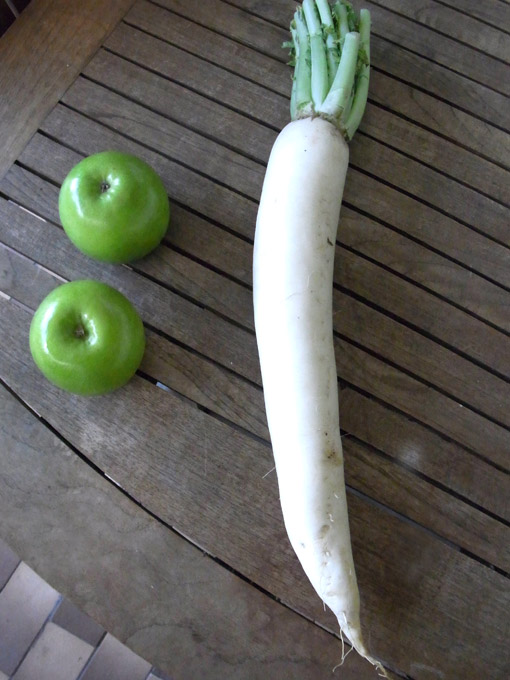
There are some vegetables that fascinate me but I don't think I'm going to have a go at growing them. Top of that list is this large white person, the daikon, or Japanese radish. It's a daunting sight, that enormous white root 18 inches long. I always feel that growing long, straight carrots and parsnips is a pretty good effort, but I suspect daikon may well be that 'root vegie too far' for my heavyish, loamy-clay soiled garden.

One minute of Googling 'daikon' tells me that this Japanese word means 'big root' – and, well, slap my forehead and stun me into slack-jawed silence, that's a surprise!

What brought me to trying daikon was simply browsing for new flavours. I wanted to cook something with prawns (shrimp) yesterday, but something new that I haven't tried before. So I went browsing through my Asian cookbooks and found two nice recipes in the Korean section of my old, favourite Asian standby, 'The Complete Asian Cookbook' by Charmaine Solomon. One recipe is for a daikon and apple salad, and the other is for a green bean and prawn stir-fry. With steamed rice on the side, I had a dinner for two!

The silly thing about my local greengrocer is
that they don't sell individual daikons. You have
to buy a bunch of two. At least that was only
$2.99. And when a recipe calls for apples,
I almost always get Granny Smiths, one of
Australia's (and Sydney's) most popular
contributions to world food supplies.

However, I'm getting ahead of myself. Crushed toasted sesame
seeds are a staple ingredient in so many Korean dishes,
including both that I cooked last night, so I made a batch
in the afternoon, crushing them in a mortar and pestle.
I've really grown to love my mortar and pestle, preferring
it over my whizz-fast blender and electric coffee grinder.

The slightly tricky bit is dry-toasting the seeds in an oil-less
frypan. Letting the seeds burn is the big boo boo, and
constantly stirring and checking them for colour is the
main task. Over medium heat, toasting takes a few minutes.

Next step is to get the salad started. First, finely slice the apple
into julienne strips then soak in chilled water to which you've
added lemon juice, to stop the apple browning. As you can see
by the inconsistency of the julienne pieces, I used a knife.
The daikon itself is soft to cut, like other radishes
and has a typically radishy zing to its flavour, but
it's not too hot, as some radishes can tend to be.

Then slice the daikon into matchsticks. 

And slice two spring onions crossways, finely,
both the white and green parts being used.

For the salad make the dressing in a bowl. It consists of light
soy sauce, vegetable oil, sesame oil, vinegar, crushed toasted
sesame seeds, chopped chilli, salt and sugar. The flavours are 

balanced but the lingering taste is, of course, of sesame.

Toss the salad components together well, cover and chill in
the refrigerator while you make the stir-fry (and cook the rice).

The big thing with so many Asian dishes is the preparation, the
slicing, dicing, mixing and getting ready. The cooking itself
often takes just 5 or 10 minutes. Washing up the next morning
always involves washing more 'ingredients bowls' than
serving dishes or cooking utensils. This is the makings for the
Korean-style prawns and green beans stir-fry.

One finely sliced white onion.

A blend of vegetable oil and sesame oil.

400g green beans, trimmed, sliced on the diagonal.

400g green (uncooked) prawns, each cut
in half lengthways, then crossways, to make
the 'small prawns' the recipe asked for
but which I couldn't find.

The sauce for the stir-fry, which consists of light soy sauce,
sugar and those crushed toasted sesame seeds.

I'm amazed I found time to grab the camera and do a hot wok
action shot as it quickly cooked. The basic are easy. Heat the
wok, add the oils, toss in the onion, stir-fry that 1 minute.
Then toss in the prawns, stir-fry 1 minute more. Then toss
in the beans, stir-fry 1 minutes more. Add the sauce, toss
well, cover with a lid, turn down the heat. Then, about
2 minutes later, take a bean out and try it. If it's nicely
crunchy-yet-tender as you like it, it's all ready to serve.

Now, I'll have you know that I don't do 'plating up'. I put food
on plates, and I think it shows. Thank goodness I don't
cook competitively ("Plating up, minus 3!" I can hear the
terrifying judge in the cravat say with disdain.) And thank
goodness I'm not looking for a job as a food stylist.
How was it? Yummy all round, I even got the rice just right. The dominating flavour in the daikon and apple salad, at first bite, turned out to be the slightly tart apple, but as the meal progressed that slightly peppery zing of the daikon worked its way forward.
The prawn and bean stir-fry was also very easy to eat. 

Pam and I love to eat Korean food but we're not really interested at the ubiquitous 'cook at the table' barbecue which is what you find almost everywhere. Korean food has so much more to offer than that admittedly delicious barbecued fare. I also make the famous Korean rice and vegetable dish 'Bi-Bim-Bap', and I love their seafood pancakes and shallot pancakes, too. Such an interesting, robust, different cuisine!

And so, for the recipes, here goes

Mu Saingchai – white radish salad

1 giant white radishes
1 crisp cooking apple
lemon juice
2 spring onions

Dressing:
1 1/2 tablespoons light soy sauce
1/2 tablespoon salad oil
1 teaspoons sesame oil
1/ 1/2 tablespoons mild vinegar
1 1/2 teaspoons sugar
1/2 teaspoon salt
1/2 tablespoon toasted, crushed sesame seeds
1/2 fresh red chilli, seeded and finely chopped

Method:
Peel radishes and cut into matchstick strips. Peel apples and cut into similar strips, and soak in cold water with a good squeeze of lemon juice to prevent discolouration. Slice the spring onions very finely, including white and green portions. Combine all remaining ingredients and toss with the radish, well-drained apple and spring onions. Cover and chill before serving.


Saewoo Bokum - green beans with prawns

400g small prawns
400g tender green beans
2 tablespoons vegetable oil
1 tablespoon sesame oil
1 medium onion, finely sliced
3 tablespoons light soy sauce
1 teaspoon sugar
3 teaspoons toasted, crushed sesame seeds

Method: Shell and de-vein prawns, chop them roughly and set aside. Top and tail the beans, remove strings and with a sharp knife cut into thin diagonal slices. Heat oils in a wok and str-fry the onion for 1 minute, add prawns and stir-fry 1 minute, add beans and stir-fry for 2 minutes. Add seasoning and mix well, cover and simmer on low heat for 3-4 minutes more. The beans shouldn't be overcooked, so take out one after a while to taste test it for 'doneness' and if it's ready, take it all from the heat and serve with steamed rice and the daikon salad.

Remember, both recipes are from Charmaine Solomon's best-selling 'The Complete Asian Cookbook', my old standby from way, way back. I've halved the quantities for the daikon salad (and even that still made enough for four) and I've changed the method slightly in the green beans and prawns stir fries.


To finish, might as well show you this. My
copy of 'The Complete Asian Cookbook' is
the paperback 1978 edition. Its pages are
filled with spice stains! Back in 1996, while
working on House & Garden magazine,
I went to Charmaine's house for a photo
shoot, and so I took along my already very
battered, much loved copy of her book and
asked her to autograph it for me. I'm such
a groupie! She was a very lovely and
gracious person, and her cookbook really
is my Asian food bible still. Charmaine seemed
to enjoy flicking through my copy of her book,
picking out my favourite recipes by the extent
to which the pages were coloured with saffron,
turmeric, chilli powder and other ingredients.


Sunday, March 7, 2010

Seed day


I'm being a bit careful about which jobs my dodgy back is capable of tackling right now, but sowing seeds is a pleasant little task which is fairly safe, provided I don't do something silly with a full bag of potting mix. And so I'm taking a little gamble on the weather cooling down a bit over the next few weeks and I'm sowing up some pots of seeds, hoping that by the time they germinate in a week or two, things might be a little less humid summery and a bit more warm autumnal. Fingers crossed.

First up, three pots of herbs. From left to right, chervil, rocket and coriander.

I'm going to add in several links with this post, just because I think it's appropriate this time round. On the left, the chervil seeds came from the Italian Gardener an Australian-based seed supplier selling seeds sourced from Italy. So far, none of his seeds have let me down, they've all been great, and for the roughly $4.50 price of each packet you seem to get a zillion seeds, many many more seeds than from other seed companies. In the background, the rocket seeds come from Yates, Australia's biggest seed supplier, and they're absolutely fine, never let me down either. In the foreground the coriander seeds are the ones I saved from last year's harvest.

Now, this looks like far too many coriander seeds in that pot, and you're right, that's far too many. Deliberately so, because I don't know whether they're duds or not. If only 50% of them come up, it's probably still too many. But if only 25% come up, it's probably right. So, I'll just wait and see. And if I have 100% germination and too many plants, it'll be out with the tweezers and I'll ruthlessly cull the weaklings so that Charles Darwin would be proud of me.

This is just a photo of last year's coriander, the parent which produced the seeds above. Early March in Sydney is probably a month too early to sow coriander seed, especially if the weather stays warm, but as I still have hundreds of seeds left over, I'll just sow another batch in April, which is probably a more sensible time to do it, as coriander grows best during the coolest months of the year here – May through to September. The later batch will be sown in the ground. If it's hot this month, I'll move this potted coriander to a more gentle spot in the garden that only gets morning sun.

There's a simple explanation for the large number of fine, thin chervil seedlings here. I spilled them accidentally from the packet, and then got sick of picking up the fine seed to retrieve my boo boo. And so I'll wait for them to sprout and I'll thin them out then.

The great thing about chervil is that this herb loves the semi-shaded spots in gardens. In fact, don't give it full sun. So, if you're a balcony gardener with limited sunshine, or in the inner city where the neighbouring buildings and trees cast long and lengthy shadows, try some chervil. Chervil is one of the four classic French 'fines herbes' – parsley, chives, chervil and tarragon. It has a delicate flavour that has hints of aniseed. This photo is one of last year's pots. Chervil is a short-lived herb that I find grows easily from seed. A pot like this might last you about two or so months; towards the end just sow another pot of seed.

The third crop sown today is rocket. I stopped sowing rocket last November, as it's just too hot to grow rocket here in summer. It should do fine from now on. In fact, it should rocket away! It's well-named. Sown today on Sunday, the seeds will probably be up by Thursday or Friday. Rocket lives hard and dies young, and so I try to sow a pot like this roughly every four to six weeks, from now until late October.

This is a typical pot-full of rocket from last year. It's ready to harvest at this baby stage. I harvest it with scissors, cutting the plants off almost at the base. When it's baby-sized like this it's still nutty and lovely to eat in salads. Let it grow another 10 days more, when the leaves are double in size, and it will have become peppery and not really all that pleasant to eat in salads, especially if there's a lot of it in the salad. Unfortunately, this larger, peppery rocket is what most shops sell and so I find it's no wonder that rocket isn't all that popular with your average punter.

To finish off the pots of seed, I cover them with seed-raising mix. The chervil and the rocket are barely covered with seed-raising mix. The packet says to sow seed 3mm deep, and so I aim for about that thickness of coverage. Coriander seed needs to be sown 6mm deep, and so I cover it with a thicker layer of seed-raising mix.

Water well with a very fine spray so as not to wash the seeds away, and leave the pots in a warm but not sunny spot. In this warm weather, which is essentially still very summery, everything should sprout soon enough. When they do sprout I'll lightly liquid feed them then thin them out a week or so later on if they're too crowded. The chervil will remain in a semi-shaded spot, but the rocket and coriander will be moved to sunnier spots once they're underway.

Finally, another bit of seed-sowing today. On the left, some red-stemmed spring onions and some mixed mesclun lettuce, and in the round pots on the right, the Gymea lily seeds which I blogged about here.

Phew! All good fun, though and my back is just fine! I love watching seeds come up – I don't think I'll ever get sick of it – and to toss in a final link for this link-filled blog I'd have to say I am always inspired by Michelle and her great blog at From Seed to Table.

Right now I'm most fascinated to know whether the Gymea lily seeds will sprout, but my iffy home-saved coriander seeds have a very nice touch of suspense about them, too. As for the others, it's routine, but a very pleasant routine indeed.


Sunday, February 7, 2010

Making plans


The rain is doing its best imitation of Madam Lash at the moment, telling Sydney "take that, Sin City" with successive whippings of rain. And so poor innocent gardeners, who've done nothing to deserve this punishment (apart from praying for rain) are sitting with their wet, squishy noses pressed against the window pane, looking out at a super-soggy garden, doing the only thing they can do right now – dreaming up what to do next.

This is definitely one of those "click on the photo to make it readable" photos. This is how the garden looks today, after 78mm rain (three inches) yesterday, and 50mm (one inch) spread over the two days beforehand. That's enough, Madam Lash, I can't take any more! Anyway, what follows are my plans for autumn plantings – probably beginning in March at the earliest. Let's start with the foreground, left – "brodiaeas in here".

Until last Sunday night I'd never heard of brodiaeas, but now I own 50 of them. Aren't catalogues wonderful? After a recent posting here, blasting away at how much I dislike spring bulbs, I've gone ahead and ordered some spring bulbs. I just figured that I wanted to see something different next spring, and as soon as they finish flowering, I'm pulling them all up and, shock-horror, tossing them all away. Total cost is $12.50, roughly the price of an indifferent bottle of Sauvignon Blanc. But it wasn't me who picked the brodiaeas.

That was Pammy's job. Pammy is a wonderful shopper, and also a magician with restaurant menus, able to find something amazing on a menu which everyone else misses. I suspect this is because she reads menus from cover to cover, same too with catalogues. Anyway, I tossed her this catalogue with her brief to choose something interesting, and the next morning it was on the kitchen table, with helpful pink sticky note thingys indicating the brodiaeas. Blue flowers. I love blue flowers!

By the following Friday, the postman dropped off the package. Parcels in the mail, one of life's simple pleasures!

Little buttons they are. Currently they're staying in the crisper bin of my fridge until planting time, which won't be until April. I asked my resident horticultural expert, Geoffrey, for some tips, and as well as telling me to wait until Anzac Day (April 25) before planting he helpfully added that the growers incorrectly list brodiaeas as being from South Africa when in fact they actually come from Northern California. So thanks once again to Geoffrey for his growing tips and advice, which is invariably spot-on.

Once Pam had set me off with a blue theme, I wondered what else might I grow that's blue-flowered, down the other end of the garden. It has been about 15 years since I last grew the old-fashioned cottage plant, love-in-a-mist, so I ticked the box for one packet of love-in-a-mist seeds while browsing the online catalogue of another major seed supplier, Digger's. (This photo is pinched from Google Images, by the way).

In the spot where currently I have an Asian eggplant producing a crop, I've decided to grow a dwarf Tibouchina 'Groovy Baby' which is only 60cm tall and 80cm wide. I'll plant this dwarf shrub in April, once the eggplant has finished. This is more of a summer and autumn flowerer, so it'll keep my favourite blue-flowered thing going a couple of months after all the spring blues have gone up to heaven. If all goes well, this will become a permanent planting here, a summer patch of blue in a lovely, sunny spot.

Across the path from the love-in-a-mist, I'm going to grow another crop of broad beans, my favourite home-grown vegetable to eat. This is a photo of the previous crop, which was a tall-growing variety tied to a nice bamboo frame. This time round I've picked a dwarf plant which only grows 1m tall, but as I still have the bamboo poles in the shed, I'll make up some kind of support for the floppy old broad bean plants with them.

This is just the tiny photo pinched from the Diggers catalogue. It's what they solemnly promise their red spring onions will look like, and I liked that look so much I ticked the box for a packet of seeds of these, and they'll form a border around the broad beans.

Of course I am going to grow poppies again for Pammy, in the same spot where I grew them last year, and I hope they'll be every bit as lovely this time round, too.

I've run out of photos for the rest of my autumn planting plans. But on the left side, near the house, I am going to replace my rather dreary big potted bay tree with a far more exciting and interesting potted 'Black Genoa' fig. I'm really looking forward to having a fig in the garden again. When we moved here an old in-ground fig tree struggled along for the first 15 or so years, producing bumper crops every summer, then it just fell over in a storm one day, its branches full of rot. And so 'Son of Fig II – the Black Genoa' will be starring at this blog fairly soon.

And that lovely big grevillea on the left needs pruning soon. Big tip for anyone growing grevilleas: prune them often, do it twice a year, after each flush of flowers. Take off up to a third each time if you like, but that's not compulsory, although some kind of pruning is. Roses and grevilleas have a lot in common - pruning makes both of them flower much better. But grevilleas hardly need feeding. Just pruning.

On the right side of the pathway, I am going to grow a leafy patch of flavours, combining flat-leaf parsley, coriander (cilantro) and some celery leaf plants, which produce lots of celery-flavoured leaves for cooking. Celery is a notoriously tricky vegie to grow, but I do like the flavour of the leaves, etc in making all sorts of sauces, so I'll give the seeds of these leafy relatives of celery (which I bought recently in an Asian food store in Darwin) a try this autumn.

Finally, on the centre, right side of the pathway, yet another crop of mixed 'mesclun' salad greens, a crop which, along with herbs, is probably the most useful, practical crop I grow here.

One thing I can say in favour of extremely wet days is that they slow you down enough to help you do some planning. So Madam Lash's ministrations aren't all bad, but she can stop now.