Saturday, September 14, 2024

Making beautiful music together


Long ago, when I started out gardening and imagined my spring flower shows to be like beautiful musical symphonies, I discovered that the hardest thing to do is to get the timing right. 

I realised that symphonies were out, and jazz was in. While I'm not a jazz music aficionado, I realised that the way flowers do their thing each spring is much closer to jazz soloists taking their turn on stage while the rest of the band plays along behind them. 

Right now, sticking to the jazz theme, my garden's musical band consists of yellow clivias on trumpets, pretty poppies on percussion and flannel flowers chiming in on vibraphone.

They look great and if only I had special ears that could hear what they're singing, I am sure it'd be a wonderful tune.

The yellow clivias are at their peak right now, and each year the clump is growing, with more trumpets playing for many weeks in spring.

The flannel flowers have been teasing Pammy and me with their "about to open" phase lasting a week now. There's lots of them, all so soft and furry, with pale green tips at the end of each petal.

They're growing in a largish pot and I consider it a job well done to have sheltered them through a whole cycle of Sydney seasons starting in winter last year. These native blooms thrive in light sandy soils, and we definitely don't have that in our garden, so a pot filled with native potting mix is my next best option.

Every year I plant poppies for Pammy, patiently waiting for punnets of Iceland poppies to appear at my garden centre in autumn. The only thing I have learned is to crowd them in a bit closer than it says on the label, and to pinch out any early baby poppy flower stems and fertilise the daylights out of them so the leafy bases of the plants grow big and strong. Then, and only then, do I let them flower. I think it produces a slightly better show.

It's not quite true when I say I grow the poppies just for Pammy. I grow them for me, too. But as well as loving how they look in full bloom, my favourite sight is tired wet poppies in the morning. They look like pretty girls who've partied too hard but had a good time anyway.

And so that's this week's jazz band. Coming soon we'll enjoy solos put on by the Louisiana iris, New South Wales Christmas bush and half a fence full of mandevillas. They all do their own thing in their own good time, and I'm content playing my small part in keeping them happy and healthy, then sitting back and enjoying the show.

Tuesday, August 27, 2024

Our front garden has a mind of its own


Well here we are, almost one year after our great Front Garden Makeover of 2023, and my brilliant plans have not quite worked out how I planned, but I'm fascinated to see what happens next anyway.

You see, the problem is that our front garden has a mind of its own. It is doing what it wants to do, not what I want it to do, and it's looking pretty interesting anyway. Let me explain ...


This is the scene this morning, late August 2024. The main star of the show, the Corymbia 'Dwarf Orange' is growing rapidly and happily. And the easy-care green groundcover has spread to all corners of the space. So what's the problem? It's the wrong groundcover!

A wider angle view shows the carpet of green in context, but instead of being the creeping thyme that I searched for, bought and planted, it is almost entirely made of the native violets which I thought I had eradicated prior to the whole makeover starting. This area was once all bare dirt. Click on this link to get see the naively hopeful beginnings of my 2023 planting plan. It seemed like such a good plan, too!  

But I must not dwell on life's minor disappointments too much, as the great news is that the Corymbia 'Dwarf Orange' tree is going gangbusters and feels and looks like it's growing every day. That red new growth is such a cheerful sight; fills me with hope.

This is what I am hoping for (this is a late 2023 photo, not a 2024 one). Lots of dazzling orange blooms set against that darkish green eucalyptus style foliage. (Eucalyptus? you ask? Yes, many Eucalypts have been renamed Corymbia for some reason known only to botanists with PhDs.)

So, my big unanswered question at this stage is ... what happens next? All of the creeping thyme I planted is still there, still alive, with little bits of creeping thyme foliage poking through the carpet of native violets. So will the creeping thyme flower this spring? I don't know. I hope so.

Down by the front gate is the best chance of creeping thyme flowers bursting into bloom. This is a variety called 'Bergamot' and it has mauve-purple flowers. The native violets haven't swamped the bergamot like they have in most other areas.

It would be great to have splashes of purple-mauve, purpley-red and crimson flowers jazzing up the white-and-purple flowers of the native violets. At best it could be riotous, but more likely it will look like a messy painter's palette.

In the meantime, there is one more flower show that passers by in the street can enjoy as they walk past. The New Zealand Christmas Bush (Metrosideros) that occupies a pot beside the low front verandah wall is blooming better than ever before. 

I know why this has happened. I'm paying more attention to this plant, because I'm visiting our front garden more often to check on progress on the makeover, and while I'm there I water this pot, clip off dodgy looking bits and scatter around some slow-release fertiliser.
 
It's shameful to admit that I have neglected this lovely shrub over previous years, but it's true. My main focus is on our back garden, so "out of sight out of mind" played a part in its neglect, as I simply forgot to water it often enough. But not any more. 

The pot is in a spot that gets morning sun only, just a few hours. Also, the side passage cops a whole winter full of chilly southerly breezes, so it's by far the coldest part of the property, but this tough little shrub doesn't mind wintry winds. Its varietal name is 'Fiji Fire' and that reflects the fact that Metrosideros can be found on many Pacific islands, not just lovely, often cool New Zealand.

As for the front garden having a mind of its own, it reminds me of a great song called "My Mind's Got a Mind of its Own", written by Butch Hancock and performed by Jimmie Dale Gilmore, who along with Butch and Joe Ely formed the legendary Flatlanders band from Lubbock, Texas ...

"My mind's got a mind of its own
It takes me out a-walkin' when I'd rather stay at home
Takes me out to parties when I'd rather be alone
My mind's got a mind of its own."

So, my garden has a mind of its own, or at least the native violets do. They're in charge of this makeover, not me! So, once the riddle of what happens when it's time for the surviving bits of creeping thyme to bloom through the native violets is solved, I'll post an update of my update here. Stay tuned!

Saturday, August 24, 2024

Asleep at the wheel


Spring has a way of waking you up like no other season. It brings you outside, don't forget the camera, "oh look over there that one is flowering too". You know the kind of thing. For a gardener it's called excitement.

And so this morning I spent the first hour of daylight wandering around the place capturing the morning glow. So come take a walk with me around our little Marrickville garden — all 7m x 10m of it — and say hello to the first of our spring flowers.


Our Scadoxus patch is steadily increasing in size. I could only fit in nine of the 11 flowers we have, and down at ground level there's another dozen babies doing well. Too small to flower yet, they'll eventually flower at some stage. Not sure when. That's half the fun of growing these things. I barely know what I am doing, but it's working.


This wobbly pano shot shows where the Scadoxus live, under the big old frangipani (that's the ideal place for Pam to hang her forests of Spanish moss that she loves). This is a super shady place in summer but it's well lit in winter once the frangi drops its leaves. To the left of the birdbath those strappy looking things are bromeliads, and they love it here too. I never touch them and they're happily thriving. 

While we're under the frangipani tree, here's another flowering bulb from South Africa (as is the Scadoxus). This is Veltheimia, given to us by our good friends John and Liz, so it always reminds us of them.

The final South African residents happily multiplying under the care of the big old frangipani tree are the yellow clivias. Their flowers should pop out any day now, so the combination of yellow clivia trumpets and dazzling scadoxus fireworks is well worth seeing, and waiting for each year.


Speaking of yellow-flowered people, down the other end of our garden, near the house, the Mardi Gras style blooms of the native Sydney Rock Orchid, Dendrobium kingianum, are in full glory right now. The miracle of this performance is that last year these plants were being attacked by orchid beetles, little chompers that love to dine on unopened flower buds, and so the shows weren't as good as previous years, or this year. These beetles are impossible to control with organic sprays, and I'm not prepared to buy or use the bee-killing commercial sprays (containing Carbaryl) that can control these beetles. So I don't know why the beetles haven't attacked this year but I'm glad they haven't.


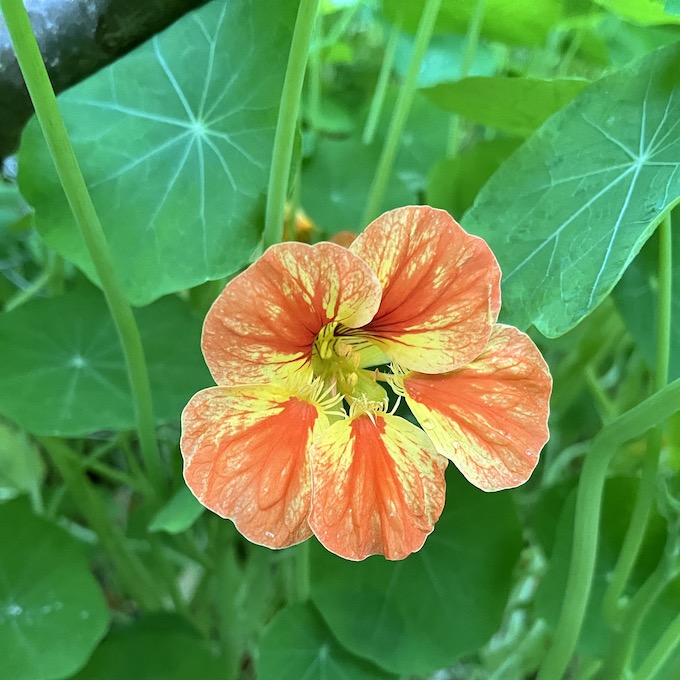
I couldn't decide which Nasturtium flower to show you so here's two: there are dozens of them and no two seem to be the same, although they come in all possible combinations of yellow, red and orange, maybe a bit of black trim. Pam and her watercolour art students absolutely adore nasturtiums as a painting subject, and as a gardener I do appreciate the way that nasturtiums suppress other weeds, but they do like to spread out and bully every other plant they come near. I cut them back every few days and they just merrily bounce back without a care in the world. They never complain, they just grow back each time.

We grow our Italian lavender in a pot and it likes it there. There's also a white-flowered type that Pam asked me to get, and it is slower off the mark and probably won't be in flower for another month or so.

One of the hardest flowers to photograph is this thing, a hellebore. That's because the flowers point down to the ground, and I'm too old to take photos lying on my back, so I hold up the flower's foliage with my hand, quickly take a snap and then edit out my finger from the photo. 


I'll finish off with two "panorama" shots of our small inner-city garden, just to give you a bit more context for what I have shown you already. To see the "pano" view, just double click on the photo itself and it will show the much wider shot (hopefully).


This first pano shows the left side of the garden looking out from the back of the house and its covered pergola. 


And this second pano is of the right side of the garden with lots of succulents in pots, more bloody nasturtiums trying to take over. The largish round white pot on the centre right is a native flannel flower bush that flowered beautifully last year and we are hoping will do so again this year too.

Finally, I actually have a couple more blog postings waiting to go. Our front garden is looking lovely but it has not worked out as I had intended, not at all. I'll fill you in on that bit of gardening fun next time.

Tuesday, November 21, 2023

Front garden makeover update


There's a lot to be said for rainy mornings. For one thing it means the gardener gets the morning off from hose-pointing duties, as Huey the rain god turns on the heavenly sprinklers for a few minutes.

And so it was this morning, but in addition to thanking Huey for the favour, I was reminded yet again that the best thing about rainy mornings is how nice gardens look when they are wet. 

This November morning I enjoyed the perfect type of rainy morning: showers. So it rains for a few minutes then it stops raining. That means you can go outside and not get wet but you can enjoy the garden, maybe even take a few photos of something that catches your eye. 

So here we are in Garden Amateur blog land, checking out the latest photos of our front garden makeover. Lots of unexpected flowers, lots of colour and lots of pleasing progress. 


In the foreground, the creeping thyme plants are spreading rapidly and joining up. It's hard to know how far apart to plant them, as "online research" only confuses you with all the options. Some say 60cm apart, others 80cm, a few say 100cm, the full metre. I chose 80cm, and as the plants are already joining up, I should have gone for the metre!


There are three varieties of creeping thyme in the garden. Of them, the "common" creeping thyme (8 plants) is flowering its head off very nicely, while the other two varieties are growing well but showing no signs of flowers. I'm happy to let the mystery be on that one.


By far the star of the show at the moment is the Australian native violets, Viola hederacea. These are remnants of the old front garden, where they thrived in the shade of the wattles and ferns. Impossible to dig out or control, they have merrily spread themselves throughout the new garden and are flowering so prettily. A very unscientific straw poll of comments by neighbours passing by agrees that the native violets look wonderfully pretty, and that the mauve creeping thyme flowers are the perfect complement to the native violets' white & purple blooms. I didn't plan it that way, honest. Just a happy accident.


Wait till the neighbours see the orange-blossomed dwarf gum tree spring into bloom this summer! The healthy little thing is covered in several of these missile clusters ready for launch. This is one of "Pam's plants" that are highlights in our garden. With certain plants she makes "I want one" style comments and I am happy to oblige. In the back garden Pam's plants include frangipanis, flannel flowers, Spanish moss galore and a white hydrangea – happily all doing well – and now out the front there's a dazzling dwarf gum tree to entertain passers-by. 

So that's it, the front garden makeover is looking great right now. The harsh reality of a hot and humid Sydney summer lies ahead, but right now in a warm, moist yet sunny spring in this lovely climate, gardening seems, dare I say it, almost easy.


Friday, October 13, 2023

Front Garden Makeover Time!


Let's see ... my last posting here at Garden Amateur was News Year's Day this year. So it's way overdue that I keep the old garden blog rolling along, and finally I have some news to report.

Pammy and I are giving our front garden a major makeover — the first one since we redesigned the front garden way back in 2000.

We're both very well, only slowly getting on in years but more importantly getting on in life quite rapidly, too. And we're enjoying our front and back gardens as much as ever. 

Our front garden was once a lovely thing, mostly native, but the main planting there had become huge, overgrown and was rapidly dying at the same time. So it was time for a major makeover: pull out everything, replace it with completely new plantings. Totally different look.

Let me show you some BEFORE photos, including the overgrown disaster, then we can settle in to show you our brand new, low maintenance garden makeover.

BEFORE      


2009, the front garden in its lovely heyday.
The bluey-green spillover plant is a Cootamundra Wattle
groundcover form. The grey centre planting is a native
Correa alba shrub, the little green hedge is native
lilly pilly 'Tiny Trev'. And there's a native yellow
gum (Eucalyptus leucoxylon 'Rosea') street tree
drooping in a branch top left. Many passers-by would
stop to ask what was what. We never imagined it
would grow so abundantly, but it was great while it lasted.


2018, and the Cootamundra wattle had taken over. The Correa alba
was dead, the Tiny Trev hedges were alive but almost invisible,
and my main job was to cut back the wattle to stop it accosting
innocent civilians walking by on the footpath.


2023, it had all got too much for me, so we hired the wonderful
Howie from GetUp Gardening and Landscaping Services, an
inner-west Sydney gardening guy I found online, to come in
and remove everything. Howie did it all single-handedly in a
day and a half, and I chose him because (a) I liked him and (b) 
his quote was very competitively priced. 

After Howie cleared everything away, our front garden looked twice
as big, and it was time for me to get out of my armchair and do
some proper gardening.


AFTER


Looks kinda bare, doesn't it? That's how it works with garden
makeovers: all the gaps between plants look too far apart, but
I am hoping my research is right, and everything will grow over
the next two years to cover the garden with foliage and colour.


Right now, the main attraction is the coloured redwood mulch,
the same mulch we started with back in 2000.


The planting plan is simple. A row of Camellias at the back,
in the shady area right next to the house. There's a single dwarf
gum tree in the middle, and everywhere else will be low, spreading
groundcovers that I am hoping will spread and join up to form
a low-growing, low-maintenance alternative to lawn.


The Camellias are the 'Yuletide' variety, with single
red blooms featuring a big, bold boss of yellow stamens.
They're a low-growing hedging type that should flower
in autumn and early winter. They're in a tough spot
that is shaded entirely by the house in full-on winter
months of June to August, but they also get blasted
by the afternoon sun in summer. There's no guarantee
they will work here, but they're my plan A, and I'll
think up plan B only if I have to.


The tiny-leaved groundcover is Corsican mint, which is planted
close to the camellias in the shadier zone.


Pam had her heart set on an orange-flowered dwarf
gum tree, and it took us a while to find one. They're
a popular plant in Sydney and sell quickly, and so we
waited until new stock arrived at Sydney Wildflower
Nursery
in Heathcote, a great source of native plants
in the Sydney region.


It was only when the little gum tree went in, this morning,
that Pammy and I considered the makeover 'finished'.
The label says it could reach 4m x 4m, we are hoping it 
goes no bigger than 3m x 3m, so we'll wait and see.


Creeping thyme is the main groundcover planted. There are
three varieties with different flower colours. This is the 'ordinary'
creeping thyme, with pinky-purple flowers, and it's showing a
few blooms already. There's also a crimson form, and another
called 'Bergamot' with more strongly purple flowers.


Speaking of flowers, this is a photo of the dwarf gum in full glory,
downloaded from a retail nursery website. We'll be pleased if
ours looks this spectacular over coming summers.


And you undoubtedly have noticed little spots of green
here and there popping up among the red mulch. Our old
garden was home to several very annoying weeds, and
I am taking on the mighty task of hand-pulling out all 
types, except one. Native violets.

We're keeping the native violets partly because they fit into the planting scheme of low-growing groundcovers, but also because it's just impossible to control native violets by hand weeding. 

As we are heading into a tough El Nino summer here, the hot dry weather will probably prove to be the native violets' nemesis. In the meantime they are growing vigorously, just as these pictured weedy ones on our side concrete path are doing this morning.


And until next time, when I have some other gardening news to report to you, I hope this blog update finds you all well and happy and enjoying your time in the garden.

It's hardly a happy time in the world at large right now. It's terrible in so many places, in fact. 

But that is why my garden is so precious to me. Of all the places in the world I could be in at the moment, I am where I want to be, at home in my garden.

Best wishes to you all.

Jamie


Sunday, January 1, 2023

Happy New Year!

 Happy New Year everyone, wishing all gardeners, readers and online passers-by the very best for 2023. May it be a much, much better year than the one just finishing.


Frangipani 'Serendipity' is enjoying the late arrival of the Sydney summer.


It's been quite a long time since I posted anything here at 'Garden Amateur' (more than a year in fact), and over the course of 2022 I am pleased to say that a lot has happened in our garden, but nothing much has changed, either.

For this Happy New Year posting I was going to include some more photos of the most eye-catching plants in our December 2022 garden, but when I checked on the previous photos from my last update from November 2021, they were almost identical, so just one photo this time, of our very colourful frangipani. 

And that's when I realised nothing important has changed here. It's still full of colour and all the key plantings seem to be healthy. 

The good news is that Pam and I are just like our plants: still healthy. Somehow we've managed to dodge the Covid virus and are enjoying the good but quiet life. I am such a homebody that "staying at home" is my preferred lifestyle option, anyway. Pam's much more social than me, and she's enjoying having restrictions lifted a bit. But homebody me? I'm happy in my garden and my kitchen.

Our major news this year is the sad passing of Pam's lovely 93-year-old mother, Val, who slipped away peacefully in her sleep back in July. How we all would like to go after a good and very long innings.

Val was a truly green-thumbed gardener of the old school, who could snip off a cutting of almost anything and have it thriving in a pot three months later. 

Val had often said that she wanted to be buried in our garden as she loved being here. I think she was serious, because she didn't like it much when we explained that the authorities might not be so keen on that idea. So we've found a nice place for her to spend a well-deserved eternity of peaceful rest at a proper lawn cemetery that has lots of lawn and native trees nearby.


Friday, November 19, 2021

Looking good


While my enthusiasm for garden blogging might be on the wane, the opposite is true for gardening itself. I've never enjoyed it more. Perhaps the blogging has been getting in the way of my enjoyment of gardening? In recent years I suspect so, hence very little activity here on the Garden Amateur blog.

So here's a rare posting on how things are going here in spring. I may post  something during summer, but right now in spring there is almost too much to talk about.

The one thought that hit me the other day as I was admiring all the flowers and crops is how spring makes you feel like you're a better gardener than you probably really are. Everything grows so well, it all seems so easy. Plant something new and whoosh! It races away like happy children in the park.

Summer in Sydney, however, brings you back to earth with a thud. The humidity, the heat, the sheer difficulty of helping everything to merely survive is hardly a joyful pursuit — it's an important part of the gardening year of course — but gardening here in spring is a much more wonderful time to be out there among all the plants. 

Encouraging little garden sprites whisper in your ear "Hey, you can do this!" and "That worked well" as you tour the flower and vegie beds. It's good for your soul to be out there soaking up the success. 

So, here's my usual little 'photos with captions' essay on what's happening here now. It's very pretty, a lot of fun, and I sometimes wish spring would last forever. 


The amazing Geranium Rozanne is getting bigger and better all the time. It started flowering its head off in midwinter when we bought it and has never let up. It's now spreading about three feet wide and rising two feet tall and it's covered in the prettiest purple flowers.

This feels like cheating, but I love it. All you need to do is buy a La Sevillana rose in flower from your garden centre, bring it home, whack it in a bigger pot and let it flower on. This is one of "Pam's plants". She saw it at a friend's house, loved the clear red colour, issued orders on what we needed next and a week later it was brightening up our pergola area. It's so lightly scented that you barely notice it at first, but I have never seen anyone admire a rose without sticking their nose into the centre. However, Pam being an artist with an eye for colour, this is definitely the rose she wanted.

This is our society garlic, or Tulbaghia, in flower. Lots of variegated strappy leaves with these pink trumpet flower clusters on tall stems rising up. I admire its tenacity. All sorts of horrid weeds like to bully it but it never gives up and always shows up.


Our potted New South Wales Christmas Bush is getting better at timing its display of coloured bracts for the festive season

Boy, are we eating a lot of spinach and silver beet right now. Pam loves it Japanese style, chopped and steamed with a sesame dressing, and I love it Indian style, in dishes such as Palak Paneer and Chicken Palak. The golden rule with these prolific spring crops is that if you think you haven't planted enough, you've probably planted too much already.

Lettuce thrives in spring but soon gives up the will to live once summer comes around. Fortunately we're a little pair of salad munching bunnies, and Pammy also loves to make up egg and lettuce bread rolls for lunch.

I'm a sucker for multi-coloured bowls of salad greens, and so I find all seed packets of "mixed lettuce" to be irresistable. Here's another crop approaching harvest time.

My other must-have crop in our garden is shallots, or green onions, or scallions, or whatever you call them in your part of the world. I'm still perfecting my skills at sowing enough — and especially not too many — seeds to raise the next punnet of seedlings while the current crop matures, but this is much more satisfying than buying a punnet of far too many shallot seedlings at the garden centre and only planting half of them.

Who me? Impulse-buy a Grosse Lisse tomato plant at the local Woolies supermarket? Yes, of course. Total sucker for growing tomatoes, with a very ordinary success rate on the big tomatoes, and a perfectly acceptable success rate on the cherry tomato front. So of course I am attempting to keep a big climbing tomato happy in spring. Summer will be the seasoning of reckoning, but I am prepared to take on the challenge.

On the other hand, all the potted succulents are looking forward to summer's heat. Ever since I repotted them they are all loving the new potting mix. And though it's hard to see here, there's a very thick layer of pine bark mulch spread between the pots and all over the formerly weedy succulent patch, and for the meantime at least, the weeds are not enjoying life at all. They're probably biding their time, waiting for the mulch to break down, but right now the succulent patch is a peaceful village of potted contentment.


So there you have it loyal readers, all 10 of you. Pammy and I are both really enjoying this year's spring in our garden. 

Pam's art students love wandering around and finding something to draw or paint, and for me as a gardener that's plenty of job satisfaction right there.