Showing posts with label courgettes. Show all posts

Tuesday, December 8, 2015

Lebanese flavour


Here in Australia, and in my part of Sydney in particular, we have a sizeable Lebanese community, and they're wonderful, hard-working people. As is the case with many established Anglo Aussies (like myself) and migrant communities (such as the Lebanese) where we first get to know a bit about each other is in our shops and restaurants. 

Pam and I love Lebanese cuisine. As well as their famous kebabs and koftas, their many vegetable dishes are superb. Our supermarkets always have in stock big piles of Lebanese cucumbers, Lebanese eggplant and Lebanese zucchini. These vegies aren't just sold to people whose family's roots are in Lebanon. Everybody buys them, and that's because the Lebanese people have bred over the centuries a wide range of vegetables that presumably suit both their climate and their palates. 

And so this year I'm having a go at growing the little pale green Lebanese zucchini, and so far the results have been delicious. I prefer them to the prolific, larger, dark green 'Blackjack' zucchini which I have grown here in previous years.


Here's two zucchinis with the flowers attached
picked this morning. These aren't as prolific
in production as Blackjacks, but they keep
well. So, after washing and drying, I pop them
in a plastic container. After a few days we
have enough for a delicious side dish.

Here's the plants in the garden, with the mirror
on the shed wall making the plot look a bit
bigger. And no, they are not a special variety
with variegated foliage! Sad to say, they have
powdery mildew on the leaves, and nothing I
am doing is really helping much at all.
The powdery mildew is quite aggressive, and though I am
regularly spraying plants with an organic treatment, it doesn't
seem to get rid of existing mildew. All it does is slow its spread
to other zucchini foliage. I'm also careful when watering to
keep water off the foliage and direct it to the roots, so I can't
think of anything else I can do.


This is the product I am using. eco-fungicide.
It's organic, a powder that you mix up in a
spray bottle and spray all over the foliage, on
top and on the underside. It's based on
potassium bicarbonate.
In previous years I've tried the other well-known organic treatment of milk sprays, and they were even poorer in performance than the eco-fungicide. Pictured below is the healthy foliage of the other Lebanese zucchini plants which haven't yet succumbed to the powdery mildew. This is a much better result with the eco-fungicide than anything I ever achieved with milk sprays, so I am sticking to the eco-fungicide.

There's one or two faint spots of mildew on the
leaf on the right, but the foliage still looks good.
The good news is that the powdery mildew, while it slowly harms the foliage and the plant, isn't instant death or anything like that. The foliage on one plant has looked crappy for a few weeks now and the plant is cropping away happily. So mostly the powdery mildew weakens the plants, probably brings the cropping to an early end, and certainly looks very dodgy!

I've always said that the baby little zucchinis you get attached
to zucchini flowers in restaurants and supermarkets have a
much better flavour than the fully grown zucchinis that are
sold without (the short-lived) flowers. Well, it's the same with
the small Lebanese zucchinis. These never grow to any great
size anyway, and they are best harvested when only 3-4 inches
(75-100mm) long, and they taste great, whether you steam
them, fry them or cook them any which way. 


Saturday, November 29, 2014

Delicious surprises


Regular readers of this blog will know that Pam and I have been on a short holiday break. Well, when we returned home we had a few delicious surprises in store for us. One was the amazing way our zucchini plants have grown and started to produce crops, and the other pleasant surprise was a package containing a new kitchen gardening DVD created by the man I worked with for many years, Don Burke. But first the zucchinis, then I'll tell you about Don's new DVD...

Our neighbour Katerina always does a brilliant job watering
our garden while we are away, but this time she excelled
herself. When we left the zucchini (courgette) plants were still
relative babies, but in just one week they had turned into monsters
and were starting to produce both flowers and fruit.
A small harvest for dinner that night: small zeeks with the flowers
still attached. Pam loves these! These vegies can grow into monster
marrows, of course, but they do taste best when small, like this.
Meanwhile, out in the garden, lots more little zucchinis are
already popping out. Yes, we're going to have a zucchini glut!
One extra detail that I am pleased about is that the chervil I sowed
to go with our zucchinis is starting the thrive. The chervil plants are
in a row of pots in a semi-shaded spot under the lemon tree
 and just behind the zucchinis. So, when I pop out to harvest more
zucchinis I also harvest a handful or two of chervil, a herb with
a delicate, slightly aniseedy flavour which teams superbly
with zucchinis. Isn't it nice when plans work out well!  

And now, for the second delicious surprise awaiting me when we got back from holidays was a little parcel containing this new DVD by Don Burke. It's called "Backyard Farming: Back to the Kitchen" and so it's all about my favourite topic, which is growing your own food, then harvesting it to enjoy in the kitchen. As you can see there's a chook on the front cover, so Don has also included some segments on keeping chooks so you can have a supply of freshly laid eggs to accompany your homegrown organic produce.


I'm sure many many readers of this blog were also fans of the popular 'Burke's Backyard' TV show that was for many years a regular part of Aussie Friday nights at home with the family, watching the television. This DVD is what I would call "classic Don Burke". He really knows his stuff and deals with an incredible array of backyard farming topics, and the treat is the sense of fun and good humour he brings to every segment. It's very easy to watch, very enjoyable viewing – just like tuning in to the Burke's Backyard TV show once again.

While I scored a freebie from Don, it won't set you back much – just $24.95 – to enjoy the fun of watching the DVD at home. At this time of year, of course it's a great Christmas gift idea! Either drop some major hints around the home, or buy a copy for a gardening friend (or do both). You can order it direct from the Burke's Backyard website, www.burkesbackyard.com.au, but you'll probably also see it sold at leading retailers such as ABC shops, Sanity and various other outlets. If you Google "Backyard Farming: Back to the Kitchen" you'll get lots of hits from all sorts of online retailers, so it's very easy to get a copy.


Tuesday, September 21, 2010

Herb of the Year


Well, it's my herb of the year, simply because I've really come to appreciate chervil so much more in these last 12 months. It's not as if 'Herb of the Year' is any sort of official title. Chervil is just Herb of the Year here in Amateur Land.

The citation would read something along the lines of: "For services rendered making bland vegies such as zucchinis (courgettes) so much more interesting; for growing in those semi-shaded spots where hardly any other herbs grow; for looking pretty in pots; and for being easy to grow from seed." I hereby award chervil with this barely prestigious award. All the other herbs are jealous, of course. Basil is such a prima donna sometimes!

For this little blog posting I plan to celebrate this fine little herb, with a recipe at the end, of course. Here is a crop from last year, looking very nice in a glazed green bowl.

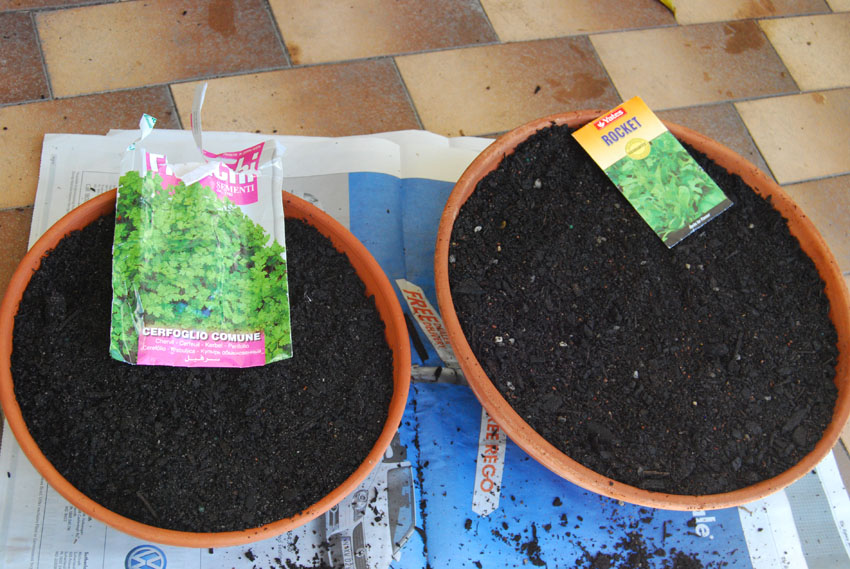
I have something else going in that nice green bowl, so to stop chervil getting a big head as a result of its recent HOTY award, I have consigned it to a humble terracotta bowl this time round. Last Saturday I sowed up a pot of chervil seeds (on the left), along with yet another batch of good old rocket seeds. By the way, Australian readers, that Italian 'Franchi' packet of chervil seeds contains about one zillion seeds and only costs $4.50 ordered online from The Italian Gardener, a seed shop based in Wollongong. These super-generous Italian seed packets are great value, so if you have several friends who'd like some seeds of all sorts of vegies and herbs, order one packet of each and there will be plenty for everyone. It's a shop well worth checking out (and, of course, this is not a paid commercial – I paid for my seeds).

This is what chervil seeds look like. Long, dark and thin.

I didn't really intent to sow them so thickly, but no harm done. The germination rate isn't 100%, and I'll just thin out the seedlings (with tweezers) in two or three weeks' time.

After scattering the seed I cover them with a fine layer of seed-raising mix (I know seed-raising mix isn't available in some countries, so any very fine, sandy potting mix is roughly the same thing). The layer of seed-raising mix is just barely enough to cover the seeds. Water in with a very fine, light spray of water, then leave the pot in a well-lit spot away from full sun. Germination takes about 10-14 days, depending on the weather.

The first leaves are long and fine, like the seeds, so it's the second and subsequent sets of leaves which start to look like chervil. Once it's growing well, I keep it happy with an organic liquid feed once a month. I use anything that has plenty of nitrogen in it (there are lots of those to choose from these days). Here in Australia, Nitrosol, Seafeed 3-in-1, and all the other fish emulsions fit that bill.

The foliage is a bit like a cross between parsley and coriander, although it's most like curly parsley which has been uncurled, if you know what I mean. The flavour is very mildly aniseedy. Some say that it's 'delicate' but I think that is almost synonymous with 'boring', so I'll stick with 'mildly aniseedy' thanks.

Just for the record, chervil does produce flowers at the end of its season (it's a short-lived herb, like parsley, coriander, basil, dill, etc). Each batch of chervil provides a pretty good supply of leaves for about three to four months on average. Then I sow another pot.

There are two great things about chervil worth concluding with. The first is that it's a food plant which does well in semi-shade. The full blast of Sydney's summer sun all day is too fierce for it. If I can, I grow it in spots which get lots of morning sun, but no afternoon sun.

The other great thing about chervil is its flavour, especially in our case the way it has made bland-ish vegies such as zucchinis (courgettes) and other watery squash-type vegies interesting. So, it's on with the recipe!

Zucchinis with chervil
Serve this as a vegetable side dish.

4 zucchinis (courgettes)
salt
knob of butter
black pepper to taste
2 tablespoons chopped chervil

1. Grate all four zucchinis using a cheese grater. Sprinkle with salt, mix together with a fork, and let the zucchinis shed some liquid with the salt for a while (eg, 20 minutes or half an hour).
2. Next, rinse the zucchini of the salt under running water, and let it drain off the excess water in a colander.
3. Heat a knob of butter over gentle heat in a saucepan, add the grated zucchini and let it slowly cook for 10 minutes, stirring occasionally to ensure even cooking. Don't add any more salt, but add as much or as little ground black pepper as you wish. It's hard to overcook the zucchini over gentle heat, so the timing isn't that important.
4. Just before serving, sprinkle the chervil over and mix through. Serve straight away.
The chervil becomes the star in this recipe, with the zucchini just the chorus.

Chervil of course has many other uses. It's great with egg dishes such as scrambled eggs. You can stir chopped chervil into a mayonnaise to serve beside all sorts of fish dishes. In fact you could sprinkle chopped chervil straight over Atlantic Salmon and you'll be glad you did so. It's also worth a try over steamed chat potatoes. And some chervil leaves added to a tossed green salad will have the foodies asking "what's that lovely herb?". And you can answer "Oh, that's the 2010 Herb of the Year, chervil".