Showing posts with label pineapple lily. Show all posts

Saturday, February 1, 2014

Pineapple lilies


Here's your word for the day, folks – "etiolated". It's the word used to describe plants which lack sunshine. It's what's wrong with my pineapple lily flowers, but I don't care, because they don't have a bad case of being etiolated at all. They've just got a mild deficiency that shows up in the strange way they flower. If they were people they'd still be still up and about, but they'd tire more easily. In bad cases, etiolated plants are bedridden hospital patients, rapidly yellowing and on death's door.

So, my pineapple lilies don't look so sick to you? Good. I didn't know they even had a problem until I looked at a photo of how healthy, sun-kissed, athletic pineapple lilies should look, and mine were, by comparison, skinny and rangy, even if they were still rather elegant, scented and pretty. I showed a gardening guru friend, Geoffrey, a photo of them a few years ago, and he replied swiftly that "Your pineapple lilies aren't getting enough sunshine, my boy." Instead of thick, dense spikes of fragrant blooms topped with a spiky green topknot that gives the plant the 'pineapple' part of its name, mine are generally scrawny. They're etiolated. They lack sunshine. They could do better. I don't care!
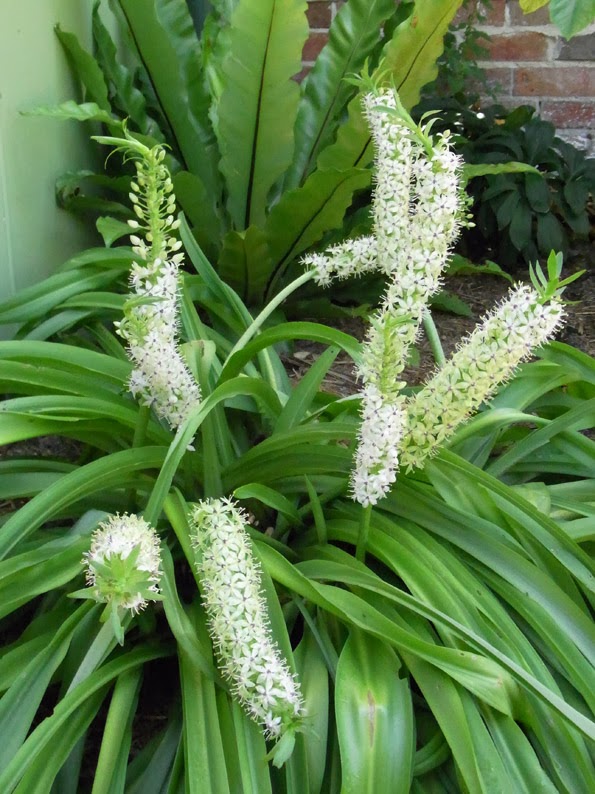

Of course they lack sunshine. They were planted
up against the garden shed, in the shade of the
lemon tree. They didn't stand a chance. Yet
as plants they have thrived here in their own
slightly sickly way for several years now, 
flowering as reliably can be every January.
The foliage is generally green and healthy enough.
If the flower spikes were kissed by more
sunbeams, they'd be thicker, more dense and
more fragrant. But these still have to be one
of the prettier basket cases I've come across.
There are several colours mixing it on
each bloom: white, a blush of green,
purple centres and yellow pollen blobs.
If you're wondering "what in the hell are pineapple lilies" they are bulbs from South Africa, with the botanical name of Eucomis. I still have the Yates label, and it says it's "ideal for planting under trees or in partially shaded spots" (which is what I did) but for really good flowering it needs the flower heads to be bathed in more than the few hours of summer sunshine it gets in my garden every day.

As it's under the lemon tree it thrives on the regular water and food I give the lemon, and the soil drainage is good. Over the years the two bulbs I planted have grown into quite a clump, without any care from me at all. It dies down in winter, and I do cut off the scrappy dead leaves then. The foliage doesn't get more than 40-60cm tall, and the January flower spikes are about 60cm long.

"Why don't you move it to a sunnier spot?" you may ask. They're all taken, I'm afraid. That's the problem with small gardens – you run out of space. Fortunately this is a plant which is not in its ideal spot, which doesn't flower as well as it should, and yet still satisfies and pleases me.

For gardeners in warm climates like Sydney all the traditional spring-flowering bulbs such as tulips and daffodils are at their best in their first season, and many struggle to flower again in the following year. Jonquils do better here. However, the bulbs which are doing best for me are South African bulbs such as our spring-flowering Scadoxus and our summer flowering Eucomis. They're reliable, tough and easy care, and both are slowly forming bigger clumps as the years go by. I'm glad I planted both of them.


Saturday, January 30, 2010

Pineapple lilies


I've never been mulch of a bulb-grower, simply because I can't stand the sight of the plants after they have flowered. Slowly dying down, they seem such miserable things, yet of course it is essential that you let them go through this stage if you want to see any blooms in the following year. One exception I have made to my distaste for the ugly side of flowering bulbs is in flower now. It's my pineapple lily, Eucomis to the botanists.

Quite a lovely little spire of vaguely greenish-tinged white with purple centres and yellow feelers sniffing the air.

The plant itself is just a moderately handsome tangle of strappy green leaves, and the reason I have managed to tolerate the "dying down" period with this plant is simply that it's at the back of the garden, almost out of sight unless you wander down to look at it. And it is only one plant.

However, there is another reason for growing it in my garden. Many of the classic spring-flowering bulbs such as tulips, daffodils, etc need a much colder climate than Sydney's to come back reliably each year.

Eucomis is a summer-flowerer which originally comes from South Africa, and so it really likes it here in Sydney and seems to be flowering better and better with each year. It does its ugly dying down thing in late autumn and early winter, which is a much better time to look a bit decrepit (compared with the spring-flowering bulbs, which look like crap in early summer here, when everything else is just surging along with joy – they ruin the party with their miserable carrying on).

But enough talk of ugliness and decay, right now my pretty pineapple lily is a joy to behold, and enjoying its beauty at this time of year is my real reason for growing it.


Saturday, May 2, 2009

Lily's last fling


"Well, it was fun while it lasted, Lily, see you again next summer." Not that I play around much, mind you, but I've been bidding a fond farewell this weekend to three lovely lilies, and my wife Pammy didn't even bat an eyelid, either. She understands my needs.

That flaxen-haired strumpet, Ginger Lily, partied hard all through summer and now all her energy is spent. Hair tousled, still magnificent if a bit frazzled, she's ready for her beauty sleep.

It wasn't so long ago that she looked like this. To tell the truth, each ginger lily bloom doesn't last all that long but this plant seems to organise itself so that one striking bloom follows the other. Like well-behaved chorus girls, no upstaging goes on amongst the ginger lilies.

These are the stems prior to flowering, and remarkably enough this is just one season's growth. A bit later in the year, in the depths of our fairly mild winter, in late July, I'll cut every last ginger lily stem down to ground level, and follow up with a good feed of manure soon after. It will rocket away in rapid growth once more when spring gets underway in September. If I cut them down now, the plants might actually get growing again and send up new shoots – and that would be a disaster come the chills of July.

Not far from ginger lily's place, her flame-haired cousin, Canna, is also signing off after another great summer. The plentiful spiders of autumn are making the most of the free frames for their delicate webs, and they're welcome to them.

Back a few months ago in the heat summer, Canna was a feast of hot orange that dared the blazing sun to burn even brighter.

Canna is an energetic lass, and even now she has the verve to send up one last blast of colour. Hope she makes it.

And I couldn't discuss Cousin Canna without mentioning her tiger-striped foliage. She's not a subtle thing, our canna. She's show-biz loud and tropically lush and that's why I like her. Like the ginger lily, canna's headed for a midwinter chop-then-feed routine, and she'll be back next year, bigger than ever. I had to halve the size of her clump last year as she was simply spreading too far in every direction. She took this in her stride and put on a pretty good show in this, her first year after the 'Big Division', and I'm sure that next year she'll be in top form again.

And the third of my lilies to be fading away is this little oddity, my pineapple lily. It's a South African bulb with the botanical name of Eucomis. I've had it growing for three years in my garden, and this year was the first time it flowered (in midsummer). As soon as I read that this one had green flowers, I had to get one, and I've been mostly disappointed with it ever since! In its first two years it grew a lot of leaves and grew and grew, and never flowered. This year it bloomed at last, and they looked just fine. Hopefully it will not now wait another three years before performing again...

Finally, a suitably messy scene of devastation and slow decay, made even more grim by my corpse garden gnome (on the right, poor chap murdered by gnomes unknown). I'm letting the pineapple lily's foliage die down, but the rotter is taking months to even get the foliage fading from green to yellow. Fortunately it's almost hidden from view so isn't much of an eyesore, but I'm not a great fan of the way all the bulb-type plants actually look ugly and scrappy in the garden for a longer period than they ever look pretty. I'm sure they're great in big woodland gardens, and of course the bulb life-cycle is a wonderful adaptation for survival in nature, but in very small gardens like mine, I'm not sure if I have room for them. Oh well, one more year and then I'll decide if odd Miss Pineapple Lily stays or not!