One of the good things about gardening in backyards is that the rest of the street can't witness the strange things you sometimes get up to: like gardening in the rain.
Now, all my Sydney gardening friends don't need a weather report – we all know it has been raining for the last few days, and that it's likely to keep on raining for a while longer yet. So most sensible folk might think "oh well, it's raining, might as well read a book/watch a video/bake a cake/clean the house, etc etc".
But no, not this little gardener. "It's raining, yippee, time to feed some plants!" And so that's what I did today: I fed my three citrus trees. As a matter of fact, rainy days are the ideal times to pile on the fertiliser. That's because the theory is that you should water the ground well before applying plant foods. Rainy days take care of that little job for me. And then you should water the ground well after applying plant foods, to get the nutrients down into the soil. Thank you once more, rainy day!
 |
| Here in our temperate climate at least, it's best to feed citrus grown in-ground twice a year, at the end of summer (late Feb) and early spring (late August). This is my Eureka lemon tree, healthy and happy, always willing to scoff a bit more food and produce some more juicy fruit. |
 |
| It's not the prettiest lemon tree, having had a rough childhood, bullied by the roots of a nearby climber which is no longer there. But it has bounced back since the bully left, although it does lean to the left slightly, like that famous tower in Italy. |
 |
| Also getting a feed today was this person, the Tahiti lime, which is grown espalier-style on a frame of solid wires suspended between two swimming pool fence posts. This loyal trooper is about 10 years old now and is soldiering on nicely. It needs regular clipping back (about two or three times a year) to maintain its thinnish, wideish shape, but it's too lush with foliage to ever take on the classic leafy 'arms' look of the fancy pear and apple espaliers that you see in the designer gardening books. |
 |
| There's only one problem with Tahiti limes and that is they bear their fruit in a big bunch in late summer and early autumn, then for the rest of the year there's very few to enjoy. |
 |
| Even though I religiously thin out fruits where I can to cut down the gluts, I always miss a few clusters and I end up with these bunches. |
 |
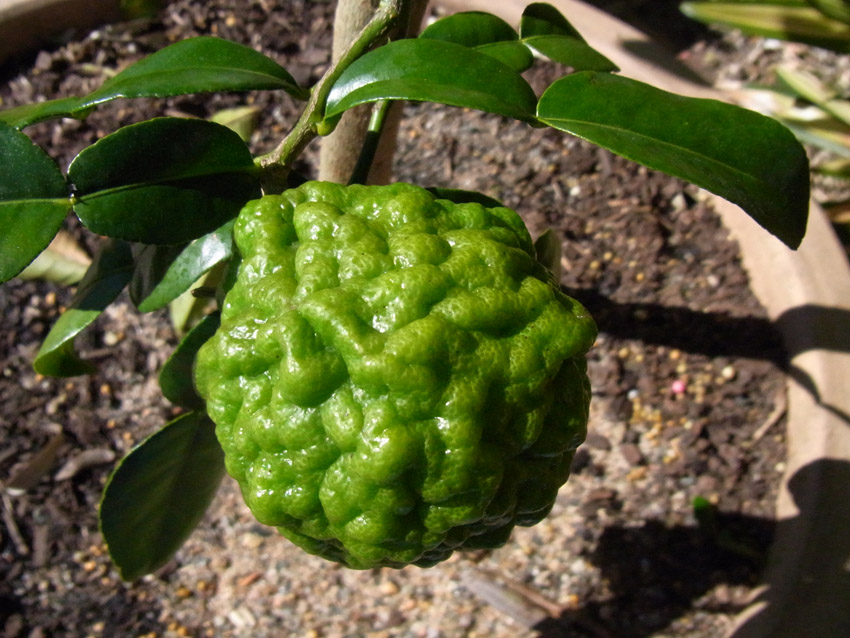
| The exception to the 'late summer/early spring' feeding regime is potted citrus, such as this potted Thai makrut lime. It gets fed lightly but more often, around once a month is ideal. |
For the potted makrut lime I prefer to use a slow-release product such as Osmocote for Citrus, but every now and then I give the pot a small half-handful of chicken poo, sometimes a bit of cow poo, if I am fertilising other plants nearby in the warmer growing season, when I am watering the pot a lot and it's probably growing faster than ever and can cope with a bit of a treat. The main thing is not to apply too much food to potted citrus trees at any one time, but to keep on giving it little feeds throughout the year.
As for the in-ground plants, I prefer an organic-based product such as Dynamic Lifter for Fruit and Citrus (for no special reason other than habit and good results). Notice I say it's "organic based" and not "organic". That's because so many good, useful modern plant foods now fall into this "organic based' category. They don't qualify as a purist organic product but that doesn't bother me greatly. The Dynamic Lifter, for example, is basically chicken poo, but these days the manufacturer (Yates) has added in trace elements to boost its effectiveness.
My commitment to organic gardening is more to do with avoiding sprays which kill beneficial insects; to use methods which slowly but surely 'feed' the soil over the years with compost, manures and mulch; and to encourage a little backyard eco-system where birds, beetles, lizards, spiders, worms and all sorts of creatures find a home to share with us, and each other.