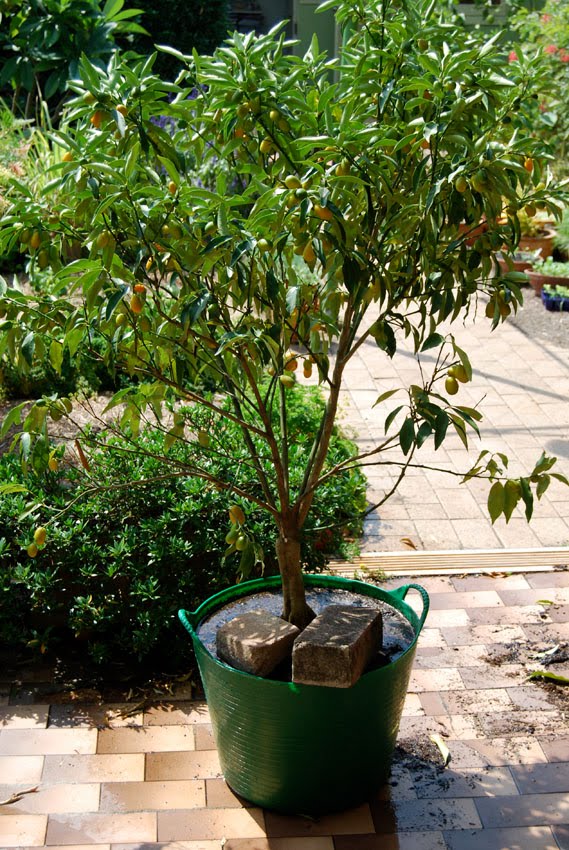
You've all heard of the seven-year itch? Somehow Pammy and I have racked up 20 years of happy marriage with my rapidly receding hairline as the only visible sign of irreversible damage, but as for my relationship with my potted citrus tree, we've got a bad case of the three-year itch. Not happy, it's not, and it reckons it's all my fault. Everything had been going swimmingly between us, until about four weeks ago. And then the symptoms began. Falling leaves. Curled-up leaves. Falling fruit. No smiles, no warm greetings in the morning. There was trouble between us.
 Here's the miserable grouch yesterday morning. I had tried lightly feeding it, as well as watering it in my usual way, until water flowed freely out the drain holes at the bottom. And that only seemed to make things worse. I inspected Grouchy for pests and found nothing.
 The change from happy to sad was rather sudden, too. Look at those inwardly curled leaves, and their sullen, droopy demeanour. I suspected the problem had to be out of sight, in the potting mix. My prime suspect was the dreaded curl grub, which I have blogged about before, here. So, instead of just watering and hoping things might come good, I decided that the only solution for our relationship was a visit to the therapist. Step one, remove plant from the pot.
 The big surprise was... no curl grubs, but the problem was embarrassingly obvious, too, and it was all my fault. The potting mix was bone dry and ants were busy turning the plant's root-ball into a bustling, ant-filled metropolis. No wonder Grouchy wasn't happy! Would you like ants in your pants all day long?
 Here's the plant and its root ball. The plant was a tight mass of roots competing for the inadequate water available. I couldn't believe this was the problem. I'm very conscientious about watering all my potted plants, and feeding them too. And this is when it dawned on me that the poor plant had simply outgrown its pot, and needed more room in which to grow. So, the solution was obvious. Buy a bigger pot, and repot it, Jamie. However, a bit of rehab prior to repotting was in order.
 Step one, re-wet the root ball. This looks like a radical thing to do, but it's essential. I put the plant into a plastic trug and filled the trug slowly with water. It kept on bubbling away for a few minutes as water soaked back into the parched soil. I left it there to soak for five minutes.
 EDIT: I've since learned that soaking it for one whole hour is a much better idea, and soaking it in a solution of water and wetting agent mixed according to packet directions also improves your chances of successfully re-wetting the ultra-dry potting mix.
 How do you like my sophisticated anti-lean technology? The plant kept on flopping over in the loose fit of the trug, so I kept it upright with my nifty baked clay stabiliser units.
 Step three, buy a new pot. Now, this isn't quite what I had in mind, but in a quick expedition-cum-mercy-dash, this was the best I could find. It's terracotta, 10cm wider at the top and 10cm taller than the existing pot, plenty of room to grow into, and very importantly, it's straight-sided, so repotting will be easy enough in a few years' time.
 If you think soaking the whole root ball in water is radical treatment, you'll hate this next step. I used a little sharp knife to cut a few vertical slits in the root ball, to encourage new roots to grow out into the new potting mix. Then I just potted it up, as per normal.
 As this terracotta pot has just one, very large, drain hole, I placed a square of mesh in the bottom to prevent potting mix flushing out too easily during watering.
 Here it is in situ. The next step is to place the existing root ball into the pot, measure how many inches it sits down from the top of the rim (in this case it was about five inches) then place a bit less than that amount of new, fresh potting mix in the bottom (in this case about four inches of potting mix). That worked nicely, then I filled in the sides around the root ball with new potting mix, making sure that there were no air pockets left over.
 A light watering-in usually exposes any air pockets in the new potting mix, and so I then top up those spots with more mix. The important thing is to not cover the top of the existing root ball with new potting mix at all. There is a system of fine feeder roots very close to the soil surface, and covering these over with new potting mix would be harmful to the plant's health. Two more things remain to be done, though.
 One is to use a seaweed extract product to encourage the roots to grow. I used Seasol. One 9-litre can of this mixed in water now, and probably another one next weekend, too, and another one a month later should get things growing well again.
 Finally, some slow-release fertiliser, to trickle down some goodies every time I water the pot over the next few months. This one is formulated for citrus, and it's a good way to provide the steady stream of food these greedy plants need.
Hopefully, this repotting will do the trick and save the relationship. But it did get me to thinking about not only the three-year itch with pots, but also where I went wrong, as it really was all my fault, and the citrus tree had every right to be grouchy.
As for the three-year itch, for fussy citrus, about three years is as long as they'll be happy in a pot before some kind of trouble sets in. Yes, I do have some other potted plants which are still healthy and happy and haven't been repotted in many years. One good example is my cast iron plant, the aspidistra on my front porch, which has been in the same pot for at least nine years and is still doing fine. But it's a low-performance tough guy foliage plant. However, high performance fruiting plants like citrus need everything to be hunky dory pretty much all the time. When it strikes they get the three-year itch big time, baby!
I've probably made things worse by spoiling my potted citrus with the best of everything: food, water, and sunshine. This good care has seen it grow rapidly, and as a result it has outgrown its pot rapidly. I realise that in two to three years from now, this same citrus plant will need repotting again, when it gets that three-year itch once more.
I got myself into this high-maintenance trap of a relationship and so I can't complain (well, not much). Now I know the ground rules, I'll be on the lookout for more trouble in about, say, three years from now.
 Traaa daaa, Pam's yellow nasturtium, in flower today, June 1, the start of winter here.
 Now here's something a bit more newsworthy, winter-wise. My frangipani doesn't seem to know it's winter yet. You would have thunk it would be dropping leaves all over the place, as the May which just finished made it into the papers as the coldest May since Elvis died (or was it Buddy Holly?) Anyway, it was some long-distant milestone of time like that.
 Not merely content to hang onto its foliage, the frangipani is still sending up flower buds. Perhaps this happened overnight? The minimum of 17°C last night was almost the warmest June minimum for Sydney since Elvis/Buddy Holly days, too, and so maybe the frangipani thinks there's still time to party?
  Now here's something that is no surprise at all for the first day of winter, as this is the time of year when my potted cumquat should be covered in fruits rapidly turning a beautiful shade of orangey-yellow, which it is doing beautifully this year (due in large part to some great advice and help from our gardening writer, Elizabeth Swane).
 My little pot of dill seems to be enjoying the cooler autumn-winter weather, so from now on I'll confine my dill-growing escapades to this time of year.
 The plectranthus 'Mona Lavender' which I planted a few months ago hasn't stopped flowering since then. No doubt the soft accordion serenades of my gnome, Flaco, each evening, have made the plectranthus feel like part of the family from day one.
 And finally, just for my Pammy, another nasturtium shot because I know she loves them.