Showing posts with label Banyan fig. Show all posts

Tuesday, March 1, 2016

Holiday break


I know February is a shortish month, even with that extra leap day added this year, but here we are with no posts whatsoever last month. During these most humid and uncomfortable last weeks of summer, Pammy and I found time to enjoy a little holiday break, seeing friends in Brisbane and visiting lots of art galleries as well.

The last few times we've stayed in Brisbane we've rented a serviced apartment across the road from the Brisbane City Botanic Gardens, and a day spent there is always a treat for both of us. So that's mostly what this blog posting is about.


One wonderful thing about visiting a subtropical garden such as Brisbane's is the chance to enjoy the lushness of growth here, the different colours, and the spectacular trees. However, for starters, here's a planting which is perfectly possible to grow much further south. These canna lilies in two different colourways, mass-planted, are helpfully backlit by the morning sunshine. (I think the foreground ones are 'Tropicanna' and the background ones are 'Bengal Tiger' but I could be wrong, as they weren't labelled.)  


Another sight you can enjoy all along the East Coast, not just the subtropics, is the calm presence of an Eastern Water Dragon sunning itself on a palm trunk. 


Colvillea racemosa, or Colville's glory, a delicious spot from which a bossy noisy miner could keep a lookout for other birds wandering onto its aggressively guarded territory.


Originally from India, this is the very large bloom of Dillenia indica ...


... and these are the cricket ball sized fruits which follow.


While on the topic of large Indian things, this is my favourite tree in the whole gardens, a Banyan fig (Ficus benghalensis). If it were to grow in my backyard the base of the tree would also occupy at least all of my two neighbouring backyards and the branches would spread to cover the gardens either side of them. 


The amazing aerial root system of the Banyan fig is a magical world in itself, not all of it friendly to childish imaginations. The very helpful sign at the gardens says that this tree was planted here in the 1870s. As for the roots, the sign adds: "These roots eventually develop into a new trunk and so the tree spreads — one in India covering 1.5 hectares (3.7 acres) with over 1,000 subsidiary trunks."


Another favourite tree here is the appropriately named African sausage tree (Kigelia africana). 


Due to a lack of labels all I can tell you about this lovely grey palm is that I like it very much.


Tropical favourites such as heliconias were everywhere, but most of them were fading by the time and weren't as photogenic as this one.


There were dozens more delights that I saw in the time I wandered around the gardens, and during that time Pam had found a shady, comfy bench from which to do some "en plein air" watercolour painting. It never fails to draw a crowd, an artist with a pad, and so Pam had quite a few curious visitors while she created her piece.

Fortunately, that water dragon I showed you earlier had taken a liking to Pam, sitting at her feet while she painted, and so that kept the numbers of curious children well down.

Finally, if you want to drop in on these gardens while visiting Brisbane, they are down by the Brisbane River, at one end of the city's CBD. The main botanic gardens of Brisbane are now in another location, in Mt Coot-tha, and they are well worth visiting too, of course, but I do prefer the charm of these original riverside gardens and make a beeline for them every time we visit BrizVegas.


Sunday, February 17, 2013

Busy in Brizzie


As tourists, we love it when the soggy weather forecasts don't come true. They said 'cloud and showers' and all we got was cloud, with hardly a drop on our heads all day. Pammy and I were keen to re-visit the Botanic Gardens in the city, on the banks of the Brisbane RIver, as we knew the gardens had been slammed by the awful 2011 floods and we wanted to see how everything was going. The short version is 'very well, considering' but there are still many signs of damage and recovery but it's remarkable how plants can survive and bounce back from such a devastating event as those major floods. 

What follows is lots of photos. Pammy and I each took roughly half the photos shown here. We love hitting a botanic garden, each with a little digital camera in hand, and it's amazing to see how very differently we view the same things! We were busy in Brizzie, so let's go for a wander around a beautiful, big, subtropical garden.


Pam's photo of this mussaenda captures the beauty of its
colourful bracts and those tiny little yellow flowers very nicely.

These are the mussaendas in their bed very close to the river;
there's a pinky one right, and a white one, left.
This Eastern Water Dragon stayed as still as a statue as we
snuck around it snapping as quietly as excited kids can.
The water dragons are no rarity in the gardens; we saw several
here and there, all very still and quiet as we passed by.

Beside the Central Path which effectively splits
the gardens in two is this new flood level marker
which shows that much more than half the gardens
must have gone underwater in the 2011 floods.

As a grower of the deciduous frangipanis which do so well
in Sydney, it's always great to come across the evergreen
tropical frangis, which are in leaf and flower year-round.
The flowers aren't as sweetly scented as the deciduous ones,
and they're a different shape, too, but they're still lovely.

Wouldn't you know it, this is one of the few trees in the gardens
which didn't have a helpful little name plaque on it! It took me
a while to track it down online, but I am fairly sure this is the
'Pride of Bolivia' Tipuana tipu, a truly glorious tree with a
perfect domed crown and a broad spread that must be at
least 30 metres across. Our weed control experts say it's a
weed in Australia, but this is surely our most magnificent weed!
While I'm admiring big trees that I cannot grow
at home I might as well show you the African
sausage tree (Kigelia pinnata), a huge tree
dangling dozens of these big seed pods.
The flower stalks of the sausage tree hang
down like this on long stalks, and presumably one
of these multi-flowered candelabras produces
just one marrow-sized sausage each.
And the Banyan fig is even bigger than Tipuana
or the sausage tree. I paced out its canopy
from one side to the others, and it's 50 metres
wide. These mature enormous trees are one of
the reasons I love to come back to these old
gardens, the first established in Brisbane.

It's great fun to meet a fruit which you have only
seen in supermarket shelves actually growing
on the tree it comes from. This is the custard
apple fruit, introduced into Australia via these
Brisbane Botanic Gardens many years ago.
And for the record this is the custard apple
tree itself, a handsome fruit tree.
In the same vein as meeting a custard apple
on its tree, we also came across an enormous
jackfruit on its tree. These huge fruits are bigger
than a basketball, and you wouldn't want to
be under the tree when it decides to fall off.
While these crotons were inside the gardens,
you see them everywhere as roadside infill
plantings here in Brisbane. They're such a
perfect embodiment of tropical foliage colour.
Speaking of tropical colour, the hibiscus were all in bloom,
and of course I don't have a clue which variety is which, so
for the next few photos here's a good sampling of the vivid
range of colours you can find in these classic subtropical blooms.


Nice variegated foliage!

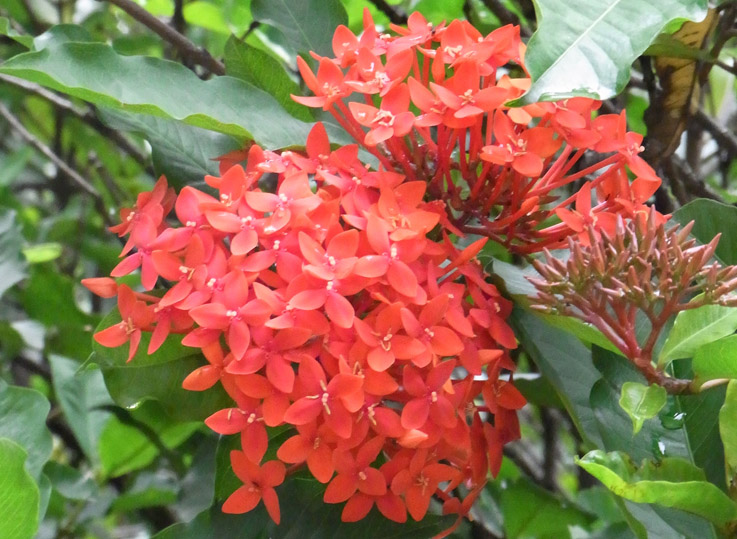
If crotons are everywhere in Brisbane, so too are these blooms
of Ixora, which are often seen around office buildings, in the
forecourts of public buildings and as park hedges.
Still with me? I showed you a superb crepe
myrtle in our previous 'Country Comfort' post
and yes, the crepe myrtles looked great here
too. This one was loud with bees.
Every time I looked back as we wandered
around I could see Pammy taking shots of
details that I suspect will one day become the
subject of a painting, like these buttress roots...
... or this wrinkled, thick, corky bark...
... or this sculpture of a Banyan fig's aerial roots.

Pammy's not a fan of having her photo taken, and especially
of having her photo posted in my blog (although there are a
couple in our USA trip blogs back in 2011) so to finish off
this mega-long posting here's half of our photographic team
in his favourite 'Peace, love, Gumbo' T-shirt posing by the
hectic little waterfall that flows into the lotus and waterlily pond.
We really are having a lovely, busy time in Brisbane right now. An enjoyable evening eating home-cooked Mexican (thank you Karl!) out on the deck under the canopy of a big, broad-spreading poinciana tree last night, and today we're off to the Queensland Art Gallery to see the Triennial Asia Pacific Art Exhibition at the Qld Art Gallery. We love this art show, held every three years. We've been to the last two shows and so this pilgrimage up to beautiful Brisbane is hopefully something that we'll keep on doing for many years to come. As Pammy said, it's nothing like Sydney, more like a big Darwin, with a feeling and tempo all its own. We love it here.