Showing posts with label Asplenium australasicum. Show all posts

Saturday, January 17, 2015

Spotted in the shadows


There's an old gardener's tip which says you should never plant indoor potted plants out into your garden, because you never know how big they'll grow. So, of course, that's exactly what we've been doing lately, but I think we'll get away with it this time.


These are Pam's former home office/art studio plants, and they're both loving their summer holiday in the garden. The eye-catching spotted marvel on the right is a begonia (I think it's Begonia maculata, but that's just me Googling and guessing). It just outgrew Pam's tiny studio in a matter of months. 

It started off as a cute baby in a little pot and in no time at all, we had to repot it. That just encouraged its teenage hormones to kick in, and then it grew like crazy (with Pam's loving care helping things along, of course). And so, running out of space in her office, Pam spotted that shady, bare corner, outside, decided the begonia would look good in there, and a whole new branch of shady gardening fun commenced.

The other, more familiar little face on the left is a maidenhair fern which had grown a bit scrappy and didn't look too great in its pot. So far, it's loving its shady new home and is growing back nicely.
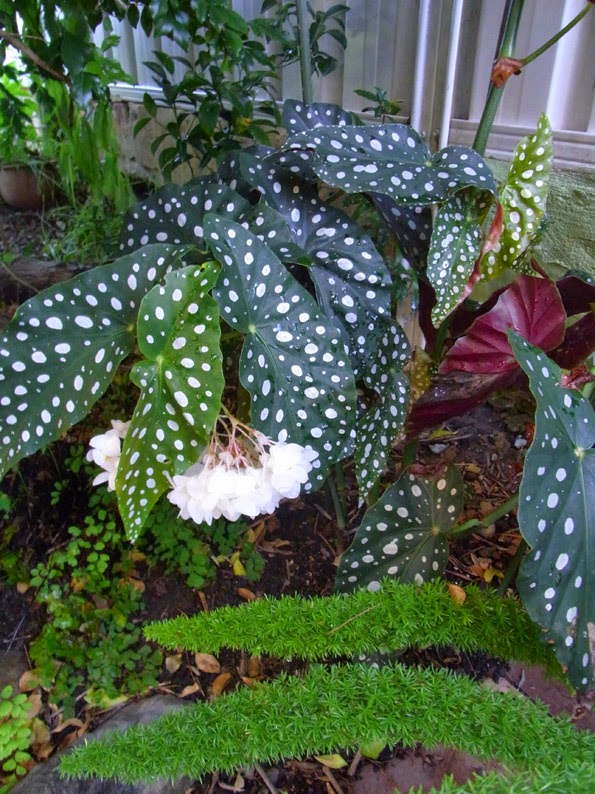
Getting up close to the begonia, it's full of
great little extras, such as ruby coloured
undersides to its leaves, and sprays of white
flowers. Though its spot is well lit, it is at
the base of a fairly dense murraya bush,
which is in the shade of an olive tree, so there's
no direct sunlight down on this little forest floor!

Meet Pam and Jamie, our little stone pigeons. We are hoping
one day they will be covered with moss. I've tried the "yoghurt
treatment" to encourage some moss to grow with no luck, so
any suggestions are welcome. (*Back on topic, Jamie*)
Oh yes, and in the background is the maidenhair fern, which
various websites tell me will not enjoy being outdoors in the
ground. That sounds like a gardener's challenge to me!
We've been bitten by the "shady plants" bug, and so a few
weeks ago we planted two little bird's nest ferns under the
shade of our over-large grevillea. This photo was taken in the
early morning, when the only sunlight to reach this area
during the day was beaming in cheerfully. I like the fact that
these ferns are Australian natives, so positioning them under
our native grevillea is not such a bad spot to put them.
We already have a well established bird's
nest fern growing behind our lemon tree,
squeezed up against my garden shed. It gets
very little attention from me, apart from
copping regular splashes of water from my
regular watering of the lemon tree,
and it is thriving. 
So, the upshot of this little posting is to say that if you have a dark and unpromising patch of bare ground in your garden where nothing but mulch is spread, or weeds grow, then next time you're at the garden centre, wander over to the fern area and pick out something interesting and bring it home. 

And if you feel like taking a few daring risks, you could pop over to the potted indoor plant section and choose something that looks great and should never be planted outside. Be warned, it could die outdoors (especially in winter, as many indoor plants are from the tropics). If you get lucky, it could grow into a fifty foot high Triffid which wanders off to do battle with Godzilla, or it might just settle in and provide your formerly boring shady area with a bit of colour and personality.

Good luck! I'll let you know next spring if my shady characters have survived the winter here.

Saturday, October 17, 2009

Frond happenings


Around this time each year, as spring gets into full swing, my bird's nest fern goes about the interesting business of unfurling its new fronds. It's a slightly eerie thing, this fern, the kind of plant that large vego dinosaurs probably munched on, before that errant asteroid ruined everything for them 65 million years ago.

Uncurl, unfurl, traa daa!

Several of them look like a gathering of so many alien elders in a conference of some sort.

The late afternoon light glowing through its fronds distracts your attention from the fact that this oddly fascinating plant also has to occupy one of the worst positions in my garden. It has carried out this assignment for a long time now, without any trouble at all. It's wedged in between my tumbler compost bin and one of my olive trees, in a lot of shade.

Looking down into the plant, you can see how it feeds itself, both here in my garden and in the wild. Here, olive leaves are caught in the centre and, as they slowly turn into compost, the plant gets all the food it needs. In the forest, they usually grow either on the branches of large trees, or on large boulders. Mine is in the ground.

The older adult leaves are quite leathery things, but these fresh, green youngsters remain quite pretty for a month or two.

Here's what I mean about a truly lousy position in the garden. It's shady, hidden from view by a murraya hedge, and crowded with other foliage plants, including several other ferns.

The botanical name of my bird's nest fern is Asplenium australasicum, and that second part of its name confirms that it is an Australian native fern, of which there are numerous species that populate our many shady forest gullies around the continent. This is probably the most commonly grown native fern in gardens, so common that a lot of people don't realise that it's a native.

If you have a rotten spot where nothing seems to thrive, and where the wide-spreading habit of this plant wouldn't be a bother, give a bird's nest fern a try. I've read that they don't like frosts much, though, but as that isn't a problem here in Sydney my bird's nest fern and I have been happy companions for years now, and I am sure that will remain the case for many more years to come as well.